Patron saint festivals in Puglia follow the saint, not the tourist calendar: those tied to a fixed day, such as 7-9 May in Bari for Saint Nicholas or 29 September in Monte Sant’Angelo, fall on the same day every year. Here is a selection of 43 festivals in 42 towns, month by month.
How to read this calendar
A patron saint festival falls on the saint’s day, and that day stays the same year after year: this is why there is no year in the title. A few festivals follow a rule (“the third Sunday of May”): for those we give the rule and the day it produces in 2026. The detailed programme, with times and guests, is published by the town council and the festival committee, usually a few weeks ahead. The dates come from those sources, not from copied lists.
Patron saint festivals in Puglia, month by month
January
- Castellana Grotte — Maria SS. della Vetrana and the Fanove, on 11-12 January.
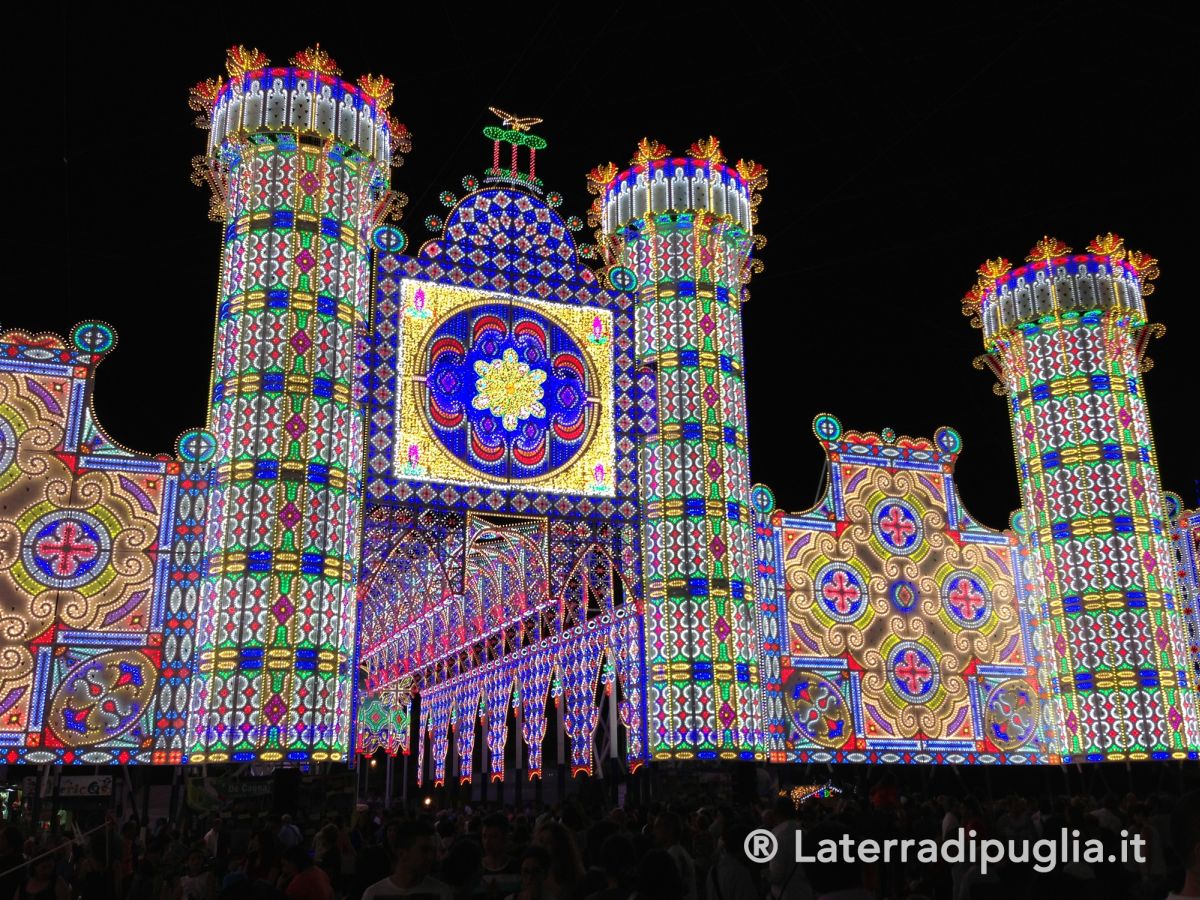
- Novoli — Sant’Antonio Abate, 16-18 January; the fòcara bonfire is lit on the evening of the 16th.
- Grottaglie — San Ciro, with the fòcra, on 31 January.
February
- Molfetta — San Corrado di Baviera, on 9 February.
- Vico del Gargano — San Valentino, the patron saint, on 14 February.
- Nardò — San Gregorio Armeno, on 19 February.
March
- Altamura — San Giuseppe, on 19 March.
April
- Locorotondo — San Giorgio Martire and Santa Maria della Greca, on 23 April.
- San Marco in Lamis — San Marco Evangelista, on 25 April.
May
- Bari — San Nicola (Saint Nicholas), 7-9 May.
- Vieste — Santa Maria di Merino, on 9 May.
- Taranto — San Cataldo, on 10 May.
- Conversano — the Madonna della Fonte, on the third Sunday of May: 17 May in 2026.
- Bitonto — Maria SS. Immacolata, on 26 May.
- Apricena — Maria SS. Incoronata, on the last Sunday of May: 31 May in 2026.
June
- Ceglie Messapica — Sant’Antonio di Padova, on 13 June.
- Polignano a Mare — San Vito Martire, on 15 June.
- Galatina — Saints Peter and Paul, on 29 June, with celebrations from the 28th to the 30th.
July
- Rodi Garganico — Maria SS. della Libera and San Cristoforo, 1-3 July.
- Martina Franca — San Martino and Santa Comasia, the summer festival: the Sunday after 4 July, which is 5 July in 2026.
- Mesagne — the Madonna del Carmine, on 16 July.
- Peschici — Sant’Elia (the Prophet Elijah), 19-21 July.
- Gallipoli — Santa Cristina, 23-25 July, with the procession on the 24th.
August
- Putignano — Santo Stefano Protomartire, on 3 August.
- Otranto — the Martyrs of Otranto, on 14 August.
- Torrepaduli (Ruffano) — San Rocco, 14-17 August, with the central day on the 15th: the night of the ronde and the sword dance.
- Carovigno — the Madonna dell’Uragano, on 17 August.
- Lecce — Sant’Oronzo, Giusto and Fortunato, 24-26 August.
- Ostuni — Sant’Oronzo, with the Cavalcata, on 26 August.
- Manfredonia — Maria SS. di Siponto, on 30 August.
- Oria — San Barsanofio, patron of the town and the diocese, on 30 August.
September
- Manduria — San Gregorio Magno, on 3 September.
- Brindisi — the patron saints Teodoro d’Amasea and Lorenzo da Brindisi, with the procession at sea: 5 September in 2026.
- Molfetta — Madonna dei Martiri, 7-9 September, with the procession at sea on the 8th.
- Cisternino — the Nativity of Mary, the Bomminella, on 8 September.
- San Giovanni Rotondo — Santa Maria delle Grazie, 8-10 September, with the main day on the 9th.
- Mattinata — Santa Maria della Luce, on 15 September, with the novena starting on the 6th.
- Copertino — San Giuseppe da Copertino, on 18 September.
- Alberobello — Saints Cosmas and Damian, 25-28 September.
- Ginosa — Saints Cosmas and Damian, on 26 September.
- Monte Sant’Angelo — San Michele Arcangelo (Saint Michael the Archangel), on 29 September.
November
- Adelfia — San Trifone, 9-11 November, with the climax on the 10th.
December
- Monopoli — the Madonna della Madia, on 16 December.
This is only a selection. The area-by-area calendars (Terra di Bari, Valle d’Itria, Salento, Gargano, Daunia, Brindisino, Tarantino) are for now in Italian.