Getting to Puglia with a bike is a different question from cycling once you are here. This page is about the first: how to bring your own bicycle from northern Europe or from northern Italy, what the trains will and will not take, and whether it is worth hiring instead. If what you want is where to ride — routes, distances, climbing — that is the cycling in Puglia section.
Flying in, and what to do about the bike
Most people arriving to ride in Puglia fly into Bari or Brindisi, which are eight and six kilometres from their respective city centres and both served by budget airlines from across Europe. That makes the practical question a simple one: bring the bike as hold baggage, or hire when you land.
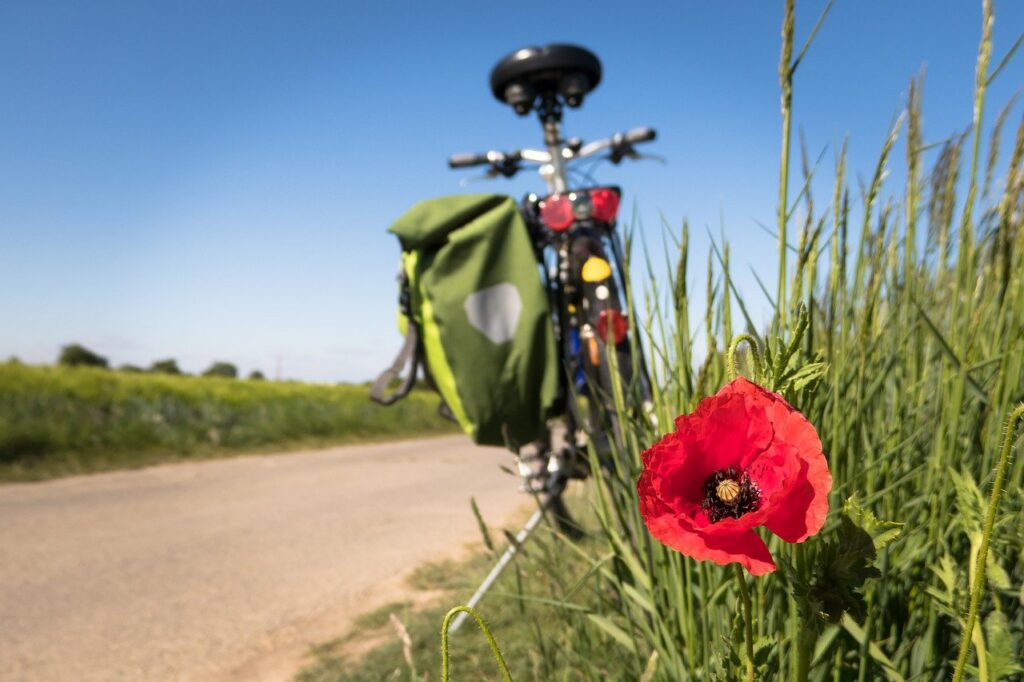
Bringing your own is worth it if you are riding for more than a few days, if you care about the fit, or if you want a specific setup — a gravel bike for the Apulian Aqueduct Cycle Route, say, whose surface is compact crushed stone rather than tarmac. Airlines carry boxed or bagged bikes for a fee that varies widely; book the slot in advance, because the allowance per flight is limited.
Hiring locally makes more sense for a short trip, and in one area it makes more sense than anywhere else: on the Gargano, where the classic loop climbs 1,714 metres in 61 kilometres, an e-bike turns a trained rider’s day into an accessible one. Mountain bikes can be hired at the Foresta Umbra and at the National Park’s visitor centres.
By train from northern Italy
The long-distance trains that reach Puglia — Trenitalia’s Frecce and Italo — will take an assembled bicycle, with the right arrangements and a supplement, on the services that are equipped for it. Not every train is: the bike spaces are on specific departures, so check when you book rather than at the platform.
The alternative that always works is a folding bike, which travels as luggage on any service.
Once you are in Puglia, the picture changes completely — and in your favour. Across Italy an assembled bike on a regional train normally costs a supplement. In Puglia it is free. On Regionale trains marked with the bicycle pictogram, bike carriage costs nothing: present yourself to the on-board staff before boarding and the guard issues a zero-cost supplement.
It comes from an agreement between the regional government, the regional transport agency and the five operators — Trenitalia, Ferrovie Sud Est, Ferrovie del Gargano, Ferrovie Appulo Lucane and Ferrotramviaria. Two caveats: it applies only to trains carrying the pictogram, and the spaces on board are few.
By car, and by ferry
Driving down with the bikes on the roof is what most Italians do, and it has one clear advantage: you arrive with everything and you then leave the car parked. Two things worth knowing before you set off are that Italian motorway tolls are paid at the barrier, with no vignette system, and that town centres are often restricted traffic zones monitored by camera, with fines arriving months later at your home address.
Ferries reach Bari and Brindisi from Greece, Albania and Croatia, and they take bicycles. Note the direction of travel: those ports face east, so a ferry is how you leave Puglia for the Balkans, not how you reach it from western Europe. The details are on arriving by ferry.
When to plan it for
Not summer. Puglia is flat almost everywhere and the difficulty here is not gradient but heat: from June to September the interior regularly passes thirty-five degrees, and there is no shade — olive trees give none, dry stone walls give none. The two good windows are April–May and September–October, which are also the months when flights and accommodation cost less.
- The Apulian Aqueduct Cycle Route — 523 km, nine stages, and the two hundred that are open today
- Cycling in Salento — the Ciclonica, the loop from Lecce, and the coast road to Leuca
- Cycling in the Gargano — twelve marked sections, and the only real climbing in the region
- Cycling in the Valle d’Itria and the Murgia — trulli, the Alta Murgia, and a Roman road
For every other way of getting here, see getting to Puglia.