In short. Locorotondo is a small white town with a perfectly circular old centre, sitting at 410 metres in the middle of the Valle d’Itria. It has its own roof shape found nowhere else, the best view over the valley, cool nights in August, and — because everyone else stays in Alberobello — the most sensible base for the whole area.
The name says what it is: locus rotundus, the round place.
It is one of the small towns that make the Valle d’Itria worth slowing down for, and it is regularly listed among the most beautiful villages in Italy.
The old town is a ring, and walking its circumference is the whole visit — twenty minutes of white lanes, flowered balconies and, on the outer edge, a view that stops people mid-sentence.
The circle, and the roofs
Locorotondo is not a trulli town, and that is what makes it interesting next door to Alberobello. Its houses have their own roof: the cummerse.
Cummerse: the roofs that made the skyline. Unlike anywhere else in Puglia, the traditional houses here have steep double-pitched roofs with shaped eaves that funnel rainwater down into underground cisterns. It was never a decorative choice — in a country where water was the scarce thing, every drop of rain had to be collected. The result is an unmistakable profile: a rhythm of pitched lines repeating all the way round the circle. From outside, Locorotondo looks like one continuous building turning on itself.
What to see
- Piazza Vittorio Emanuele — the centre of things, with the bars, and where the town gathers in the evening.
- The Belvedere — along the outer rim of the old town, and the reason to time your visit for late afternoon.
- Chiesa Madre di San Giorgio — dedicated to the patron, with medieval reliefs and sacred art inside.
- Chiesa della Madonna della Greca — a small fifteenth-century gem.
- Cappella di San Rocco — protector of the town, celebrated with a large feast every August.
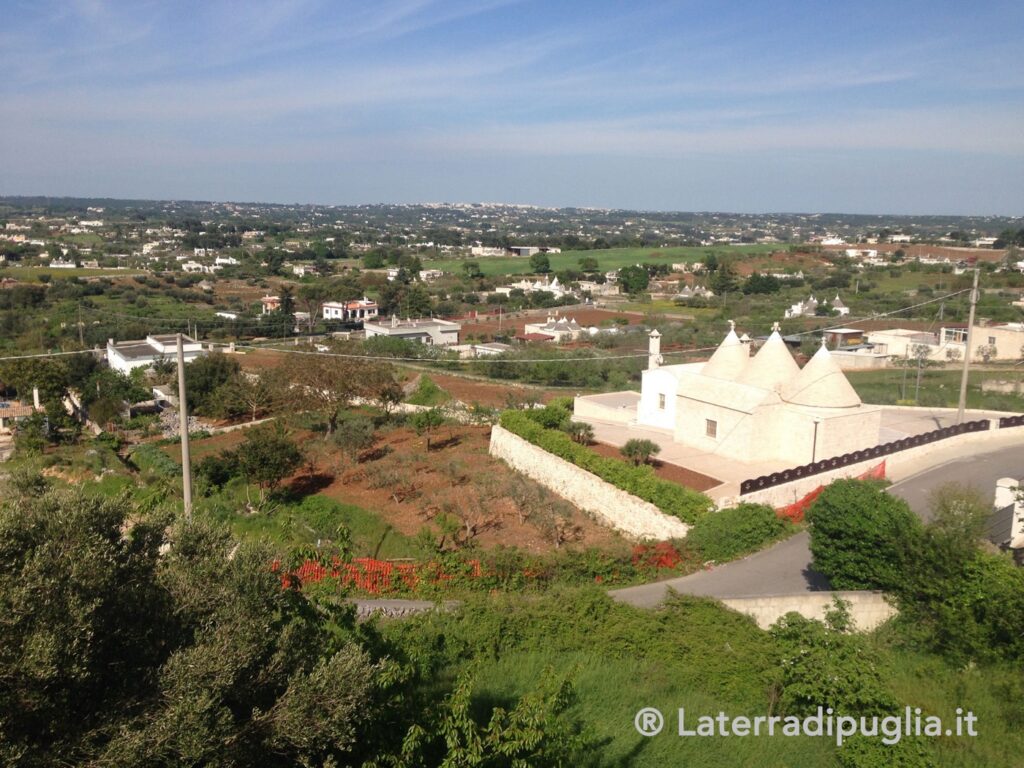
The view from the belvedere. The walk runs along the perimeter of the old town, which is what accentuates the circle. From it the whole Valle d’Itria opens out: a mosaic of ancient olive groves, ordered vineyards and trulli scattered between them like small architectural gems. It changes completely with the hour — gold at dawn, pink and orange at sunset — and it is the single best panorama of the valley from anywhere in it.
Why to sleep here
The most central base in the valley. Alberobello and Martina Franca are 9 km away, Cisternino 12, Ostuni 25. Geometrically, Locorotondo is the middle of the Valle d’Itria — everything is fifteen minutes off. Staying here rather than in the famous towns means cheaper rooms, the square to yourself in the evening without the tour coaches, and, at 410 metres, cool nights even in August, when the coast is stifling.
The altitude also explains the climate more generally: dry fresh air in summer, mild winters with a lot of sun, and a place that is genuinely pleasant to visit out of season.
Wine, and the summer festival
Locorotondo gives its name to a white — Locorotondo DOC — made from Verdeca and Bianco d’Alessano, and the vineyards start immediately outside the ring. It is the local drink rather than a souvenir, and it is what the town pours.
In summer the Locus Festival brings international musicians into the valley, and the feast of San Rocco in August fills the streets with lights, bands and the kind of crowd that only a patronal feast produces.
Getting there, and the distances
- By car — the SS172 links it to Martina Franca (9 km), Alberobello (9 km) and Ostuni (25 km).
- By train — the Ferrovie del Sud Est serve Locorotondo directly from Bari and Taranto.
- By air — Bari Karol Wojtyła 70 km, Brindisi Papola Casale 50 km.
- Further afield — Bari 70 km, Brindisi 50 km, Lecce 90 km, Polignano a Mare 40 km.
Locorotondo is the geographic centre of the Valle d’Itria, nine kilometres from both Alberobello and Martina Franca.