In short. Vieste is the main town of the Gargano coast: a white old town on a rocky headland, a long sandy beach beneath it, a 26-metre limestone stack that is the symbol of the whole promontory, and a castle built by Frederick II. It also has the darkest single day in its history carved onto a stone in the middle of town.
If you are coming to the Gargano for a week by the sea, this is where most people stay, and with reason: it works for couples and for families, it has enough town to fill an evening, and the coast on either side of it is the best on the promontory.
The beach and the stack
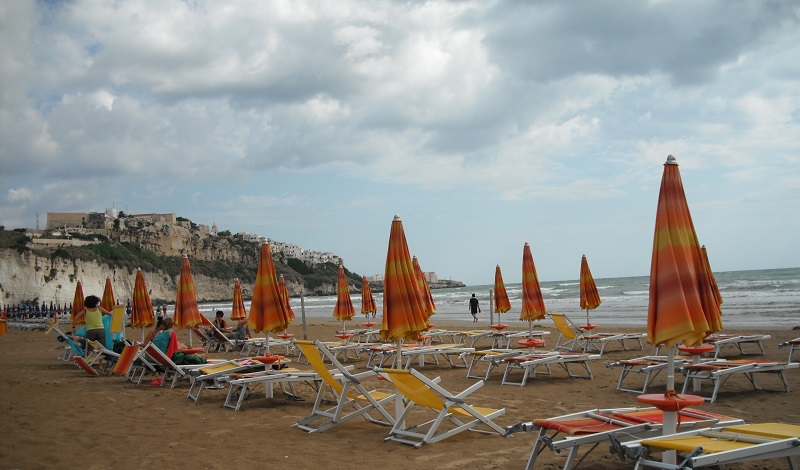
Vieste sits inside the Gargano National Park. Its famous beach is the Scialara, which everyone calls the Castle Beach, running below the old town. At one end of it stands the Pizzomunno: a limestone stack 26 metres high, detached from the cliff, and the undisputed symbol of the town.
The legend of the Pizzomunno. The story every child in Vieste knows: a young fisherman was in love with a girl, and the sirens, out of jealousy, killed her. The grief turned him to stone, and the stone is still standing on the beach. Once every hundred years, on a night of full moon, the spell lifts and the two lovers are together again until dawn. It is a small thing, and it is the reason the beach feels the way it does at night.
The castle and the cathedral
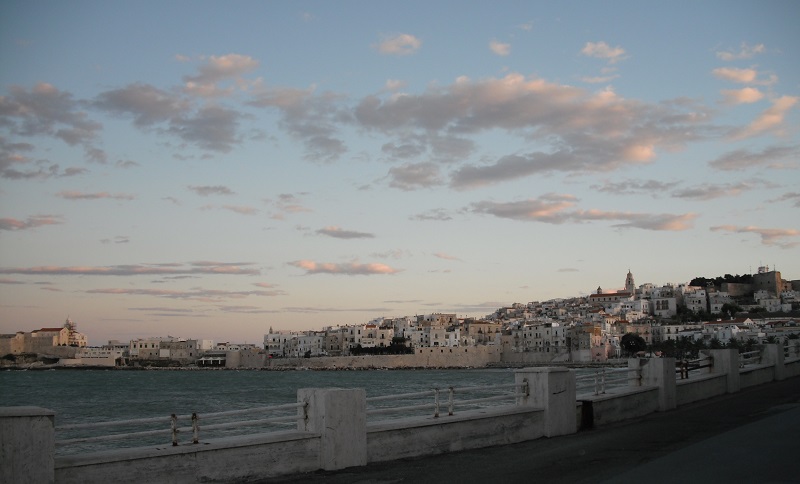
The castle is Frederick II’s, built in the thirteenth century over an earlier Norman structure, on a rock directly above the sea. The plan is triangular with rhomboid bastions — the standard vocabulary of Swabian fortification — and the position was chosen to watch the coast and to hold off Saracen raids. The Spanish altered it later. It belongs to the Navy today and opens to the public only on particular occasions, but the view from outside is most of the point.
A short walk away is the Cathedral of Santa Maria Assunta, built in the eleventh century and one of the oldest Romanesque buildings in Puglia. It has been changed over the centuries — the façade is baroque, the bell tower eighteenth-century — and inside it holds the venerated statue of the Madonna di Merino, carried through the town in a solemn procession every 8 May.
The Chianca Amara
The bitter stone. In the middle of the old town there is a memorial to what happened in 1554, when the Turkish fleet landed at Vieste with seventy galleys and massacred the population. The stone is called the Chianca Amara — the bitter flagstone — and it is where, by tradition, the killing was done. Towns on this coast tend to keep their fortifications as scenery; Vieste keeps this as a memorial, which is a different thing.
The rest of it
The old town is worth an hour on its own: narrow lanes, small squares, shops and bars in the arches. Above the Marina Piccola stands the convent of Punta San Francesco, built in 1438, for the view as much as for the building. And for something genuinely unexpected, the Malacological Museum holds a collection of some 15,000 shells and marine specimens from around the world.
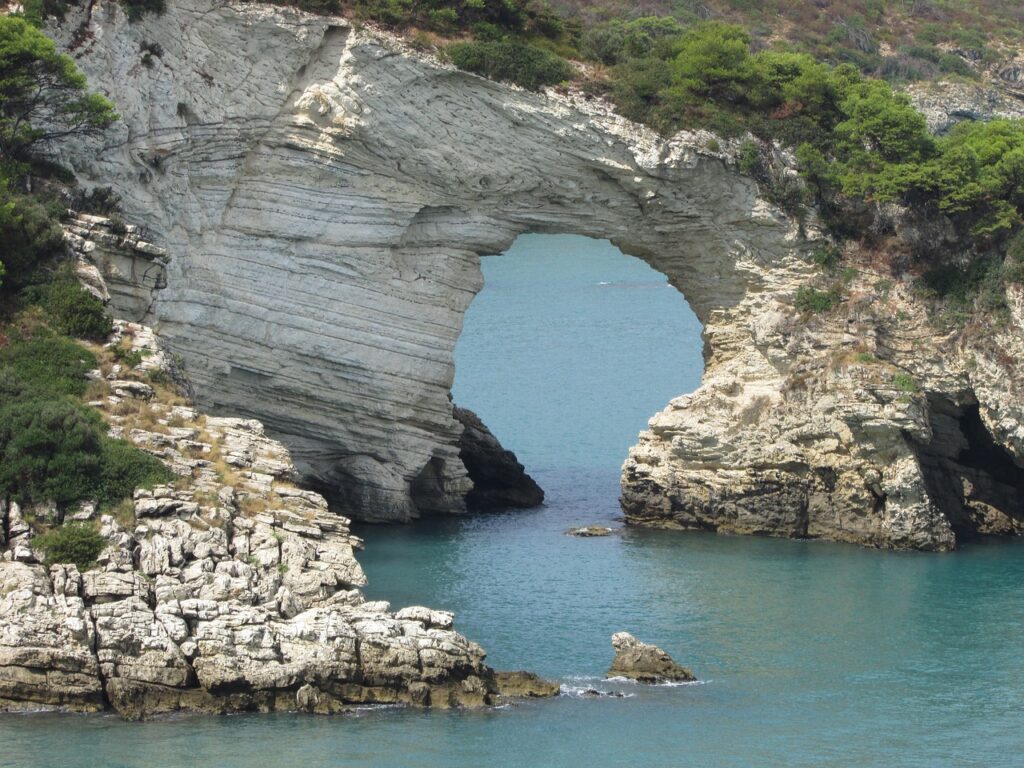
The best half-day here is on the water. The coast south of Vieste is a run of cliffs, arches and caves that can only be seen from a boat, and the trips leave from the harbour. We have written that up separately: the sea caves of Vieste.
Around it
North along the coast is Peschici, twenty minutes away and worth an evening. Inland and up, Monte Sant’Angelo is the other side of the Gargano entirely — forest, stone and pilgrimage instead of beach. And from the harbour there are boats to the Tremiti islands.
Vieste is the main town of the Gargano, and the easiest base for the coast.