In short. Gallipoli is a town built on an island, joined to the mainland by a sixteenth-century bridge, with Aragonese walls dropping straight into the Ionian. It has the best-known beaches on this coast, the loudest summer nightlife in the Salento, a baroque old town — and a forgotten two centuries when its port lit the street lamps of northern Europe.
The name has nothing to do with the Gallipoli of the First World War, which is in Turkey. This one comes from the Greek Kallipolis, “beautiful city”, and after three thousand years it still describes the place accurately.
An island with a town on it
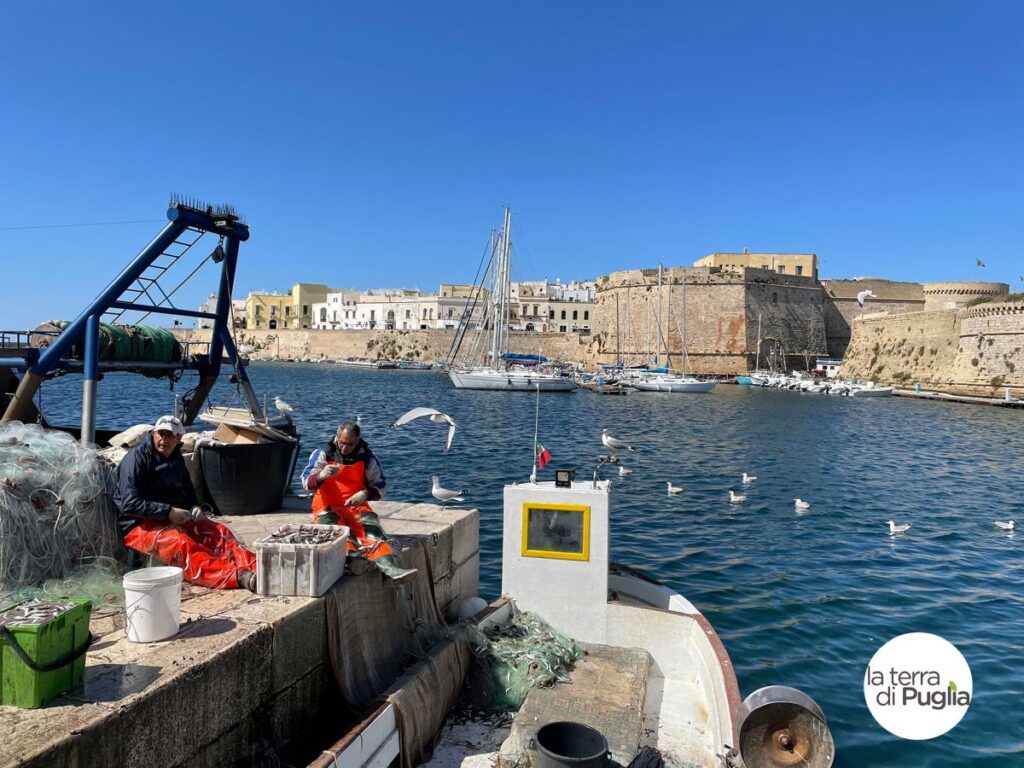
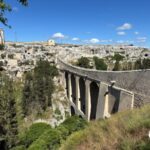
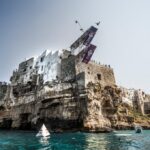
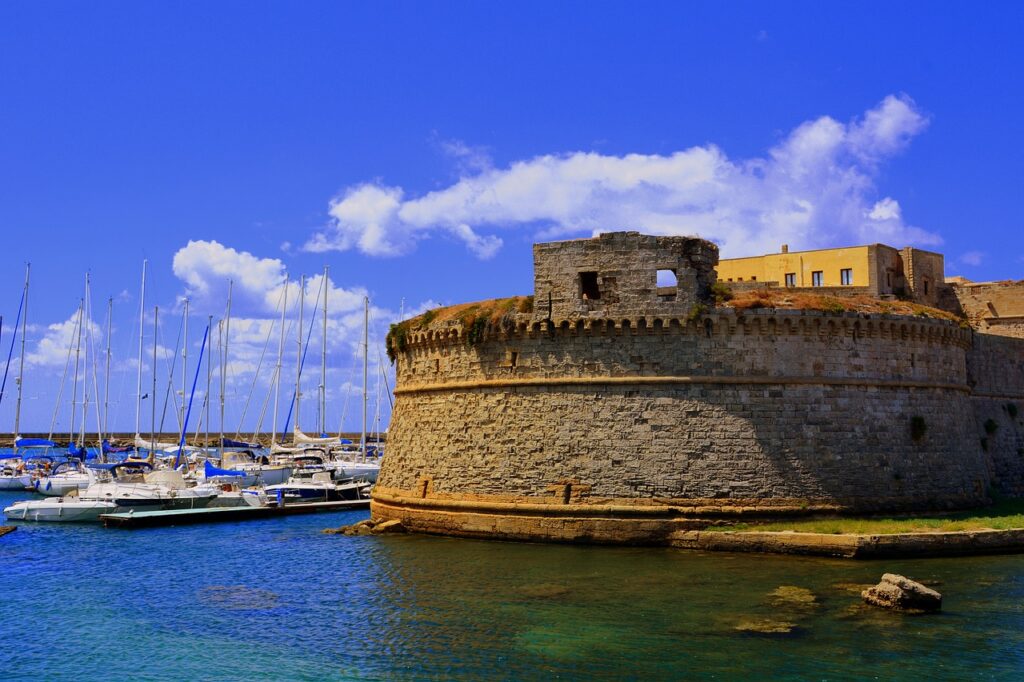
The historic centre is not on the coast — it is an island off it, reached by a bridge built in the sixteenth century. The walls run almost the whole way round, with the sea working directly below the windows of the houses. From the air it looks like something set into the water, which is more or less what it is.
The town has been fortified by everyone who passed: Greek in origin, then Roman, Byzantine, Norman and Spanish. The Angevin castle guards the bridgehead, and the Cathedral of Sant’Agata, a seventeenth-century baroque church hung with canvases by local painters, sits at the top of the lanes.
The oldest public fountain in Italy is here, and almost nobody notices it. The Hellenistic fountain by the entrance to the old town — known locally as the Greek Fountain — dates from the third or second century BC and is considered the oldest public fountain still standing in Italy. Built by Greek colonists, it was where the whole town drew its fresh water. Four lion mouths pour into a collecting basin; the design is plain, and the thing is a document. Most people walk past it on the way to the bridge.
The beaches
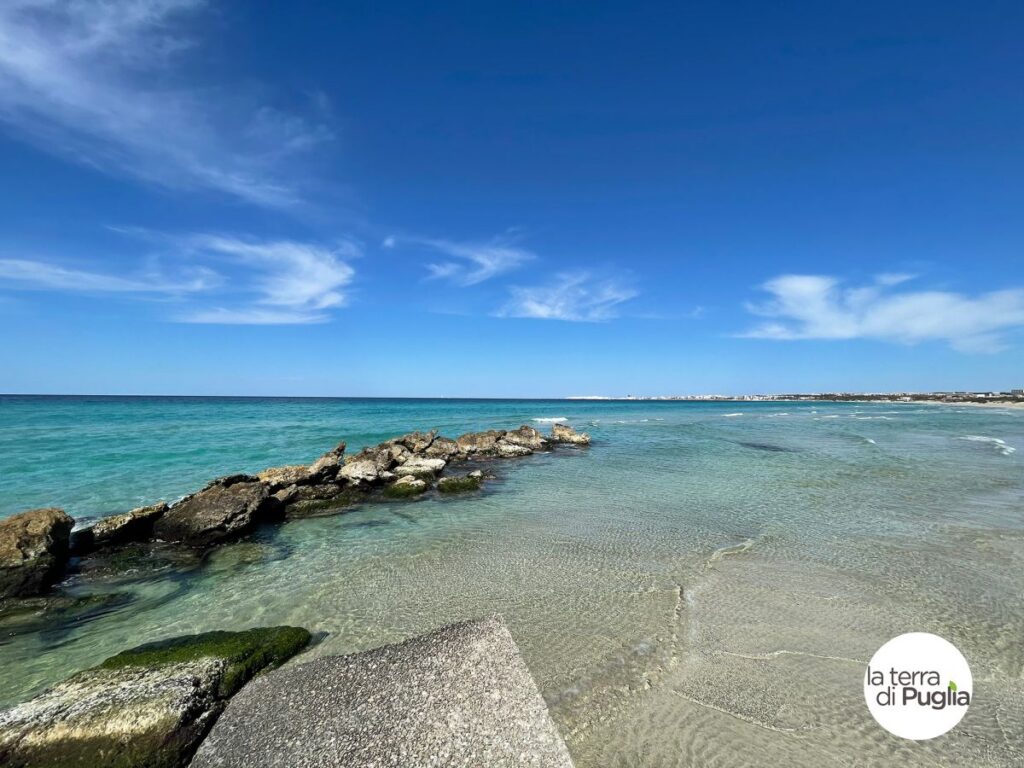
The coast around Gallipoli is the most popular on the Ionian side of the Salento: calm water, shallow bottom, fine sand. The main beaches lie north and south of the old town.
- Baia Verde — fine golden sand, the busiest and the best served. The default choice for families and for anyone who wants a full day with facilities.
- Spiaggia della Purità — inside the old town itself, so you can go straight from the churches to the water.
- Punta della Suina — shallow and clear, good for snorkelling, inside the regional park of the Isola di Sant’Andrea.
- Punta Pizzo — the protected stretch further south, with walking and birdwatching rather than sunbeds.
The two centuries that paid for the town
When the Salento lit up Europe. Before gas and then electricity, street lamps burned oil — and Gallipoli was the main European export port for lampante, the low-grade olive oil unfit for eating but perfect for lamps. The whole Salento, with its millions of olive trees, produced it in enormous quantity, and from Gallipoli it sailed for Amsterdam, London, Marseille and Genoa. In the seventeenth and eighteenth centuries this was one of the busiest ports in the Mediterranean. That trade paid for the baroque palaces and the elaborate churches you walk past in the old town today. The town also built barrels and made soap at industrial scale; today it lives on tourism and fishing.
The statue people come to see and then wish they hadn’t
The Malladrone. In the church of San Francesco d’Assisi, one of the oldest in the old town, stands a wooden figure that the people of Gallipoli have known for centuries: Misma, the bad thief crucified beside Christ, the one who did not repent. It is the work of the sculptor and monk Vespasiano Genuino, and the face is carved with a brutal realism — a jeering expression, a contemptuous grin, a stare that seems to challenge whoever is looking. Local tradition holds that its garments rot continuously and must be replaced every year, and that the teeth are real. Gabriele D’Annunzio came to see it by candlelight in 1895 and called it a thing of horrid beauty.
Eating, and the fish market
Gallipoli’s cooking is built on fish, and the town’s fish market is among the most active in the Salento. Three local dishes are worth going out of your way for: scapece, small fried fish layered with breadcrumbs and marinated in vinegar and saffron — invented as a way of keeping the catch and now the town’s signature; fish soup in the Gallipoli style, mixed fish, shellfish and country bread in one pot; and the red oysters of the local seabed, a rare mollusc — not, strictly speaking, an oyster at all — gathered by hand at considerable depth. For lunch, the puccia filled with fish is the standard.
We have written the whole list out, dish by dish: what to eat in Gallipoli.
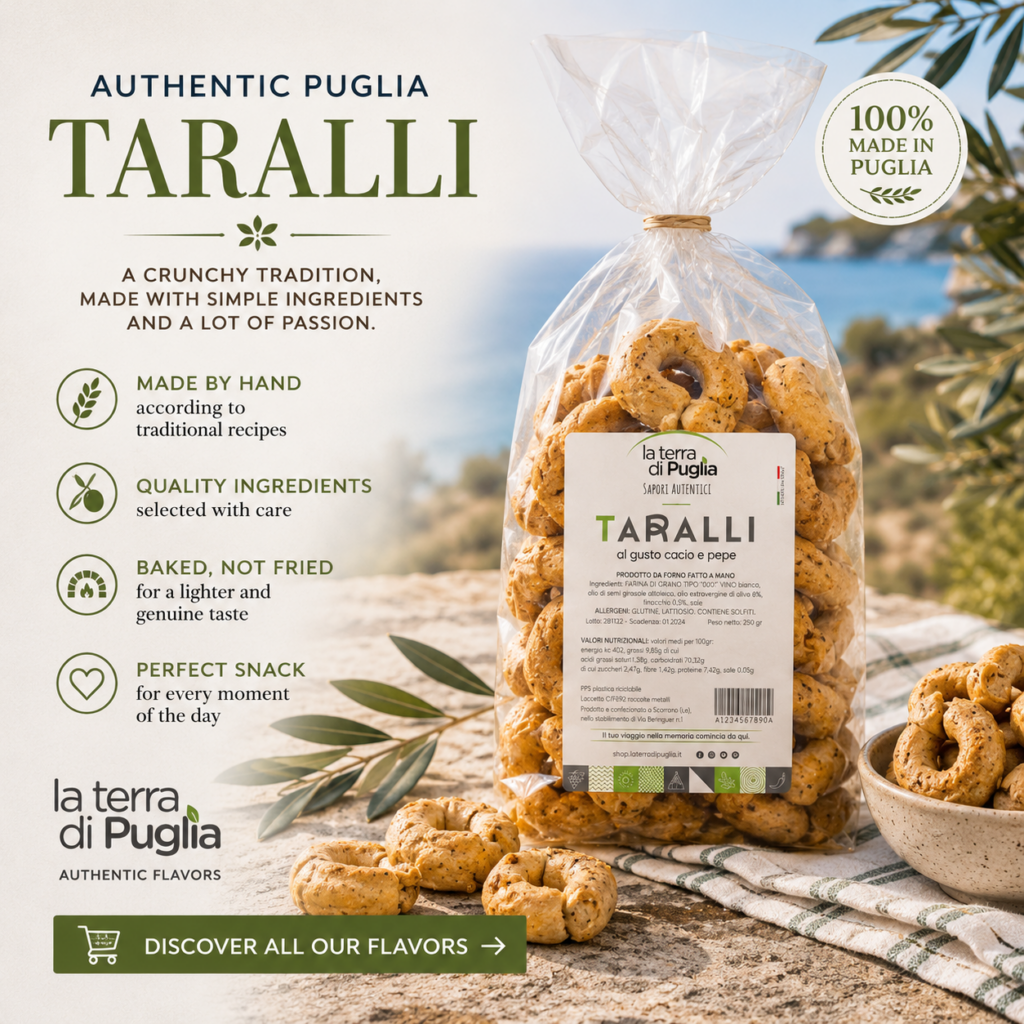
The larder, shipped. The olive oil, the taralli and the preserves of the Salento are the everyday of this coast, and they travel. We send them out from Puglia ourselves: see the shop.
Summer nights
Gallipoli is the nightlife capital of the Salento summer: clubs and beach bars along the strip south of town, national and international DJs, and a crowd that arrives from all over Italy in July and August. This is worth knowing in both directions — it is the reason a lot of people come, and the reason others should book somewhere else in August and visit Gallipoli by day.
Practical
- Getting there — about an hour by car from Brindisi airport, forty minutes from Lecce. Regional FSE trains run from Lecce station.
- Walking — the circuit of the Aragonese walls at sunset is the single best hour in town.
- Also worth an hour — the Museo del Mare, on the fishing and maritime history of the town.
Gallipoli is on the Ionian side of the Salento, forty minutes from Lecce and about fifty kilometres up the coast from Santa Maria di Leuca.