In short. Lecce is the capital of the Salento and the baroque capital of southern Italy: forty churches, a Roman amphitheatre buried under the main square, and a whole city carved out of a soft honey-coloured limestone that hardens in the air. The historic centre is small enough to cross in twenty minutes, and you will not manage it in twenty minutes.
People call Lecce the Florence of the South, and for once the comparison holds. Florence is where the Renaissance reached its peak; Lecce is where the baroque did. The difference is the stone — and the fact that almost nobody outside Italy has heard of it.
What to see in Lecce
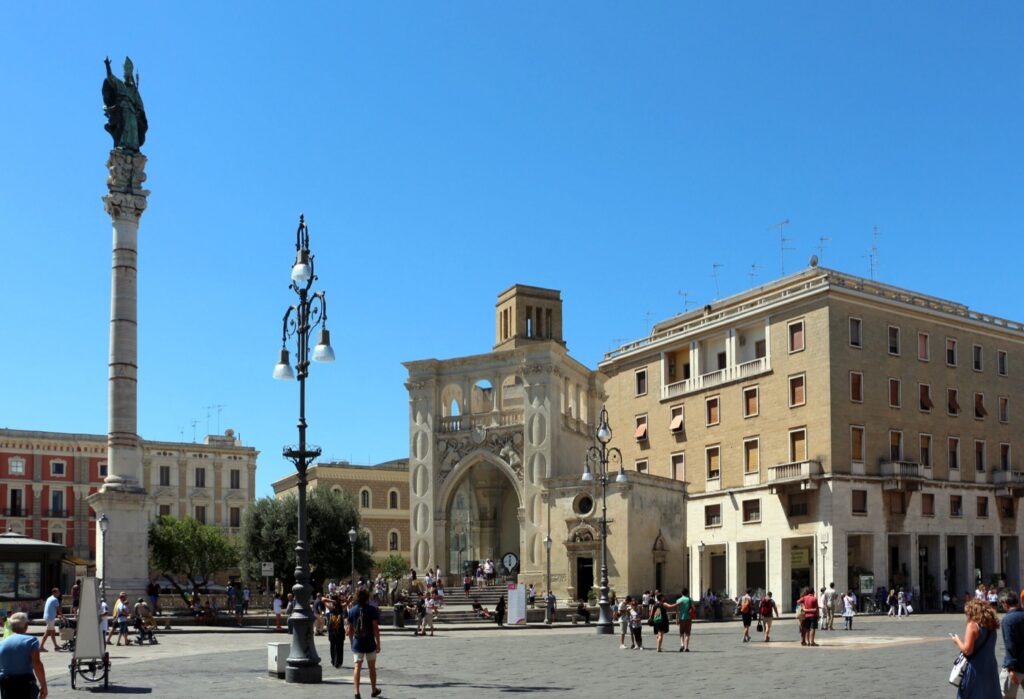
Piazza Sant’Oronzo and the Roman amphitheatre
The living centre of the city, named after its patron saint, whose column stands in the middle of it. Sunk into one side of the square is the Roman amphitheatre — and the reason you only see part of it is that the square was built on top.
The amphitheatre nobody knew was there. It was found by accident in 1901, during building work in Piazza Sant’Oronzo, and only a portion has ever been uncovered. What is visible is enough to work out the original scale: it held around 25,000 spectators — more than half the present-day population of the city — and dates from the first or second century AD. Modern Lecce sits directly on top of Roman Lecce, and every time anyone digs here, something turns up.
The Basilica of Santa Croce
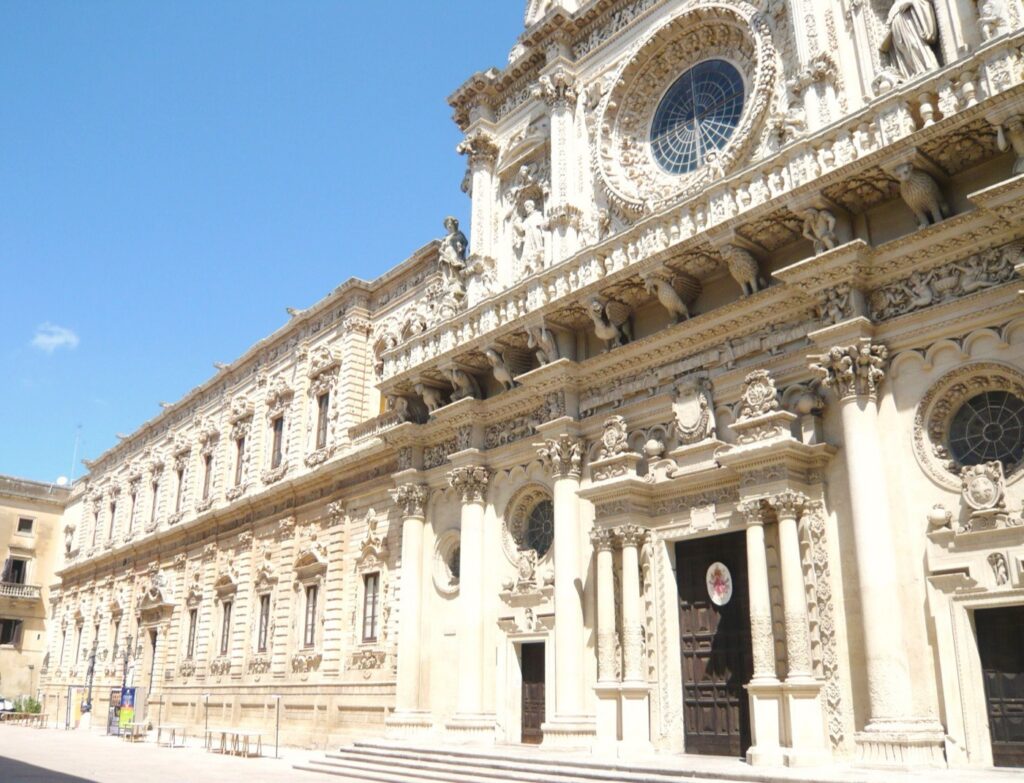
The emblem of the whole style. The façade is worked to a degree that is difficult to take in from a photograph: angels, grotesque masks, acanthus leaves, twisted columns, mythological figures, all cut into the local stone. Inside, the plan is a plain Latin cross — the extravagance is all on the outside, which is exactly the point of the Lecce baroque.
Piazza del Duomo
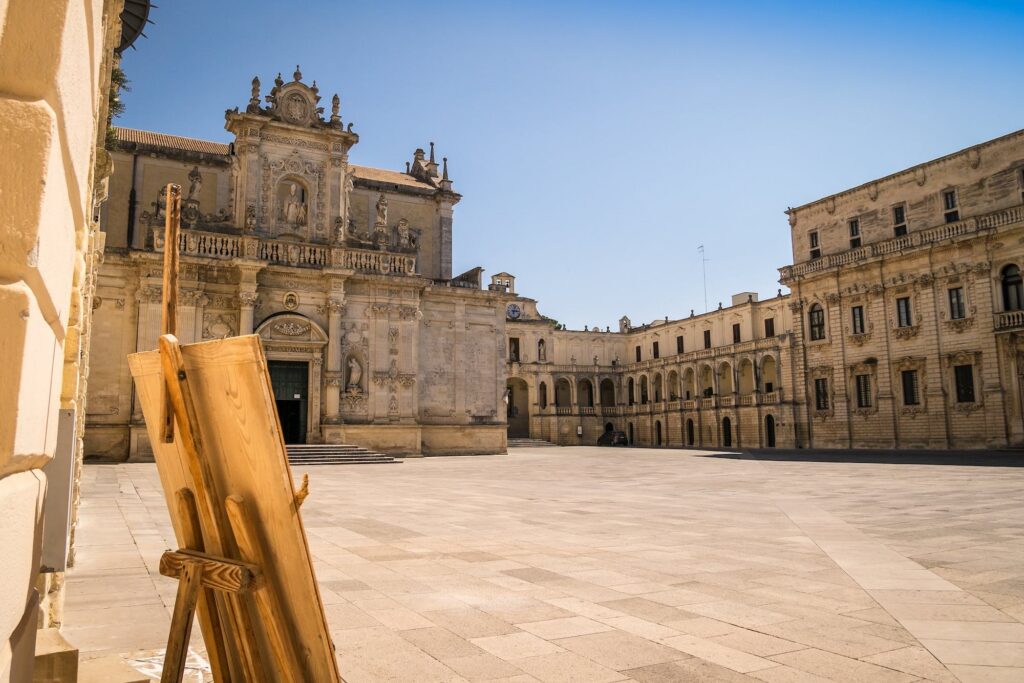
A courtyard rather than a square: you enter through a single gateway and the city noise stops. Around it stand the cathedral, its tall bell tower — climbable, with a view over the whole city and, on a clear day, well beyond it — and the Palazzo del Seminario. It is the one place in Lecce that works best at night, when it is lit and empty.
The castle of Charles V
A heavy sixteenth-century fortress thrown up to defend the city against Ottoman raids, on the eastern edge of the old town. Today it holds the Papier-Mâché Museum, which sounds like an afterthought and is not.
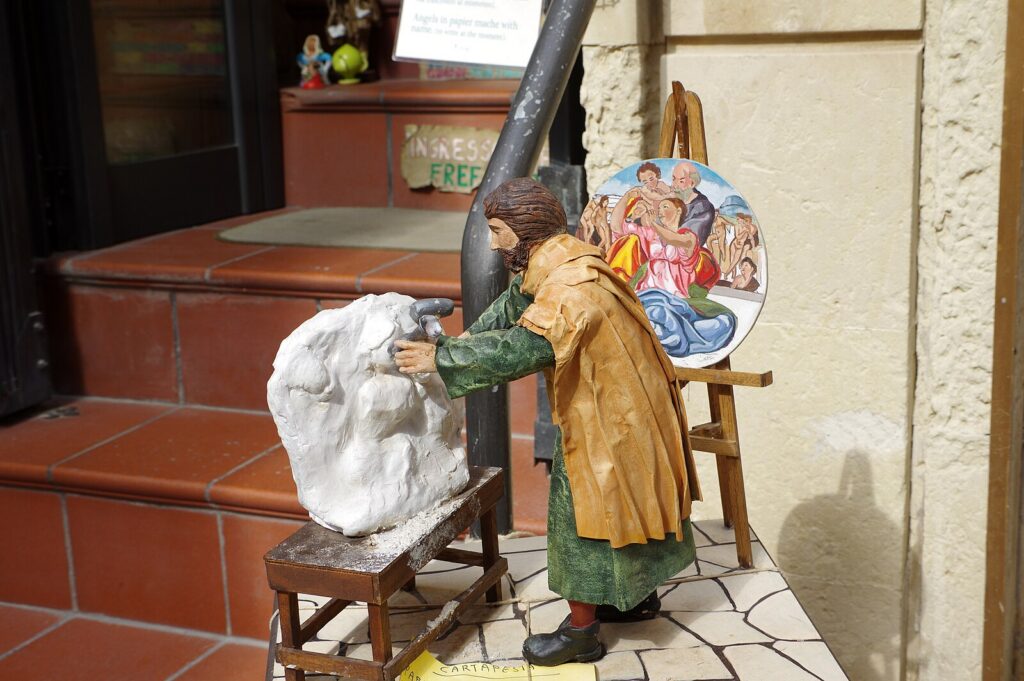
Papier-mâché: the poor material that replaced marble. The craft began in Lecce in the seventeenth century almost by accident. Local stone was expensive for ordinary families, while papier-mâché — rags, glue and plaster — let a workshop make devotional statues for almost nothing. The Lecce masters took it far past economy: their technique could reproduce the detail of carved stone using materials worth pennies. It is now recognised as one of Italy’s important craft traditions, and many of the saints standing in Salento churches are their work, not a sculptor’s.
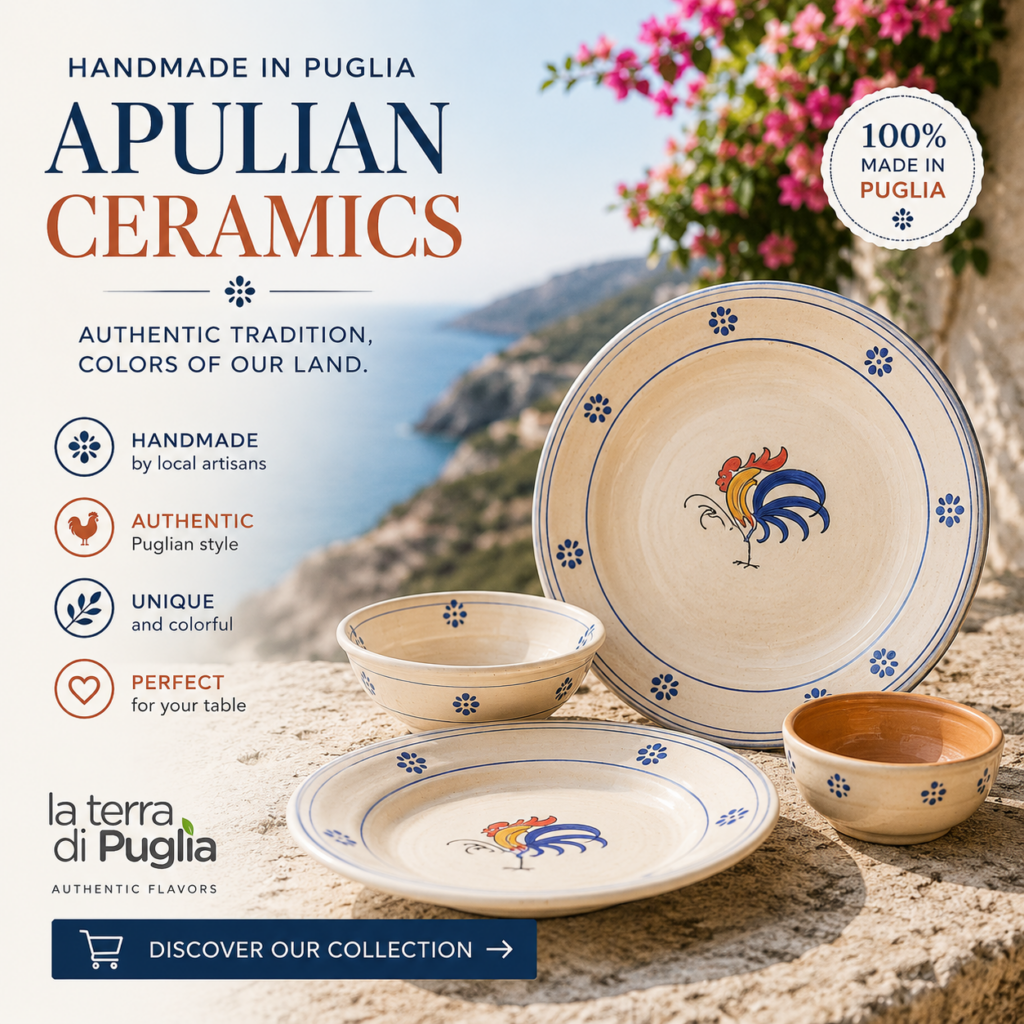
Papier-mâché is the craft of Lecce itself. The other great Salento material is clay: forty kilometres south, at Cutrofiano, and inland at Grottaglie and Laterza, the workshops that make Apulian ceramics — and the pumo, the bud you will see on balcony railings across the province.
The Roman theatre and the city gates
The Roman theatre, also found in the twentieth century, seated up to 5,000 and is still used for performances. The three surviving gates of the old town — Porta Napoli, Porta Rudiae and Porta San Biagio — mark where the walled city began, and are the natural places to start a walk.
The stone, which explains everything else
Soft to carve, then permanent. Lecce stone is a calcarenite with an unusual property: it is soft when quarried and hardens progressively on exposure to air. Seventeenth-century carvers could work it almost like wood, with very fine chisels, producing detail that would have been impossible in marble — and then, over the following years, the stone set hard. What looks like fragile decoration has stood for four hundred years. The colour is not constant either: it shifts with the light, from ivory at midday to deep gold in late afternoon. Photograph Lecce at sunset.
This is also why Lecce is called the city of a hundred churches, and why it holds forty baroque churches in a centre you can walk across in twenty minutes. For the older layers, the Castromediano provincial museum and the excavations at Rudiae, about three kilometres out, show the Messapian city that stood here before Rome.
If the architecture is what brought you, we have gone into it properly: baroque Lecce and the stone that made it.
Practical
- Getting there — by car on the A14 and the SS613; by train, Lecce is the end of the line down the Adriatic. The nearest airport is Brindisi, with buses and car hire into the city.
- Getting around — the historic centre is a limited traffic zone (ZTL); leave the car outside and walk in. The simplest option is to park near one of the three old gates — Porta Napoli, Porta Rudiae, Porta San Biagio — where paid car parks sit a few minutes from the main squares. To skip paid parking, the city runs a free park-and-ride at Settelacquare, with a paid shuttle into the centre. From any of the gates it is an easy walk to Piazza Sant’Oronzo, the Duomo, Santa Croce and the castle.
- Where it is — in the middle of the Salento, about 40 km from Gallipoli and 170 km from Bari. It is the obvious base for the whole peninsula.
- When to come — the climate is Mediterranean, with hot summers and mild winters, so it works all year. Spring and autumn are the best of it.
- Staying — from B&Bs in the old town to converted farmhouses outside it. Book ahead in summer.
Lecce sits at the centre of the Salento, and everything else on the peninsula is within an hour of it — the cathedral mosaic at Otranto to the east, the island town of Gallipoli to the west.