In short. Polignano a Mare is built on a limestone spur hanging directly over the Adriatic, above a cove crossed by a Roman bridge. It is the most photographed town in Puglia, the birthplace of the man who wrote Volare, and since 2009 a fixed stop on the Red Bull cliff diving circuit. It is also small, and in August it knows it.
Everyone has seen this town whether they know it or not: white houses on a cliff, a slot of turquoise water beneath them, an arched bridge across the top. That image has done more to sell Puglia abroad than any campaign.
The town of the lame
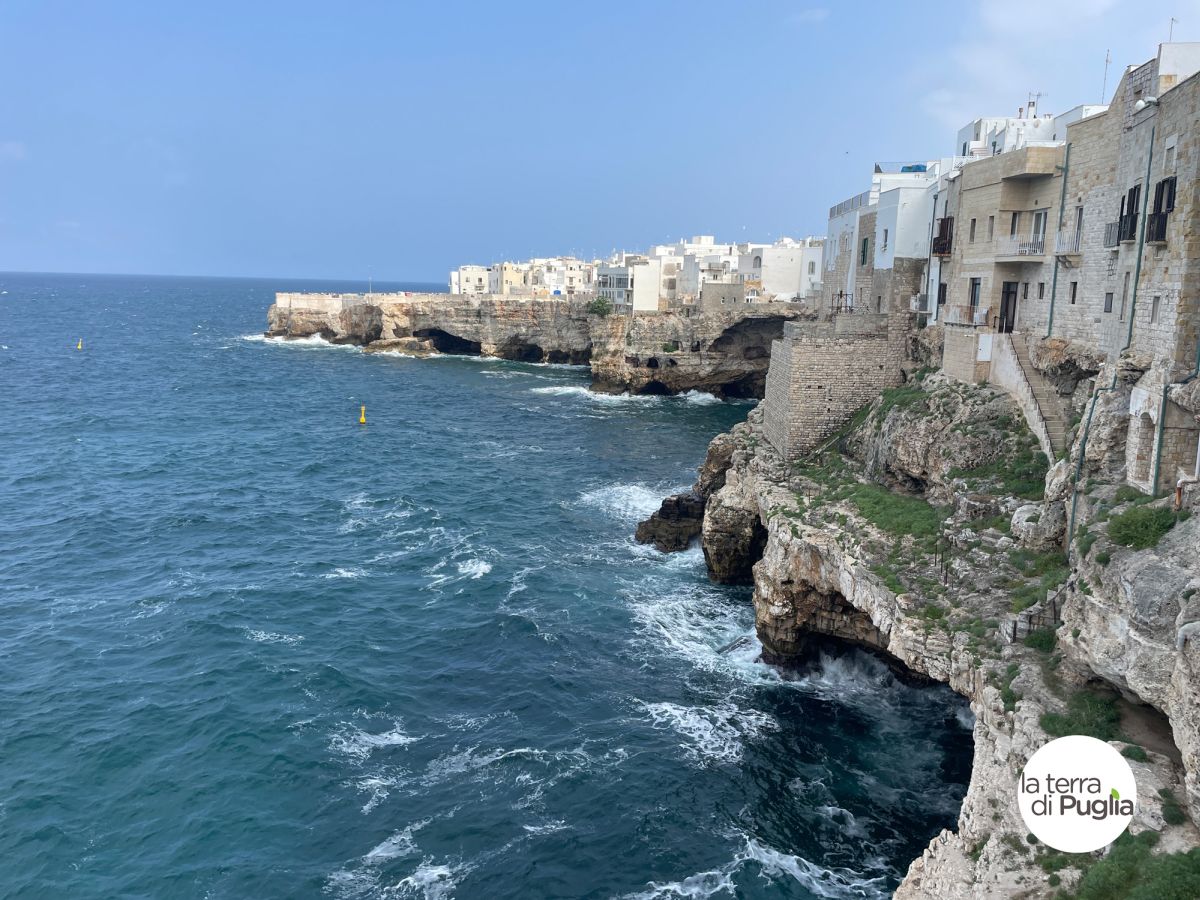
The coast here is high and broken, cut by natural inlets that in Puglia are called lame. The famous one is Lama Monachile, right beside the old town — named after the monk seal that used to live in it. There is another at Lama Santa Caterina, and any number of smaller sea caves along the cliffs. Seen from a boat, this coastline is the whole argument for coming.
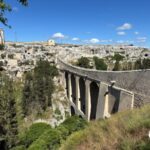
The Roman bridge over the cove. The bridge crossing Lama Monachile carries the Via Traiana, the Roman road from Rome to Brindisi, which passed straight through Polignano. The town was already a place where merchants met when that road was built — and the traffic never really stopped, though it changed hands: the commercial energy continued under the Aragonese, pushed along by the Venetians.
For all that, Polignano never became one of the great Renaissance trading ports, and the reason is the thing you are admiring: perched on a cliff, it could never build itself a decent harbour. Its living came from farming and from trade with the interior instead — and today, from visitors.
The cliff diving
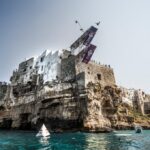
How a beautiful town went viral. Since 2009 Polignano has been a fixed stop on the Red Bull Cliff Diving World Series. Divers go off the rocks at Lama Monachile from heights of up to 27 metres, in front of thousands of spectators on the rocks and in boats below. The pictures — a body in the air, the white town stacked behind it — went round the world and turned Polignano into an international destination. It was always this beautiful; the diving is what made everyone find out.
The 2026 round is on 25-27 September: dates, where to watch and how to get there are in our guide to the Red Bull Cliff Diving 2026.
Domenico Modugno
The other reason people come is a song. Domenico Modugno was born here, and there is a statue of him on the seafront, arms open towards the water.
Volare. Nel blu dipinto di blu was presented at the Sanremo Festival in 1958 and won. It became the first Italian song to reach the top of the American charts and took two Grammy Awards in the same year — Song of the Year and Record of the Year — and it remains one of the most covered pieces of music in the world.
He spent most of his career denying he was from here. Modugno told the public for years that he was Sicilian, believing it made him more interesting to his audience. He only made peace with his birthplace in 1993, a year before he died, at a concert in Polignano itself, where he finally said publicly that he was from here. The town, for its part, had never stopped claiming him.
Older than any of it
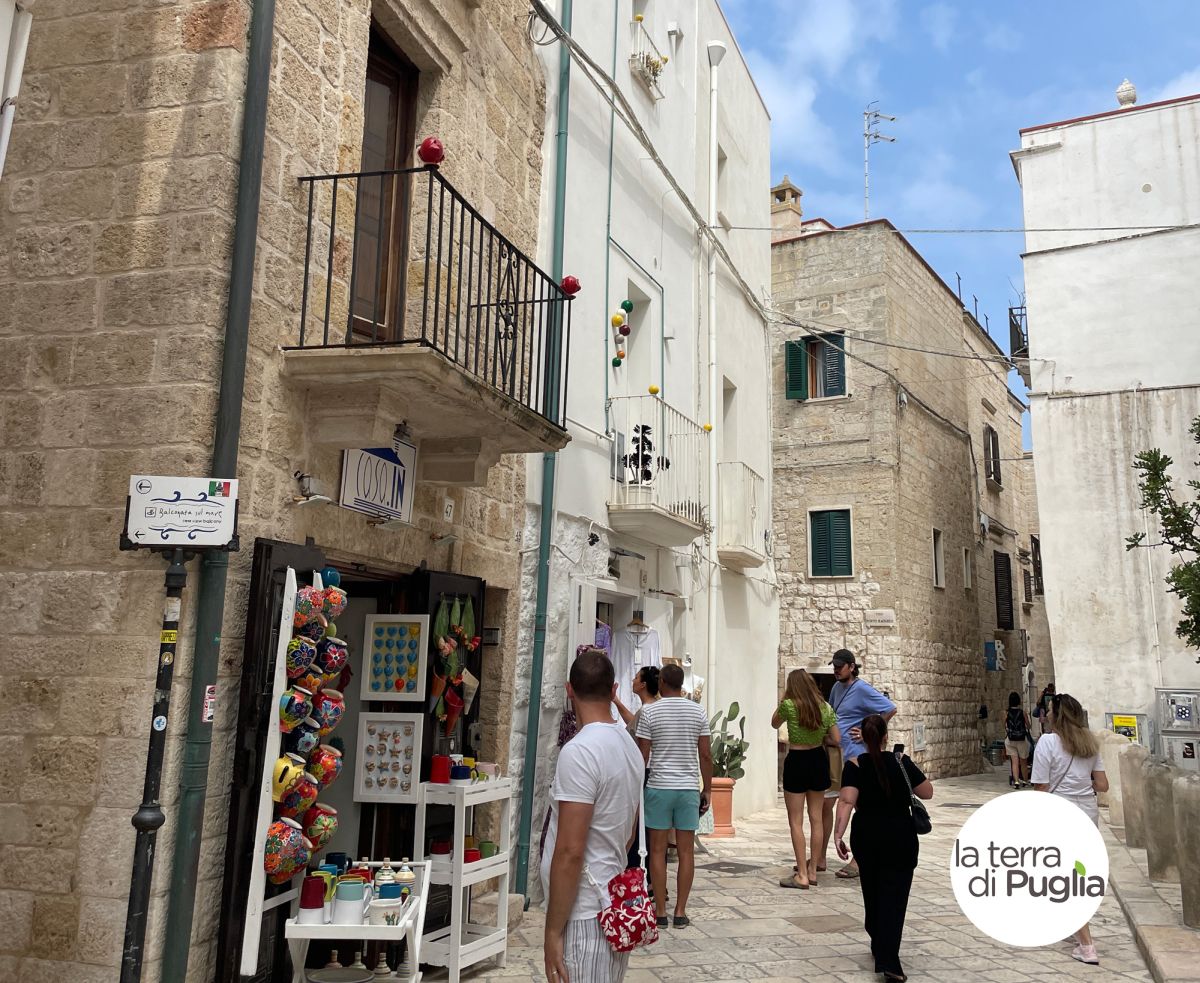
The history goes back to the Neolithic, on the evidence of what has been dug up around the town, and the Roman presence left more than the bridge. Walking the old town — a knot of white lanes, arches and terraces that open without warning onto the sea — is the best half-hour here, and it is free.
Practical
Three things worth knowing before you go, none of which appear on the postcards.
The beaches, honestly
Lama Monachile is the one in every photograph, and it is a small pebble cove between two cliffs: in August it fills before ten in the morning. Cala Paura and San Vito give you considerably more room. None of them is a long sandy beach — this is a rocky coast, and that is the point of it.
The special coffee
Ask for a caffè speciale. It was invented here: espresso with lemon zest, cream and amaretto liqueur, served in a small glass. It sounds like an invention for tourists and it is not — it has been made in the same bar for decades, and it is the one thing to order that you cannot get anywhere else.
And the quote on the t-shirts is false
You will see it printed everywhere in town: “this place was created before Paradise”, attributed to Mark Twain. Twain never came to Polignano. The line appears in no work of his, and the attribution seems to have been invented locally for the souvenir trade. The town is worth the journey without it — which is rather the point of saying so.
- Getting there — trains from Bari take about half an hour, which makes this an easy day trip without a car.
- When — it is small and it fills up. Out of season it is one of the loveliest towns on the coast; in August, go early or stay somewhere else and visit.
- Nearby — Monopoli is twenty minutes down the coast and far more relaxed, with more beach and more parking.
There is also something specific that grows here, in the sandy soil right by the sea: the carrot of Polignano, a Slow Food presidium and not the joke it sounds like.
Polignano a Mare is the most photographed town on the Adriatic coast — and, thirty minutes from Bari, the easiest to reach.