In short. The Salento is the tip of the heel: a flat peninsula held between the Adriatic and the Ionian, covering the whole province of Lecce and the southern parts of Brindisi and Taranto. Two seas that behave completely differently, a capital city carved out of golden stone, nine villages where a Greek dialect is still spoken, and a wind that never stops. This page explains how it works, and where to go.
There is a saying here — Salentu: lu sole, lu mare e lu ientu, “the Salento: the sun, the sea and the wind” — and it is not tourist-board copy. Those three things decide everything: which coast you swim on, when you can visit, and why the whole peninsula smells of salt.
Where it is, and what it is
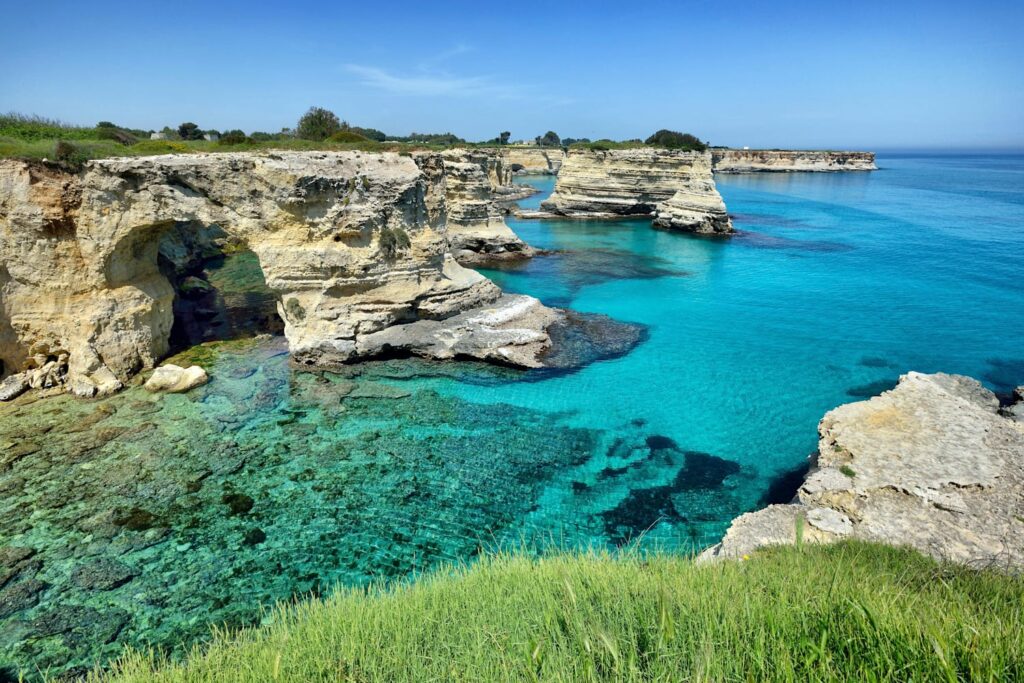
The Salento is a geographic sub-region, not an administrative one: it takes in the whole province of Lecce plus the southern ends of the provinces of Brindisi and Taranto. Both its coasts are sea, and the land between them is low and farmed — olive groves, vineyards, dry stone walls, and almost no relief to speak of.
Where the name comes from — nobody actually knows. Three theories have been argued for centuries. One traces it to King Sale, a legendary ruler of the Messapians, the people who lived here before Rome. Another to the Latin salum, used for a peninsula. A third to Cretan settlers said to have come from a place called Salenzia. None of them has ever been proved. One of the oldest inhabited corners of Italy still cannot say for certain what it is called after.
Two seas, and they are not the same sea
This is the single most useful thing to understand before you book. The Salento has an Ionian side and an Adriatic side, and they are different in temperature, colour, seabed and mood.
Why the Ionian looks like that. The Ionian is an enclosed sea with slow turnover and a high average depth. It warms up slowly in spring but holds its heat well into late October. Currents are minimal and the bottom shelves gently — which is where the transparency and the turquoise come from. The Adriatic is more open, colder and rougher: rocky coast, cliffs, deeper water straight off the shore. Same region, two entirely different seas.
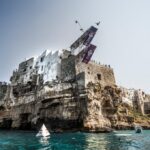
Which means the choice is practical, not aesthetic. Fine white sand and shallow water for children: go Ionian. Rock, grottoes, cliff-diving and deep water: go Adriatic. And if the weather turns, you cross to the other side — it is rarely more than an hour’s drive.
The wind decides the beach
The wind here is a feature of the landscape rather than a nuisance, and locals plan around it. The maestrale from the north-west cools the Ionian coast and makes it good for windsurfing. The tramontana from the north churns up the Adriatic, and on those days everyone moves to the Ionian side. The scirocco from the south-east, warm and humid, does the opposite: rough water on the Ionian, flat calm on the Adriatic.
The beaches people mean
- The stretch called the Maldives of the Salento — on the Ionian coast between Torre Vado and Pescoluse, in the municipality of Salve. Pescoluse is the famous one: very fine white sand, shallow turquoise water, ideal with small children. Torre Pali nearby is quieter, and Lido Marini has the most facilities.
- Punta Prosciutto and Porto Cesareo — further up the same coast, shallow and sandy.
- Baia Verde, just south of Gallipoli, and the pine-backed cove of Porto Selvaggio.
- Torre dell’Orso and the Alimini lakes on the Adriatic side, then the cliffs running south from Otranto to Santa Cesarea Terme and Castro.
The five places to start with
The Salento has hundreds of villages and it would take a season to work through them. These five are where the history, the sea and the food actually concentrate — and each has its own page here.
- Lecce — the capital, and the most extraordinary baroque city in southern Italy.
- Otranto — the easternmost town in Italy, with a cathedral floor unlike anything else in Europe.
- Gallipoli — an old town built on an island, and the best-known beaches on the Ionian side.
- Santa Maria di Leuca — where the land ends and the two seas meet.
- Brindisi — the port where the Appian Way ended, and the airport most visitors fly into.
The Greek villages
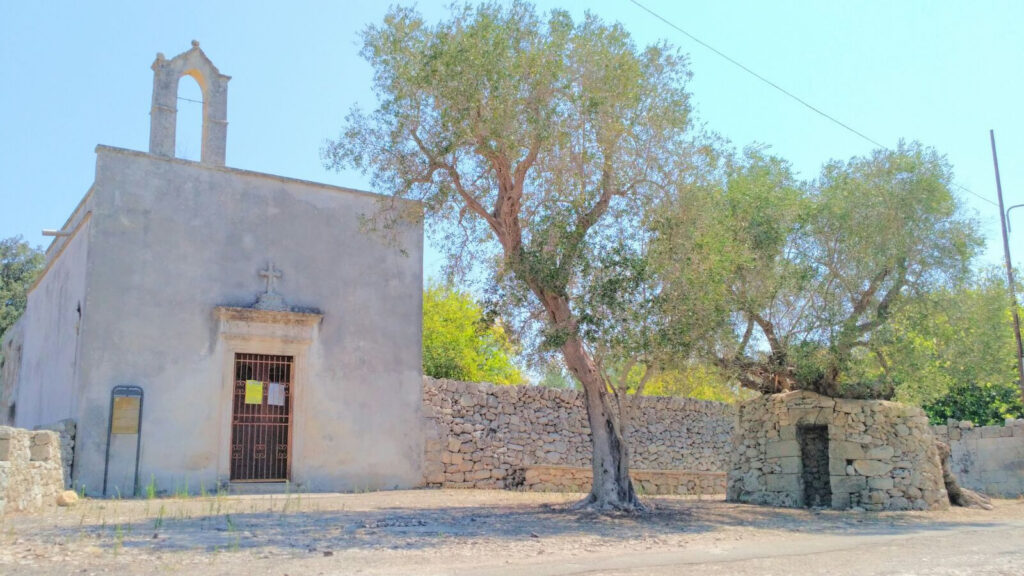
Inland from Lecce there is an area of nine villages — Calimera, Martignano, Sternatia and Zollino among them — where people still speak griko. It is not modern Greek. It is the language brought by the colonists of Magna Graecia, which survived in the fields of the Salento for more than two thousand years while everything around it changed. There is nothing else like it in Europe, and the villages are ten minutes apart. We have written about how it survived: Griko, the Greek still spoken near Lecce.
The music, and the one night everyone comes for
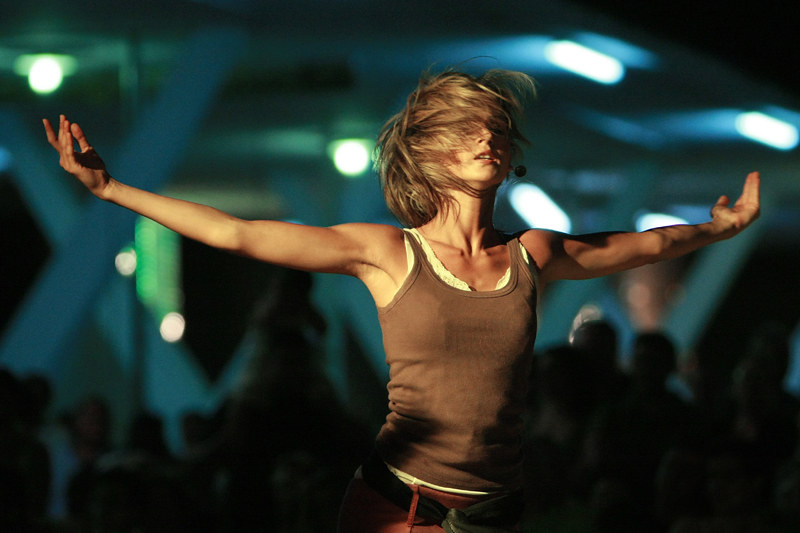
The pizzica is the local dance, fast and circular, and it is played all summer in village squares. In August the whole thing culminates at Melpignano with the Notte della Taranta, the largest pizzica festival in Europe. If you are here in the second half of August, plan around it rather than into it: the roads for miles around fill up. The story behind the dance is worth knowing first: pizzica and the Notte della Taranta.
What you will eat
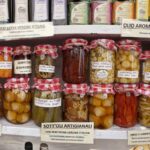
Salento cooking is frugal by tradition and generous in practice. The three things to try first are pasticciotto, a small shortcrust pastry filled with custard and eaten warm for breakfast; frise, twice-baked bread rings you soften under water and top with tomato and oil; and pitta di patate, a baked potato pie. After that, anything with sea urchins, and the local red wines.
Taking some of it home. Most of what the Salento eats travels well — extra virgin olive oil, taralli, preserves, sauces. We ship it from Puglia ourselves: see the shop.
The Salento is one of the six areas of Puglia covered in this guide. To see how it sits against the rest of the region, go back to where to go in Puglia.
To choose where to swim — beach by beach, and which coast for the day’s wind — see where to swim in the Salento.
One Salento thing that is worth timing a trip around: the luminarie of Scorrano, the illuminations that light up a small town in July and are made by families who have been building them for generations.
In August the Salento holds something almost every night. The whole calendar, day by day, is in events in the Salento in August.