Puglia has two sides. One is in full sun: the sea, the trulli, the Romanesque cathedrals, the baroque of Lecce. The other is in the shade, underground Puglia: caves, rock-cut churches, olive mills dug into the rock, early Christian crypts. This page gathers itineraries in Puglia for both, by area and by theme.
Travelling in Puglia means choosing between two worlds. The first is on the surface: the sea, the trulli, the glare of the sun on the whitewashed walls of the Valle d’Itria, the cathedrals and castles, the patron saint festivals and the food. The second is in the dark and out of sight. You have to go looking for it, but it repays anyone curious enough to seek it out.
Itineraries by area
- The areas of Puglia — the Gargano, the Tavoliere plain, the Murgia, the Valle d’Itria, the Salento and the Ionian coast, with the towns in each
- The Salento — from Lecce down to Leuca, along both the Adriatic and the Ionian coast
- The Valle d’Itria — trulli, white towns, wine and country cooking
- From Altamura to Martina Franca — the bread of Altamura, Frederick II and the capocollo of Martina Franca
- The Subappennino Dauno — hill towns of the Middle Ages, truffles, Troia and Bovino
- Brindisi and around — the old gateway to the East, Ostuni and the southern edge of the Valle d’Itria
- Olive oil and wine in the Murgia — masserie (fortified farmhouses), olive mills and wineries
- Monopoli or Polignano — two towns on the Adriatic, side by side
- The Gargano you do not know — places well away from the crowded circuits
- Gravina in Puglia and Matera — a day out between the UNESCO-listed Sassi and the canyon
Itineraries by theme
- What to see in Puglia — a selection of the places not to miss
- The castles of Frederick II — from Castel del Monte to the castle of Lucera
- Cathedrals by the sea — Apulian Romanesque between Bari, Trani and Bitonto
- Underground Puglia — caves, rock-cut churches and underground olive mills, described further down this page
- The beaches of Puglia — Adriatic and Ionian, sand and rock
- Puglia on horseback — riding between the Gargano and the Salento
- Cycling in Puglia — cycle routes, itineraries area by area, and the bicycle that rides free on the trains
- Puglia on foot — the Via Francigena of the South, the Cammino Materano and the Via Micaelica
- The Cammino del Salento — stages, distances and a complete guide
- The villages of inland Puglia — towns worth discovering away from the sea
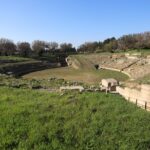
- Herdonia — the Roman town at Ordona, in the province of Foggia
- The ravines of the Taranto area — canyons with rock art and falcons, in the regional park of the Terra delle Gravine
- San Giovanni Rotondo and Padre Pio — the Gargano of faith
- The San Severo–Peschici railway — the scenic line across the Gargano
Smaller outings in the same spirit: the water parks of Puglia, the Scoparella wood and the Jazzo del Demonio, the Lama and the Grotte del Vagno, the rock-cut park of Lama d’Antico, the castle of Trani, the Zoo Safari at Fasano, and the story of Miragica, the theme park at Molfetta that has since closed.
Every town we have written about is listed by area under where to go in Puglia, with a page for each.
The hidden side of Puglia
Of all the itineraries in Puglia, the one through the world “below” is perhaps the least known: caves, rock-cut churches, underground olive mills, early Christian crypts. It runs beneath cathedrals, beneath busy towns and crowded squares, and it has stayed still and silent for centuries.
The most surprising routes start with the caves, which number in the thousands. The most spectacular are at Castellana, where winding passages open into wide halls with vaults of stalactites, shaped over the millennia by water. Hell in the Cave, a show with dancers and acrobats performing among the limestone formations, is one of the most unusual things you can see in Puglia.
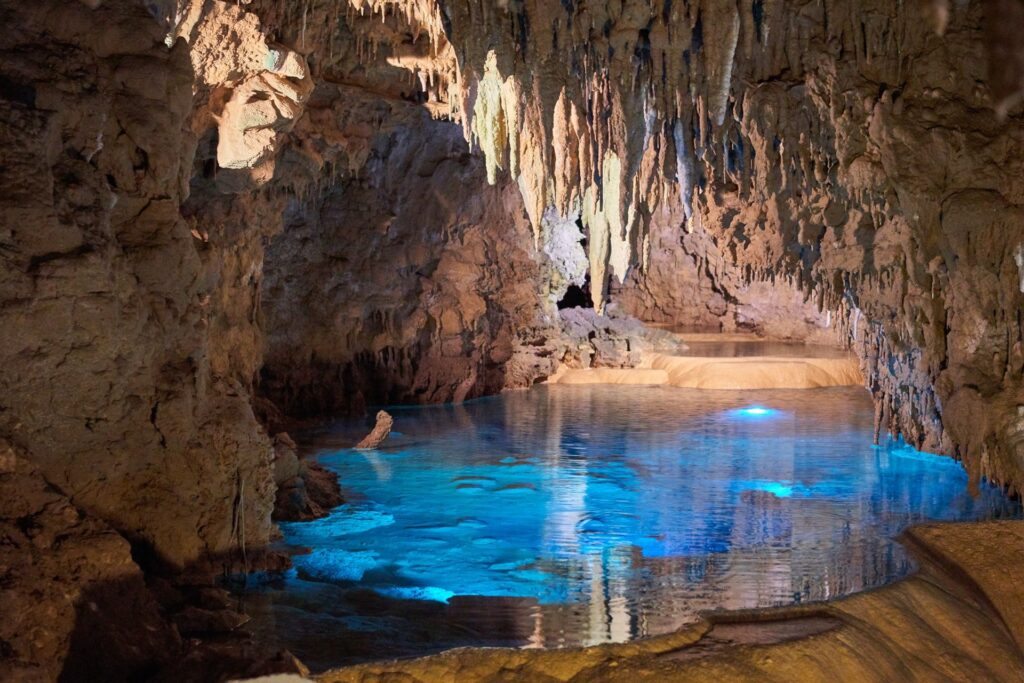
Two Puglias. The more attentive traveller wants to discover not only the Puglia of the beaches and the sea, but also the darker one, in the shade. The growing success of underground tourism says as much: mass tourism is no longer enough.
In the shade stand remarkable underground churches. Rock-cut churches cover a wide part of Puglia: those of Gravina and Massafra are among the best known. But a great many small chapels painted on the rock lie on private land, in villas or plant nurseries, looked after by owners who are often unaware that they hold works of art and history within their walls. The countryside around Monopoli is full of them.
Caves and faith: the underground routes
The caves that became places of worship, and were therefore protected by the Church, had a different fate. The clearest example is the sanctuary of Monte Sant’Angelo, whose spiritual weight is felt even by the most convinced atheist. The hushed air of the cave holds a fascinating tangle of faith and history, of legends and real pilgrimages, of saints and of emperors who came from far away to pray in this remote corner of the Gargano.
Following the example of this great holy place, many caves were dedicated to saints. One of them is the little-known Crypt of Santa Maria degli Angeli at Cassano Murge, in the province of Bari, right beneath the convent that looks over the valley from the top of a hill. In a part of the Murgia full of caves of every origin, this crypt was lived in by hermits from around the year 1000, and it still holds bones of prehistoric animals, carried into the cave by rainwater and cemented into the rock.
Much of what lies underground today was not always so. The many early Christian churches, the tombs and the ancient mosaics found beneath the crypts of the Apulian cathedrals were, for those who built them, in broad daylight. Over the centuries, metres of earth and new monuments were laid over their walls.
The cathedrals and what lies beneath them
The finest examples are the excavated areas under the cathedrals of Bari and Bitonto, each with its own underground archaeological space running through the centuries, and each with its own exceptional mosaic: the mosaic of Timothy under the cathedral of Bari, and the mosaic of the Griffin under that of Bitonto. In both, early Christian, Byzantine and early Middle Ages work merge into a single underground monument.
The journey through underground Puglia could go on and on: in Daunia, the north of the region, among tombs and burial grounds thousands of years old; in the Salento, among olive mills and farm workshops dug into the rock, where men worked for years without ever coming back to the surface. The appeal of what lies beneath Puglia is its extraordinary variety: new routes and new discoveries, well away from surface tourism.
Frequently asked questions about itineraries in Puglia
What is the most beautiful part of Puglia?
It depends on what you are looking for. If you love old towns and the baroque, the answer is the Salento, with Lecce first of all. If you want the clearest sea, head for the Adriatic coast between Otranto and Leuca. If you want nature and silence, nothing beats the Gargano. The honest answer is that every part of Puglia is “the most beautiful” for a different kind of traveller.
Which is the most beautiful coast in Puglia?
The Adriatic side of the Salento, between Otranto and Santa Maria di Leuca, has rocky shores and remarkably clear water, among the best in Italy. The Ionian side, from Gallipoli towards Leuca, is the place for sandy beaches and shallow water, ideal for families. The Gargano has the charm of variety: hidden coves, sea stacks, green water.
What are the most beautiful towns in Puglia?
Among the most visited: Alberobello, with its UNESCO-listed trulli, Ostuni, the white town, and Locorotondo and Martina Franca in the Valle d’Itria. In the Salento, Otranto, Gallipoli and Santa Maria di Leuca. Less famous but just as beautiful: Gravina in Puglia, Bovino in the Subappennino, and the villages of the interior.
Where should I go for a day trip in Puglia?
A classic that never disappoints is Castel del Monte, a UNESCO World Heritage Site less than an hour from Bari. If you are in the Salento, aim for the coast between Otranto and Leuca. From the Taranto area, Matera and Gravina in Puglia are both less than an hour and a half away.
Where can I go in one day in Puglia?
It depends on where you are staying. From Bari: Polignano a Mare, or Alberobello together with the caves of Castellana. From Lecce: a loop along the Adriatic side of the Salento through Otranto, Castro and Leuca. From Taranto: a morning among the ceramics of Grottaglie and an afternoon in the ravines.
Where should I spend a weekend in Puglia?
A weekend in Lecce with half a day at the sea on the Adriatic coast is one of the most successful combinations. Otherwise, the triangle of Ostuni, Locorotondo and Alberobello works well in every season, and best of all in spring and autumn, away from the summer peaks.
What is Polignano a Mare famous for?
For its cliffs dropping sheer into the Adriatic, for an old town perched on the rock, and for being the birthplace of Domenico Modugno, who wrote “Nel blu dipinto di blu”. It is also a regular stop of the Red Bull Cliff Diving. Discover Polignano a Mare
What is there to see in northern Puglia?
The north takes in the province of Foggia, with the Gargano, and the province of Barletta-Andria-Trani. Not to be missed: Trani with its Romanesque cathedral on the sea, Barletta with its Colossus and the Disfida, Castel del Monte, Vieste and the Tremiti islands.