In short. Vieste, Peschici, the Tremiti islands: everybody knows the postcard Gargano. But the Gargano National Park is one of the largest and most complicated territories in Italy — more than 120,000 hectares of sea, forest, upland and medieval villages. This guide takes you to five hidden places on the Gargano that will not be in the tourist office leaflet.
The Gargano is the famous spur of Italy — the promontory that pushes out into the Adriatic like a separate block, geologically distinct from the rest of Puglia, with an identity that has nothing to do with the Salento or the Murgia. It is a peninsula inside a region: its own sea, its own ancient forest, its own hill villages, its own cooking. And it holds a great many places mass tourism has not reached.
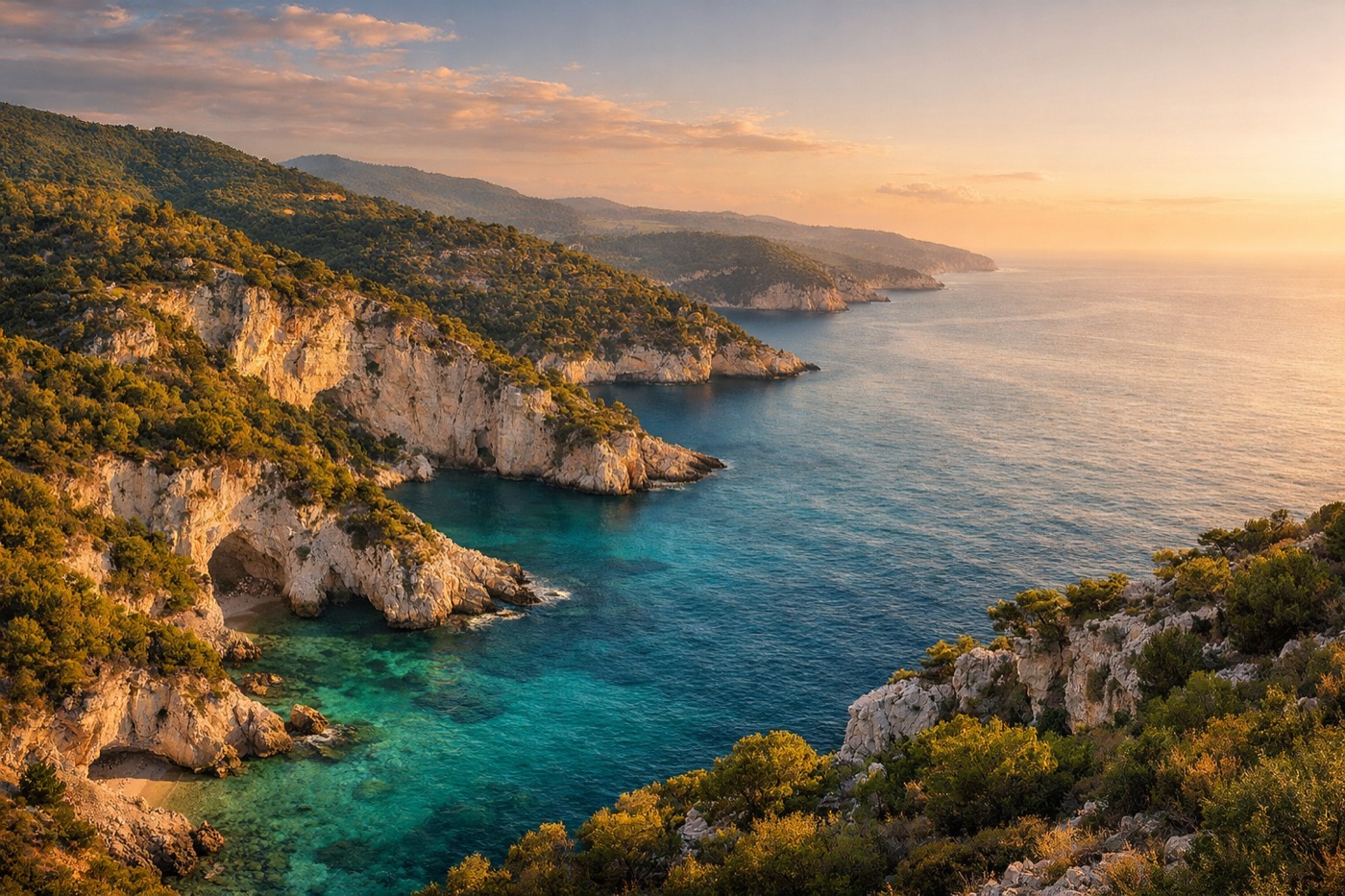
The trouble is that mass tourism has colonised three or four names — Vieste, Peschici, Tremiti — and left everything else in the shade. And the shade, in this case, is exactly where it is worth going.
In this article: five hidden places on the Gargano that rarely appear on a standard itinerary, with practical notes on how to reach them, when to go and why they are worth the journey.
1️⃣ Vico del Gargano — the medieval village that still smells real
Vico del Gargano is one of those places Apulians know and visitors miss. It is on the list of the Most Beautiful Villages of Italy, it sits a few kilometres from the Foresta Umbra, and it has one of the most intact medieval centres on the whole promontory — narrow lanes, low arches, stone houses leaning on one another, a Norman castle looking down on the village from above.
The detail that makes it unique: the Vicolo del Bacio, the alley of the kiss, a passage only fifty centimetres wide in the heart of the village, where by tradition lovers are obliged to brush against each other in order to get through. This is not marketing. It is a genuinely old lane in a village where medieval life was not reconstructed for visitors — it simply stayed.
Vico is also the town of Saint Valentine, who is its patron, and every February the old centre turns into a romantic trail of installations, events and markets. But it is in spring and in autumn, away from the organised events and the crowd, that the village is at its best.
Do not miss: the castle, with its view over the whole promontory; the church of San Giuseppe with its medieval portal; and, on the table, the paposcia vichese — a puffed, soft focaccia typical of Vico, filled with local cured meats and cheeses. You will not find it in this form anywhere else.
When to go: April to June, or September to October. In August Vico is perfectly reachable, and the coast nearby absorbs the traffic — even then the village stays quieter than any seaside resort.
2️⃣ The Foresta Umbra — not the visitor centre, the paths off the map
Plenty of people know the Foresta Umbra by name. Few really visit it. Most of those who go stop at the visitor centre, walk the main path, buy something in the shop and go back to the car. What they do not realise is that the Foresta Umbra covers more than 10,000 hectares — centuries-old beech, oak, holm oak and hornbeam — with a network of secondary paths leading to clearings that stay completely empty even in high season.
The path to the Laghetto d’Umbra, a sheet of water in the middle of the forest wrapped in a filtered light that changes with the seasons, takes under an hour on foot and is practically unknown to mass tourism. Early in the morning, or on a misty day, it is a place outside time.
The Foresta Umbra is the only beech wood at sea level in the Mediterranean — a climatic and geological anomaly that makes it an ecosystem unique in the world. Roe deer, foxes, owls, woodpeckers: the wildlife is abundant and visible, above all at dawn and at dusk on the quieter paths.
- Best time: May for the explosion of green, October for the autumn colours — both of them out of the crowd
- Getting there: from Vieste or Vico del Gargano on the inland provincial road. A car is essential; there is no regular public transport to the secondary paths
- Kit: walking boots, water, and a map downloaded for offline use — phone coverage on the inland paths is poor
- Cost: the forest is free to enter; the visitor centre charges a small fee for the indoor exhibitions
3️⃣ Manfredonia and the Daunian stelae — the archaeology nobody visits
Manfredonia is the largest town on the Gargano, and, paradoxically, the one visitors ignore most. Everybody passes through; almost nobody stops. That is a mistake.
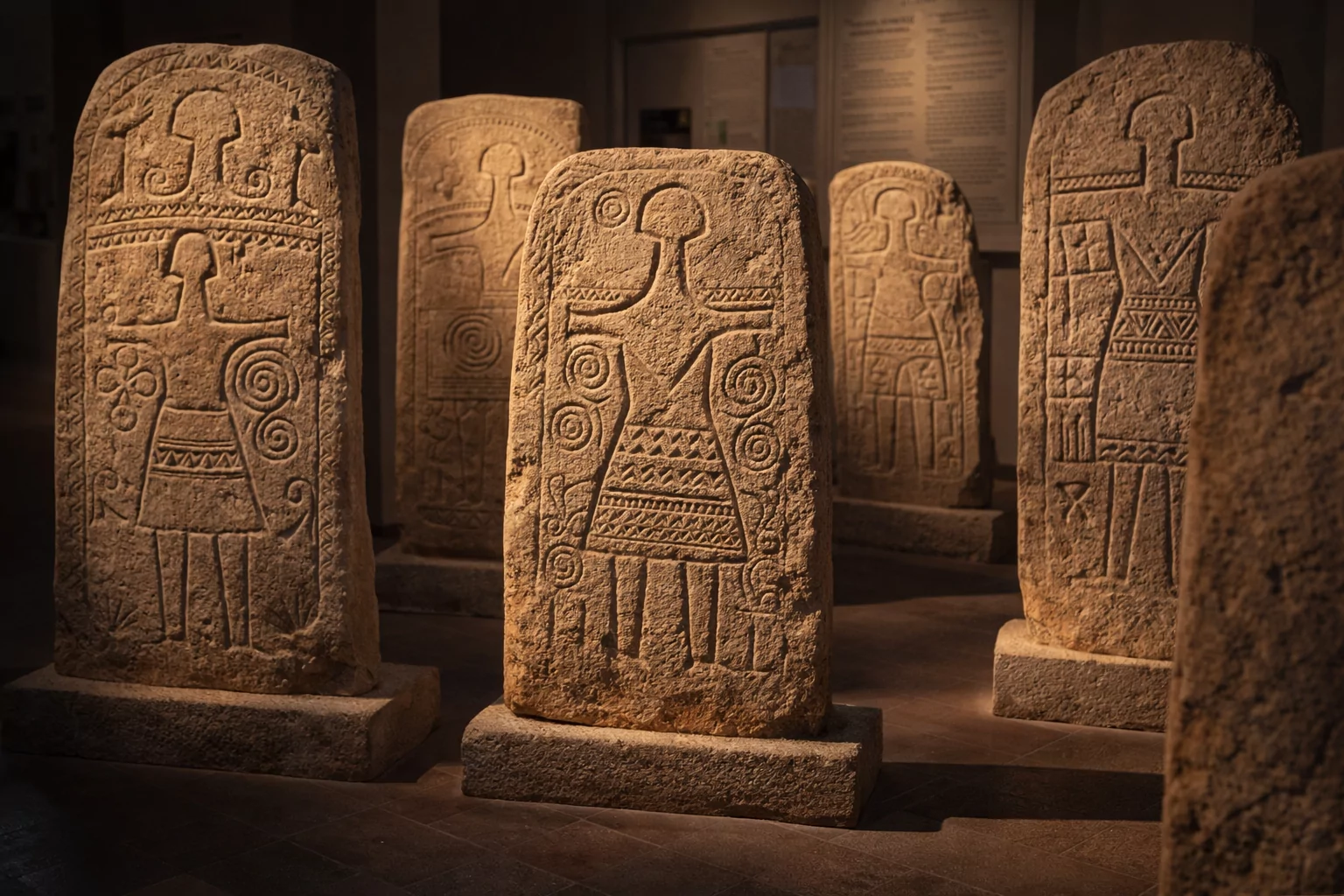
The Swabian-Angevin-Aragonese castle above the harbour houses the National Museum of the Gargano, home to one of the most underrated archaeological treasures in Italy: the Daunian stelae. These are carved stone slabs — some of them over two metres high — belonging to the Daunian civilisation, one of the pre-Roman peoples of southern Italy. They date from between the 7th and the 4th century BC and show warriors, women, hunting and battle scenes, in a stylised language that anticipates parts of modern art by centuries. They are unique in the world, and the museum is almost always empty.
Beyond the museum, Manfredonia has a broad and walkable seafront, a medieval cathedral dedicated to San Lorenzo Maiorano, and a working fishing harbour where the catch is sold early in the morning straight off the boats.
One detail worth the journey on its own: a few kilometres from Manfredonia stands the basilica of Santa Maria di Siponto — an 11th-century Romanesque church surrounded by a contemporary art installation by Edoardo Tresoldi, a wire-mesh structure that rebuilds the shape of the early Christian basilica demolished over the centuries. The effect is surreal: a ghost church, transparent, standing alongside the original medieval building. It is one of the most interesting works of contemporary art in southern Italy — and hardly anyone knows it is there.
4️⃣ The hermitage of Pulsano — where the Gargano turns mystical
If there is one place on the Gargano that belongs in the category of things hard to put into words, it is this one. The hermitages of Pulsano are a complex of monastic cells cut into the rock, sheer above the sea, in the Valle Campanile near Monte Sant’Angelo, reached by a steep path down into the gorge.
The abbey of Santa Maria di Pulsano was founded in the 6th century at the wish of Pope Gregory the Great. For centuries it was inhabited by hermits who had chosen silence and isolation as a way of life. The cells are cut directly into the rock of the cliff — some of them literally hanging over the drop, looking out at the open sea. This is not somewhere to visit distractedly.
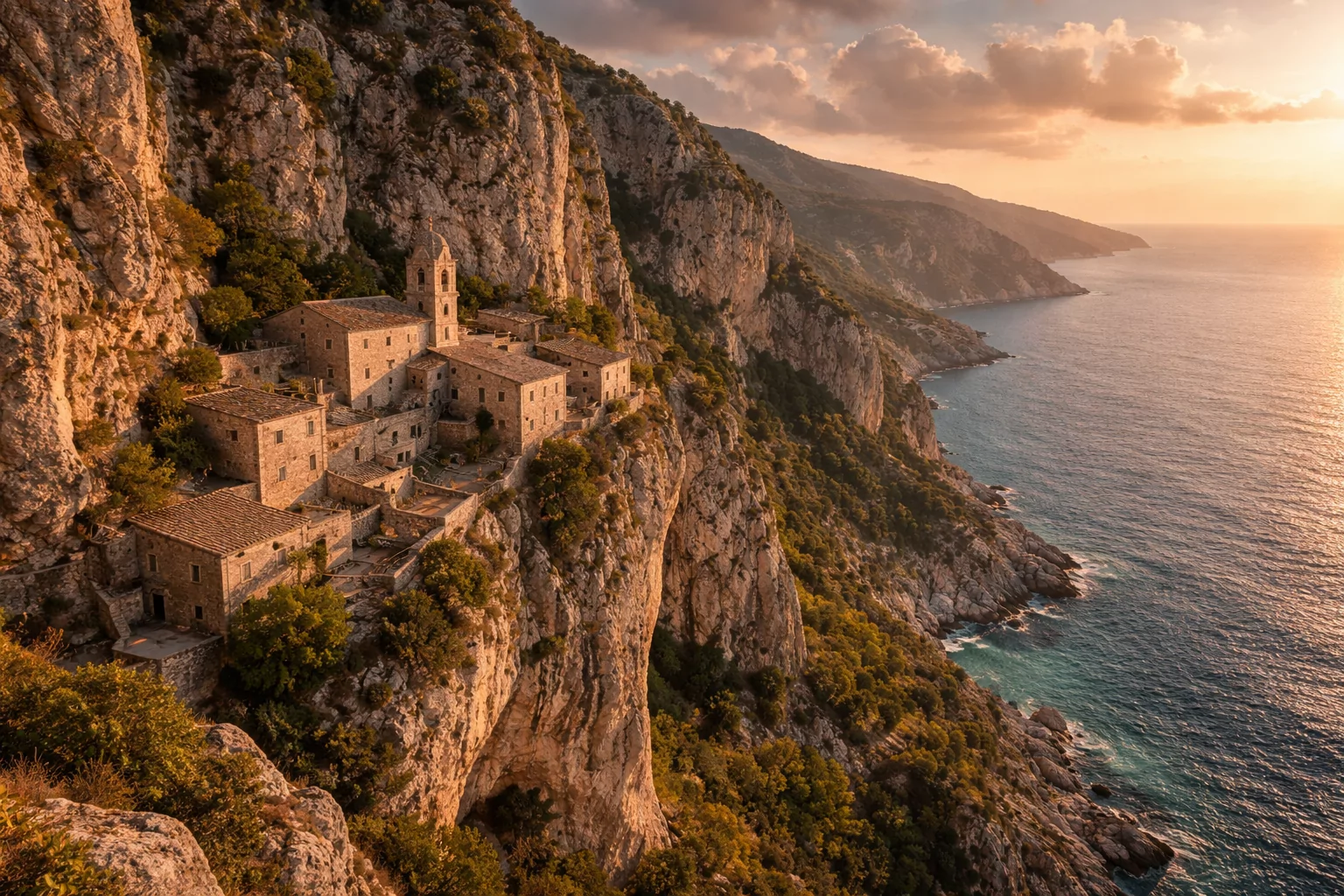
Today the complex is partly active and can be visited with a guide. The approach is demanding — around 40 minutes of descent on steep ground — but arriving is one of those moments that stay with you for years. The silence, the smell of the wood, the cells in the rock with the sea below: nothing like an ordinary tourist site.
- Getting there: from Monte Sant’Angelo, follow the signs for Valle Campanile — the last two kilometres are unsurfaced, then it is on foot
- Difficulty: moderate. The descent is steep; walking boots recommended
- When to go: spring and autumn. In summer the heat in the gorge is fierce
- Guided visit: advisable — the monks welcome visitors and tell the story of the place
5️⃣ Monte Pucci and the coast between Peschici and Vieste
Between Peschici and Vieste there is a stretch of coast you cannot see from the road. To reach it you either take a boat or walk down unsurfaced tracks towards the sea. Which is precisely why it has stayed as it is.
Monte Pucci, a few kilometres from Peschici, is a rocky headland with an archaeological site — ancient necropolises and traces of prehistoric settlement — and a view along the Gargano coast that runs for kilometres in both directions. The paths are waymarked but little used: you walk through Mediterranean scrub smelling of mastic and wild rosemary, with the sea below changing colour with the seabed.
The bay of Vignanotica — reachable only from the water or by an unsurfaced path of about three kilometres — is one of the most spectacular beaches on the Gargano: a very high white cliff, deep blue water, no beach club, no bar. People who get there bring something to eat and stay for hours. In August it is not deserted, but it is still a different world from the beaches you can park at.
The most useful piece of advice for this part of the Gargano: hire a boat. Even for half a day. The Gargano coast seen from the sea — the caves, the white cliffs, the bays with no land access — is one of the finest things in Puglia. It costs less than you would think, especially out of season, and it gives you a view you cannot get from the shore.
🗓️ When to go: out of season it is a different place
This holds for the whole Gargano, and for these five places in particular: the best season is not summer. May, June, September and October give you a completely different territory — paths walkable without the heat, villages that are liveable, a sea still or already warm enough to swim in, and prices halved.
hectares of the Gargano National Park — the largest national park in Puglia
hectares of the Foresta Umbra — the only beech wood at sea level in the Mediterranean
foundation of the abbey of Pulsano — over 1,400 years of monastic history
the period of the Daunian stelae of Manfredonia — a pre-Roman civilisation unique in the world
The Gargano is not a destination to be consumed in a weekend in August. It is a territory to explore slowly — on foot, by boat, without hurrying. These five places are not in anyone’s top ten for a precise reason: they have not yet been discovered enough to be spoiled. Which, for anyone going now, is exactly the point.
Planning a trip to the Gargano? Take the flavours of the place home with you. Olive oil, hand-made pasta, preserves and typical Apulian produce, shipped from Puglia: see the shop.
The rest of the promontory, town by town, is in our guide to the Gargano: Vieste, Peschici, Monte Sant’Angelo and the Tremiti islands. And from the water, the sea caves of Vieste.
The Gargano National Park was created in 1991 and takes in 18 municipalities in the province of Foggia, including the Foresta Umbra, the Tremiti islands and the lakes of Lesina and Varano. Edoardo Tresoldi’s installation at the basilica of Santa Maria di Siponto was unveiled in 2016 and can be visited free of charge.