In short. Santa Maria di Leuca is the southern tip of the Salento and of Puglia — the point where the Adriatic and the Ionian meet. Medieval pilgrims stopped here before crossing to the Holy Land. There is a sanctuary on the headland, a monumental waterfall running into the sea, sea caves reachable only by boat, and a seafront lined with Liberty villas. You can see it in a day; it stays with you longer.
The land ends here. De Finibus Terrae — “at the ends of the earth” — is what this southern spur of Puglia was called, and standing on the headland with two seas on either side, the name needs no explaining.
The end of the land
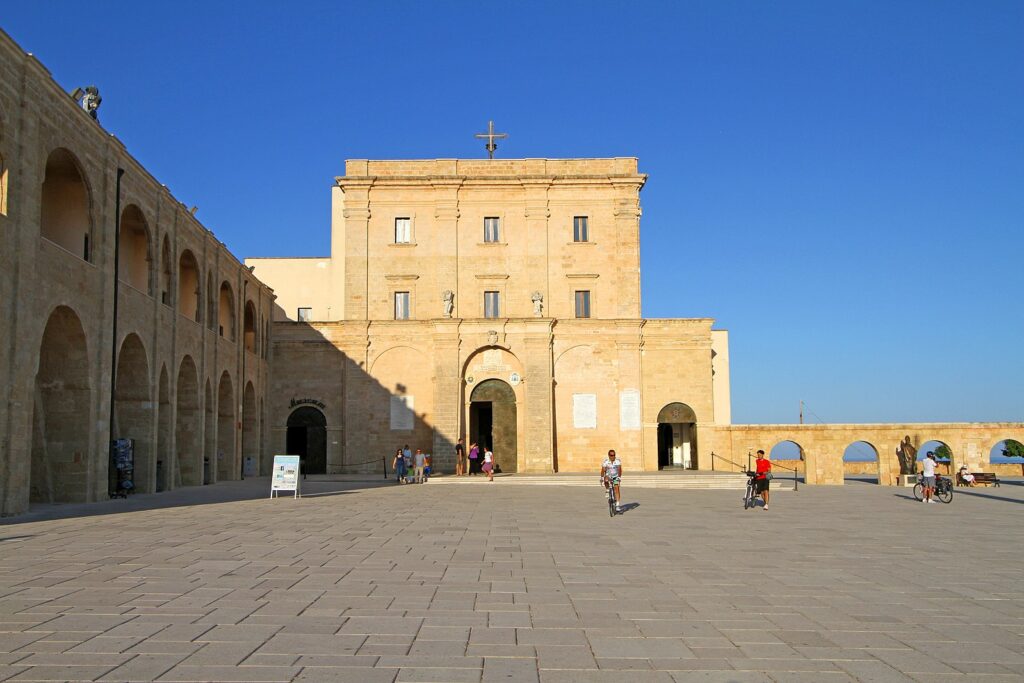
At Capo di Leuca the promontory looks out over the Adriatic on one side and the Ionian on the other at the same time. For centuries this was a compulsory stop for pilgrims travelling from Europe towards Jerusalem — a place of passage for peoples and civilisations, with a great deal of history compressed into a few kilometres of coast.
The sanctuary stands on the spot where tradition holds the apostle Peter had the first Christian church in southern Italy built, over the ruins of a pagan temple to Minerva. It is still a place of pilgrimage, above all for the feast of the Madonna on 15 August — and the local traditions around it are not folklore staged for visitors but rites the community has kept going for centuries. If you can plan the visit for August, you see Leuca as something other than a seaside stop.
Its other name says what the place has always been: Madonna delle Frontiere, Our Lady of the Frontiers. Inside hangs a painting of the Madonna de Finibus Terrae, by a pupil of Titian.
The storm of 365, and why the church looks like a house
Devotion here intensified after an event dated to 13 April 365: a violent storm struck the coast and put the local fishing boats in danger. By tradition, prayers to the Madonna calmed it and saved many lives — and from then on the sanctuary was a refuge in the literal sense as well as the spiritual one.
Why it does not look like a church. For centuries Turkish and Saracen raiders sacked it: standing on the headland, visible from the sea and easy to identify, it was an obvious target. In 1720 it was rebuilt deliberately to look like a fortified private house with a watchtower, so as to disappear into the landscape. The disguise worked — and it is why the building you see today reads as a palazzo rather than a sanctuary.
The caves and the waterfall
The sea caves of Leuca are reachable almost only from the water. The Grotta del Diavolo and the Grotta Porcinara are the most striking on this stretch of coast — the second was already in use as a place of worship in antiquity, with evidence going back to the Messapians. Boats leave from the harbour and the trip normally takes an hour or two.
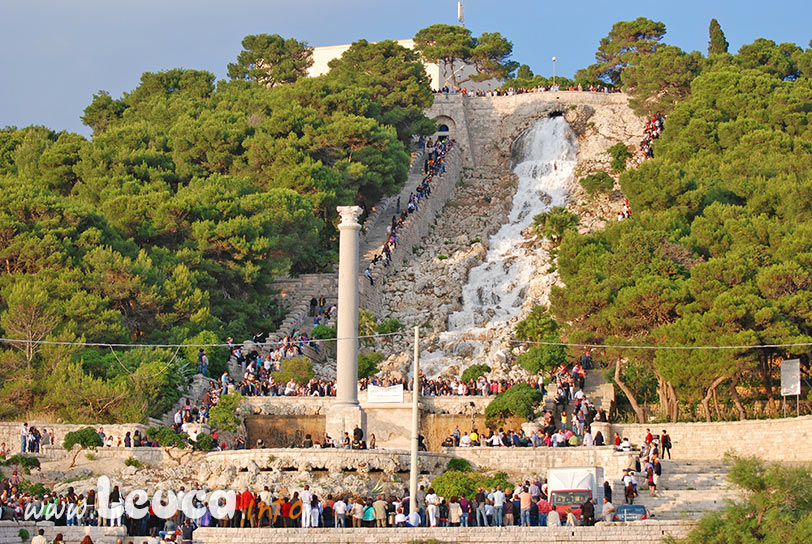
From the harbour you also see the waterfall: a monumental artificial cascade built to let the Apulian aqueduct discharge into the sea, dropping several metres straight down the cliff. In the evening, lit, it becomes the thing everyone on the promenade is looking at.
The villas and the harbour
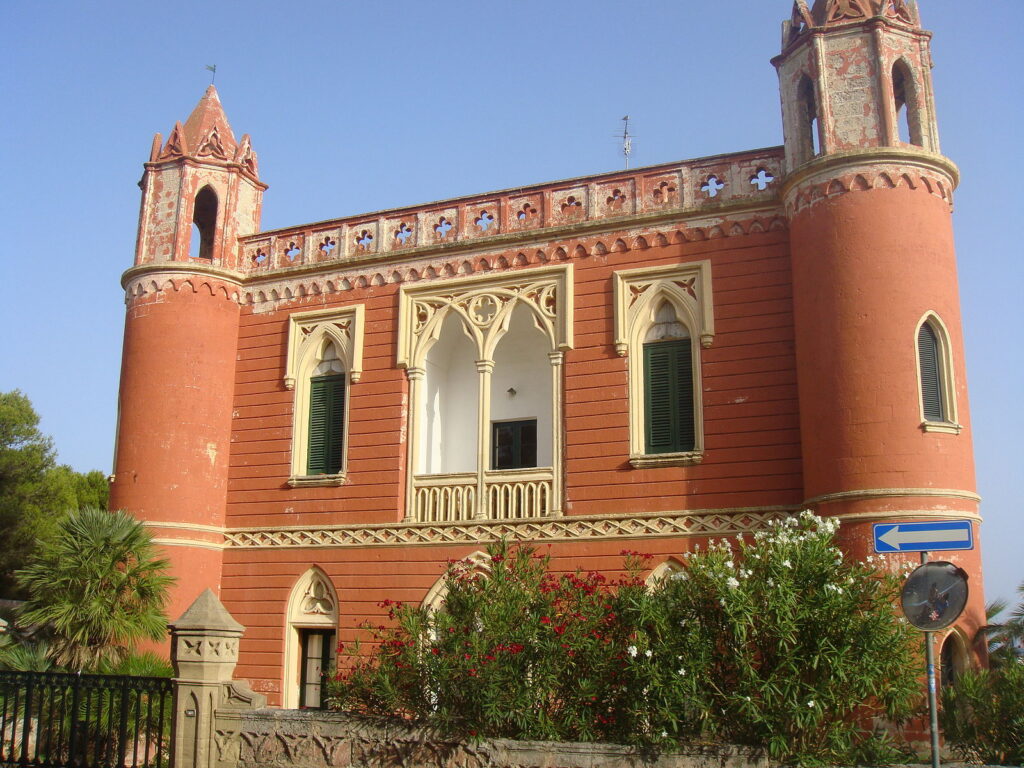
The seafront is lined with Liberty villas from the end of the nineteenth century and the beginning of the twentieth, built as summer houses by aristocratic families from Puglia and Naples. Most are still private, but the walk along the harbour gives you the whole sequence, one after another — an open-air gallery of a very particular moment in Italian architecture.
The lighthouse. The lighthouse of Leuca stands above everything else on the headland. It is one of the most powerful in the Mediterranean and its beam carries for tens of miles out to sea. Climbing to the base is enough on its own for a different view of the whole promontory — the interior is not always open to visitors, so check before you count on it.
Il Ciolo, and what is nearby
A few kilometres from Leuca is Il Ciolo, one of the most spectacular inlets in the Salento: a narrow, deep canyon opening onto the sea, with white limestone walls falling to turquoise water. You drive to it and walk down. In summer it is crowded; in spring and autumn it is almost empty, which is when to go.
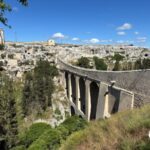
How to swim there, the steps down to the little beach and the caves nearby: see our page on the Ponte del Ciolo.
In the same area, Tricase is worth a stop for its old town and its ducal palace. Anyone arriving from the north passes close to Otranto, which is worth the journey on its own.
Practical
- Distances — about 70 km from Lecce and about 50 km from Gallipoli. The nearest airport is Brindisi, roughly 130 km away.
- By car — the easiest way. The roads off the Lecce–Leuca trunk road are well signed, and the final stretch along the Ionian coast is worth stopping for.
- Without a car — train as far as Lecce, then bus or a seasonal shuttle.
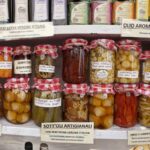
Taking the Salento home. Extra virgin olive oil, taralli, preserves and other things made here, shipped directly from Puglia: see the shop.
Santa Maria di Leuca is the southern point of the Salento — and of Puglia. From Lecce it is a straight run south, and there is nothing beyond it but sea.