In short. In a handful of villages south of Lecce people still speak griko — a form of Greek that has evolved in isolation for over two thousand years. UNESCO lists it as endangered. Fluent speakers are now a few hundred, almost all elderly.
Anyone hearing griko for the first time thinks they are hearing Greek. Native speakers of modern Greek struggle to follow it — because it is not a variant of contemporary Greek at all.
🇬🇷 What griko actually is
It is written in Latin characters. In vocabulary and syntax it shows strong affinities with modern Greek, but also with the dialect of Lecce and with Latin. It has kept archaic structures that disappeared elsewhere, and absorbed Latin, Messapian and Romance elements along the way.
In other words: it is not Greek brought here recently. It is Greek that stayed, and kept going on its own.
🏛️ Why it is here
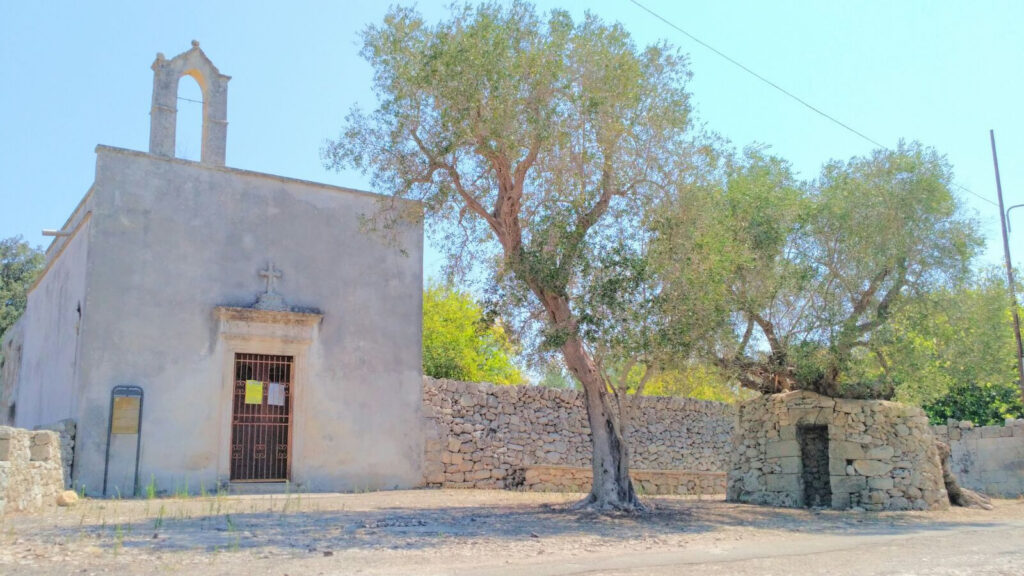
The Grecìa Salentina is what remains of the very ancient Greek presence in this corner of Italy — the world of Magna Graecia, when Greek settlers moved well beyond their own coasts, and of the Byzantine centuries that followed. When the Byzantines took control they repopulated the Salento with Greek-speaking, Greek-rite communities, and the language outlived both empires.
The monks who brought the rite. The Greek rite arrived with the Basilian monks — followers of Saint Basil — who came to the Salento in two waves: fleeing the Muslim expansion in Syria and North Africa, and fleeing the iconoclasm decreed by Leo III. They lived in rock-cut caves, partly by habit and partly because they were being hunted. The crypts they left are still there, under the fields.
The nine towns where griko is spoken. Calimera, Castrignano dei Greci, Corigliano d’Otranto, Martano, Martignano, Melpignano, Soleto, Sternatia and Zollino. Three more — Cutrofiano, Carpignano Salentino and Sogliano Cavour — share the culture without speaking the language. Melpignano is where the Notte della Taranta ends every August: the festival was started in 1998 by the union of these same towns, which is not a coincidence — it was a way of putting a minority culture back on the map.
What is being lost. Every year the language loses something that cannot be recovered — a turn of phrase, a song, a way of naming a tool that had no other name. There are recordings and courses, and there is genuine local effort. But a language kept alive by a few hundred people over eighty is a language in trouble.
More on how people speak here: the dialects of Puglia.