Until a few decades ago, in many homes in Puglia the pig raised all year round became, in a few winter days, the family larder: sausages, soppressata, lard, hams and capocollo. The right time was the cold, between Christmas and February; the saint to look to was Saint Anthony the Abbot; and there was only one rule: waste nothing. This is how it went, and what is left of it today, from the capocollo of Martina Franca, newly a PGI, to the traditional cured meats of the region.
It started in the dark. The relatives arrived, the aunts with their aprons already tied, the men with their sleeves rolled up, and the kitchen filled with steam and voices. The children were sent to play well away from the yard and came back only when, on the long table, the meat had already become a filling, and the air smelled of pepper and wild fennel. By evening the sausages hung from canes above the fireplace, like garlands.
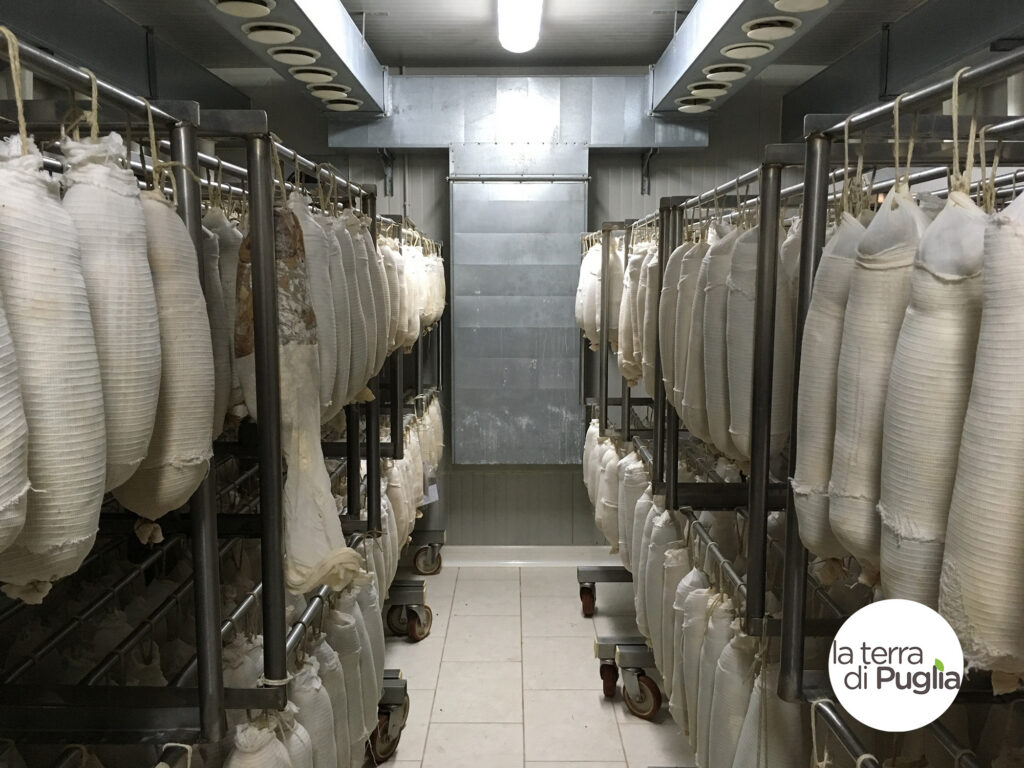
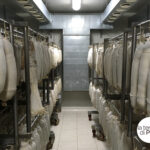
Capocollo from Martina Franca hanging to cure.
The right time was the cold
In the Daunia, the north of Puglia around Foggia, the «Terra Mia» Foundation of San Severo, which in 2018 held the fourteenth festival of the Daunian black pig, explains that the season ran from Christmas to the first ten days of February, the coldest time of the year, with the «blackbird days» at the end of January. On the Gargano, in the Daunian Mountains and in the upper Tavoliere plain, the whole family turned out for the pig raised with care in the stable next to the house or out in the country, because the cold was thought to be the best condition for the work.
The farming calendar also had a symbolic date: 17 January, the feast of Saint Anthony the Abbot, protector of animals. Pietro Sisto, writing in the Gazzetta del Mezzogiorno, the Bari daily, describes it as the day of the pig ritual, «the symbol of a civilisation that could not afford the luxury of wasting anything», and as the opening of Carnival. The saint is shown with a pig beside him: the monks of Saint Anthony had the privilege of raising pigs that roamed freely, a bell around their necks, fed by the townspeople with leftovers. In the old town of Bari people played the lottery numbers of the day: 4 the pig, 17 the saint, 81 the bell. And in Rutigliano the Carnival season opened with terracotta whistles, among them Saint Anthony with his pig.
The whole town’s pig
In Muro Leccese, in the Salento, according to a folk tale reported by the local press, for the feast of the doctor saints, Cosmas and Damian, a piglet was raised that wandered freely through the streets and grew up at everyone’s expense. On the appointed day it was cooked in huge copper pots, and every resident had the right to a little of that boiled meat, as an act of devotion. The custom is gone, but the festival of «Lu porcu meu» («my pig») remains, in October, along with the teasing nickname of the people of Muro.
Nothing was thrown away
In the Daunia even the bristles were kept, and the intestines became the casings for the sausages; the offal went into humble sausages such as polmonata or fegatazzo. In Faeto, in the Daunian Mountains, where the pig was «the emblem of a family’s wealth», the bristles were mixed with pitch to make shoelaces. In Gravina in Puglia the less prized cuts, tongue, cheek, rind, ended up in pzzntell, a sausage that is now listed among the traditional products of Puglia.
What was made in those days
Every area had its own cured meats, many of them now listed as traditional products of Puglia. On the Alta Murgia, the high plateau inland from Bari, in Gravina and Spinazzola, there is the «knife point» sausage: ham and shoulder cut by hand, with cubes of lard, wild fennel seeds, chilli, the diavolicchio («little devil»), and white wine from Malvasia grapes grown in Gravina; the coils are divided into links called ferse with string and pricked with the cuscedd, a large needle. In the Daunian Mountains, sausages and soppressata, once dried, are kept in jars under lard or under oil.
In Faeto the lard was hung from a wooden hook: each farmer searched his own patch of the town woods for an elm branch shaped like a hook, softened it over the fire, stripped off the bark and shaped it by hand. As far back as 1440, according to a history of the village published in 1934, the lard of Faeto was a prized gift to be offered at Christmas to the dukes of Airola, the feudal lords.
Capocollo of Martina Franca, now a PGI
Capocollo is a cured meat made from the muscles of the upper part of the pig’s neck, a cousin of coppa; in the dialect of Martina Franca it is called chépecùdde. A local history essay quoted in the PGI application finds it recorded as early as an expense note drawn up in Alberobello on 30 May 1797. What sets it apart is the mire cutte, a bath made of half wine and half cooked grape must from the Verdeca and Bianco d’Alessano varieties, and the smoke from the wood and dry leaves of the fragno, a local oak of the area: Martina Franca, Cisternino and Locorotondo, above 350 metres, in the Valle d’Itria. With Commission Implementing Regulation 2026/2293, published on 15 October 2026 in the Official Journal of the EU, the capocollo of Martina Franca became a PGI, a Protected Geographical Indication, and it now appears in our list of PDO and PGI products of Puglia. Alongside it, again from Martina, come soppressata and pancetta, smoked with fragno bark and almond husks.
To go further. For a board of Apulian cured meats, the shop has capocollo from Martina Franca.
How this article was written. Customs, names and cured meats come from written sources: the «Terra Mia» Foundation, the Gazzetta del Mezzogiorno, the local press of the Salento, the sheets on the traditional products of Puglia and the EU documents on the PGI. The opening scene, with the family at dawn, the children sent off to play and the sausages hanging above the fireplace, comes from oral memory and is told as such. If your family had a different custom, write to us.