In short. A carrot that is purple, yellow, red, orange or nearly white, grown on 10 to 20 hectares of sand at Polignano a Mare and watered from wells that reach brackish water. It is a Slow Food presidium, it survived because a handful of growers kept saving the seed, and it tastes closer to fruit than to a supermarket carrot.
The first time a Slow Food coordinator was given one to taste, he said it was like eating an apple. That is not sales talk — it is the standard reaction of anyone trying it for the first time, and almost nobody outside Polignano ever has.
🥕 A carrot that never learned to be orange
Supermarket carrots are all orange because somebody, over the centuries, selected and standardised that colour. This one was never put through the process. The growers of San Vito — the hamlet of Polignano where almost all of it is grown — pick their seed plants every year for health and vigour, without looking at the colour.
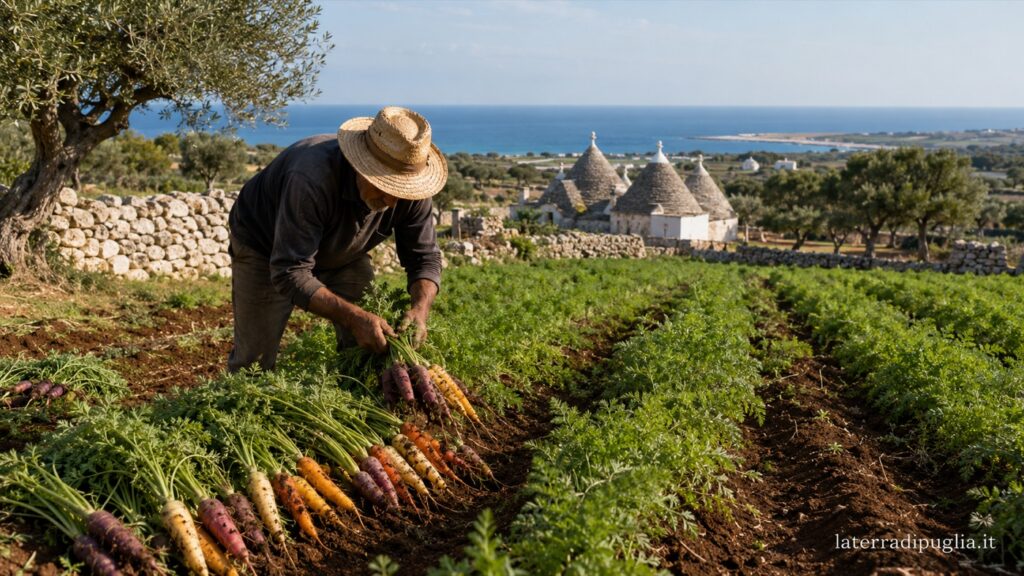
What comes out is a range you will not see anywhere else: pale yellow, deep yellow, orange, red, dark purple, almost white — sometimes all six in the same crate. Its official name is the yellow-purple carrot of Polignano, or carrot of San Vito; in dialect it is bastinaca.
🌊 Sand, and wells that taste of the sea
The flavour has a precise cause. The fields of San Vito are sandy and sit almost on the Adriatic, and the irrigation water comes from old stone wells 10 to 20 metres deep — deep enough to meet the first seepage from the sea. The water is not fresh: it is brackish, and that salinity, filtered through sand, goes into the root and changes everything.
What the numbers say. Compared with common carrots, it carries about 3.5 times the carotenes — and the purple ones up to four times the antioxidants — with 22% less sugar, in a form with a very low glycemic index. It tastes sweeter and contains less sugar, which is not a contradiction: it is what the salinity does to the balance of the root.
🌱 Sown in August, dug by hand
It is a winter vegetable, not a summer one. Sowing is staggered through August and September; harvesting starts in November and runs to April or May. There is no machinery: an irregular root in sandy ground cannot be lifted mechanically. A fork goes into the soil, levers it open, and the carrot comes out by hand — slowly, so it does not snap.
How to eat it. Raw, in pinzimonio — dipped in good olive oil with salt — which is how they serve it in Polignano and the only way to taste the difference between the colours.
The town itself: Polignano a Mare.