Puglia has 63 PDO and PGI names: 25 food products (14 PDO and 11 PGI) and 38 wines. The latest arrived in 2026: Zampina di Sammichele di Bari PGI in June, Capocollo di Martina Franca PGI on 15 October and Oliva Alta Daunia PDO on 22 October. Here is the full list, product by product, with the area of each and what the labels mean.
A PDO or PGI is not a courtesy label: it is a name protected by the European Union, which only producers inside a defined area who follow a set of rules may use. In Puglia these names map the region better than any atlas: the olive oils of the five growing areas, the cheeses of the Daunia and the Murgia, the citrus of the Gargano, the bread of Altamura. Here they are, up to date at the end of October 2026.
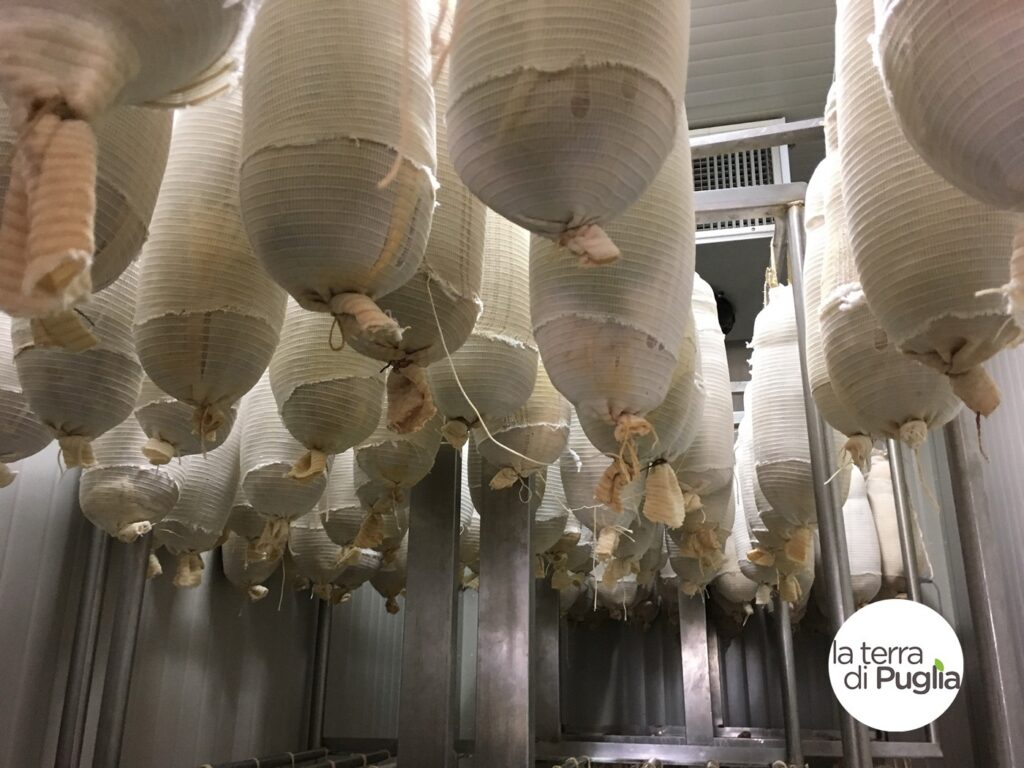
Capocolli curing: Capocollo di Martina Franca has been a PGI since 15 October 2026.
PDO, PGI and TSG: what the labels mean
The rules are set by EU Regulation 2024/1143, in force since 13 May 2024. In Italian, PDO is DOP and PGI is IGP.
- PDO, Protected Designation of Origin: the product owes its character essentially to its area of origin, with its natural and human factors, and every stage of production takes place inside the area.
- PGI, Protected Geographical Indication: the quality, characteristics or reputation of the product are linked to its place of origin, and at least one stage of production takes place there.
- TSG, Traditional Speciality Guaranteed: it protects a traditional recipe or method, in use for at least thirty years, with no link to any area.
In one line: a PDO keeps everything in the area, a PGI at least one stage, and a TSG protects a recipe rather than a place. For wine, the Italian labels sit inside the European ones: DOCG and DOC are PDOs, and IGT wines are PGIs.
Cheeses
- Canestrato Pugliese PDO (1996): the whole province of Foggia and some neighbouring towns in the province of Bari.
- Caciocavallo Silano PDO (1996): shared with Calabria, Campania, Molise and Basilicata. In Puglia it covers towns of the Gargano and the Subappennino Dauno, the Murgia and the north of the province of Brindisi. See our page on caciocavallo.
- Mozzarella di Bufala Campana PDO (1996): shared with other regions. In Puglia, since 2007, part of the province of Foggia, including Manfredonia, Lesina and Poggio Imperiale.
- Ricotta di Bufala Campana PDO (2010): shared with other regions. In Puglia, the plain and hills of the province of Foggia at the foot of the Gargano.
- Mozzarella di Gioia del Colle PDO (2020): 16 towns in the province of Bari, 6 in the province of Taranto and part of the town of Matera.
- Burrata di Andria PGI (2016): the whole of Puglia. See our page on Apulian burrata.
Extra virgin olive oils
Five PDOs trace the olive-growing areas of the region, and since 2019 a PGI covers them all. The differences are explained on our page about the olive oil production areas.
- Collina di Brindisi PDO (1996): Carovigno, Ceglie Messapica, Cisternino, Fasano, Ostuni, San Michele Salentino, San Vito dei Normanni, Villa Castelli.
- Dauno PDO (1997): the province of Foggia.
- Terra di Bari PDO (1997): towns in the province of Bari.
- Terra d’Otranto PDO (1998): the whole province of Lecce, the province of Taranto except the Terre Tarentine towns, and twelve towns in the province of Brindisi.
- Terre Tarentine PDO (2004): part of Taranto and twelve towns of the province, from Ginosa to Martina Franca.
- Olio di Puglia PGI (2019): the whole region.
Table olives
- La Bella della Daunia PDO (2000): Cerignola, Orta Nova, San Ferdinando di Puglia, Stornara, Stornarella, Trinitapoli. This is the bella di Cerignola.
- Oliva Alta Daunia PDO (22 October 2026): whole Peranzana olives in brine from San Paolo di Civitate, Apricena, Torremaggiore, San Severo and Lucera.
Fruit and vegetables
- Arancia del Gargano PGI (2007) and Limone Femminello del Gargano PGI (2007): oranges and lemons from Vico del Gargano, Ischitella and Rodi Garganico.
- Clementine del Golfo di Taranto PGI (2003): Palagiano, Massafra, Ginosa, Castellaneta, Palagianello, Taranto, Statte.
- Carciofo Brindisino PGI (2011): artichokes from Brindisi, Cellino San Marco, Mesagne, San Donaci, San Pietro Vernotico, Torchiarolo, San Vito dei Normanni and Carovigno.
- Uva di Puglia PGI (2012): table grapes from towns in the six provinces lying below 330 metres.
- Patata novella di Galatina PDO (2015): new potatoes from 19 towns in the province of Lecce, including Galatina, Gallipoli, Nardò, Ugento and Taviano.
- Cipolla bianca di Margherita PGI (2015): white onions from the coastal strip of Margherita di Savoia, Zapponeta and Manfredonia.
Pulses, bread and cured meats
- Lenticchia di Altamura PGI (2017): shared with Basilicata. Altamura and other Murgia towns, from Gravina to Santeramo, plus towns in Basilicata such as Matera.
- Pane di Altamura PDO (2003): Altamura, Gravina in Puglia, Poggiorsini, Spinazzola, Minervino Murge. More on our page about bread and wheat in Puglia.
- Capocollo di Martina Franca PGI (15 October 2026): Martina Franca, Cisternino and Locorotondo, above 350 metres. See our page on capocollo di Martina Franca.
- Zampina di Sammichele di Bari PGI (June 2026): the fresh sausage of the town of Sammichele di Bari alone.
Wines: 32 PDO and 6 PGI
In the EU register Puglia’s wines make up 38 names. Four PDOs carry the Italian DOCG label: Primitivo di Manduria Dolce Naturale, Castel del Monte Bombino Nero, Castel del Monte Nero di Troia Riserva, Castel del Monte Rosso Riserva.
The other 28 PDOs are DOC wines: Aleatico di Puglia, Alezio, Barletta, Brindisi, Cacc’e mmitte di Lucera, Castel del Monte, Colline Joniche Tarantine, Copertino, Galatina, Gioia del Colle, Gravina, Leverano, Lizzano, Locorotondo, Martina, Matino, Moscato di Trani, Nardò, Negroamaro di Terra d’Otranto, Orta Nova, Ostuni, Primitivo di Manduria, Rosso di Cerignola, Salice Salentino, San Severo, Squinzano, Tavoliere delle Puglie, Terra d’Otranto.
The 6 PGIs are IGT wines: Daunia, Murgia, Puglia, Salento, Tarantino, Valle d’Itria. Read more in our section on the wines of Puglia.
Applications in progress
Two Apulian names are waiting. Cicoria puntarelle molfettese has applied for PGI status: the application was published in the Official Journal of the EU on 20 July 2026 and covers Bisceglie, Bitonto, Giovinazzo, Molfetta, Terlizzi and Ruvo di Puglia. Oliva dolce di Bitetto applied for PDO status at the start of 2026.
Beyond PDO and PGI. Puglia also has a regional quality mark, «Prodotti di Qualità», for products certified under its regional quality scheme, and 414 traditional food products (PAT) on the Italian Ministry of Agriculture’s list, from cartellate to taralli, from orecchiette to pasticciotto. Each region identifies its PAT products, and the ministry gathers them into a national list updated every year.
A list that keeps changing. In 2026 Puglia gained three new names. This page is up to date as of 31 October 2026, based on the EU register of geographical indications, eAmbrosia. More local specialities are on our page of typical products of Puglia.
Frequently asked questions
How many PDO and PGI products does Puglia have? 63 names: 25 food products, that is 14 PDO and 11 PGI, and 38 wines, that is 32 PDO and 6 PGI.
What is the difference between PDO and PGI? With a PDO every stage of production takes place in the area of origin. With a PGI one stage is enough, and the link with the place can also be its reputation.
Which are the newest PDO and PGI products from Puglia? Three from 2026: Zampina di Sammichele di Bari PGI, Capocollo di Martina Franca PGI and Oliva Alta Daunia PDO.
What is a TSG? A Traditional Speciality Guaranteed: it protects a traditional recipe or method, in use for at least thirty years, wherever it is made, with no link to a particular area.