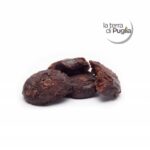
Capocollo di Martina Franca is the most prized cured meat of Puglia. It is cut from the upper part of the pork neck, marinated in vincotto, smoked over the bark of the local oak and then aged for at least three to four months in the cool, dry air of the Valle d’Itria. It is a Slow Food Presidium.
There is one place in Puglia where cured meat ages well, and it is Martina Franca. Cool air, ancient oaks and families who have worked pork for generations: capocollo from Martina is not just a salume, it is the product of a microclimate that the rest of the region, too hot and too humid, has never been able to copy.
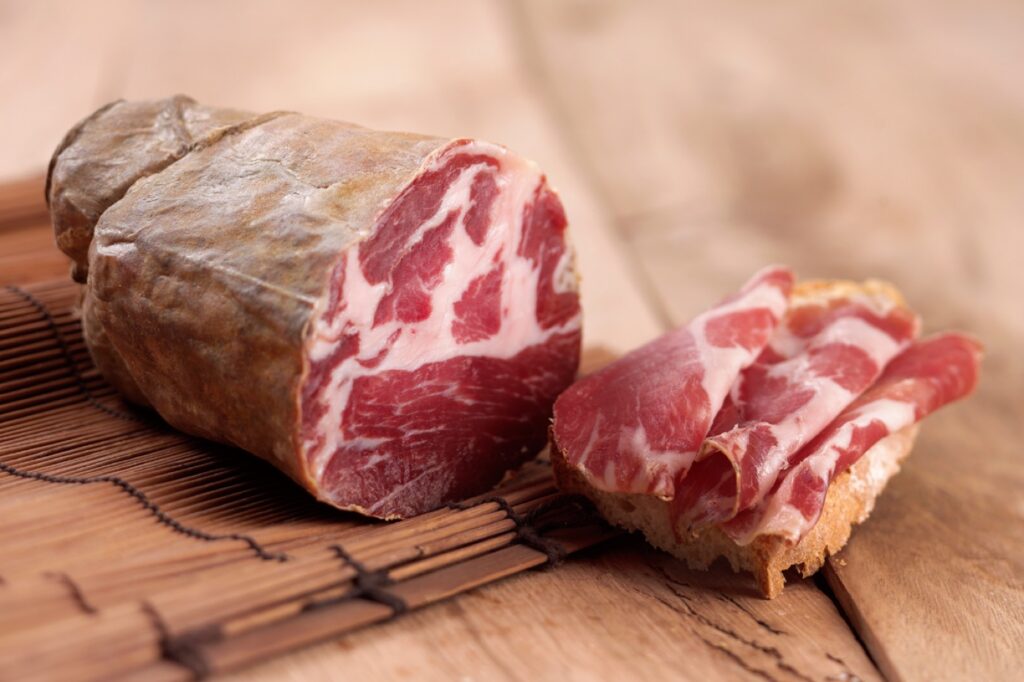
What capocollo is
Capocollo is the top of the pork neck, the cut that northern Italy calls coppa and central Italy lonza. In Martina Franca it becomes something different from either, because of what happens to it after it is cut: a wine marinade, a slow smoke over oak bark and a long rest in rooms built of local stone. Locals often call it simply capocollo martinese, “the capocollo from Martina”.
The ingredients are few and precise: local pork, coarse salt, pepper, herbs and spices from the Martina Franca area and vincotto, the dark syrup that Puglia cooks down from grapes or figs. The vincotto is not optional: it is what gives this capocollo its character.
How it is made, in six stages
- Trimming and seasoning: the piece of pork is trimmed into a cylinder, rubbed with dry spices and salted.
- Curing: it marinates in vincotto with herbs of the Murgia, the limestone plateau behind the town.
- Casing: it is stuffed into a natural casing.
- Drying: it rests slowly for two weeks in well-ventilated stone rooms.
- Smoking: over oak bark and aromatic plants of the Mediterranean scrub.
- Ageing: at least three to four months in ventilated rooms kept at 13 to 15 °C.
The oaks that make the capocollo. The oaks of the Valle d’Itria are a remnant of the last ice age, trees that have survived thousands of years. Their bark, burned together with other plants of the Mediterranean scrub, gives the capocollo its unmistakable smoky aroma. And the pigs raised in the area were fed on the acorns of those same trees. A closed circle, entirely local, entirely from Martina.
Why only here
In most of Puglia the damp climate and mild temperatures make ageing cured meats difficult. Only around Martina Franca do the microclimatic and biological conditions exist that a product like this needs. Historically, pigs raised all over Puglia were brought to Martina Franca to be slaughtered and cured: local know-how and the cool, breezy, dry climate did the rest. Since the days of the Kingdom of Naples, the cured meats of Martina Franca have been sought after well beyond the region, and the capocollo carries the scent of the oak woods of the Valle d’Itria.
Besides Martina Franca, capocollo is also produced in the neighbouring towns of Locorotondo and Cisternino. They are worth the trip for more than the food: this is the countryside of trulli and oak trees.
Slow Food Presidium and the Consortium. Capocollo di Martina Franca is a Slow Food Presidium, with strict production rules. The producers are grouped in a Consortium that protects the product, keeps the butchering tradition alive and promotes it in Italy and abroad.
Where to buy it
We work only with producers who use traditional methods and who raise local pigs in the open, with respect for both tradition and animal welfare. Buying online gives access to a wider choice of producers than a single shop can offer, and the capocollo travels to your door. You can find it in our shop: Capocollo from Martina Franca.
For a shorter introduction and serving ideas, read our article on the capocollo of Martina Franca, or browse the rest of Apulian food.