In winter the Murgia, the high plateau of inland Puglia, is best explored from its towns: in Altamura the three museums of the Altamura Man publish winter opening hours, and in Gravina in Puglia the old town looks out over its canyon. It is also the season when Altamura PGI lentils are sown, and this is where the PDO bread comes from. Here is what is open, what to check before you go, and how bread, lentils and ravines fit together.
Altamura and Gravina in Puglia are neighbours on the edge of the limestone plateau of the Murgia (Italians also call it “the Murge”), and part of each town’s land lies inside the Alta Murgia National Park. We only give opening hours where an official source publishes them; where there is none, we say so.
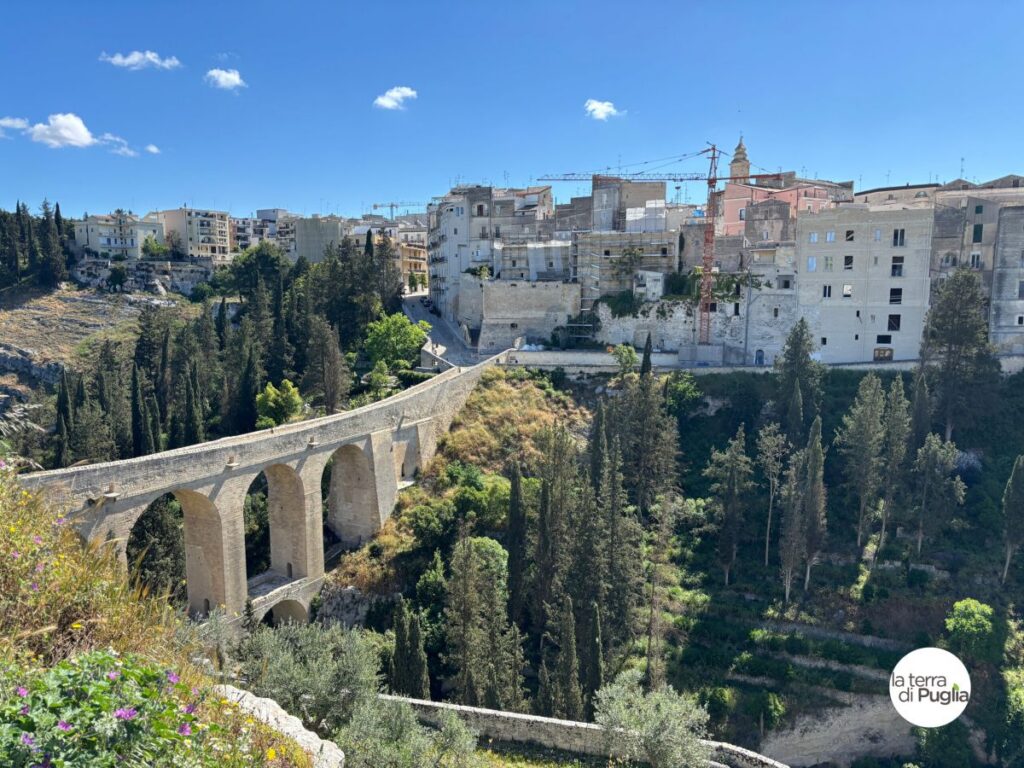
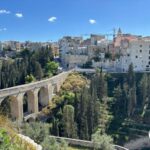
The aqueduct bridge of Gravina in Puglia, linking the two sides of the gravina.
Altamura: Frederick II’s cathedral
In Altamura the place to start is the cathedral of Santa Maria Assunta. It dates from 1232 and was commissioned by the emperor Frederick II of Swabia; it was reworked many times, up to the present interior, completed between 1854 and 1861. Italy’s national tourism portal describes it as Apulian Romanesque blended with the Gothic of Frederick II’s age.
The three museums of the Altamura Man
In 1993 a group of cavers found, inside the Lamalunga cave system, the fossil skeleton of a Neanderthal man: the Altamura Man. According to ISPRA, Italy’s national environmental research institute, a fragment removed in 2009 made it possible to date him to between 172,000 and 130,000 years ago. The skeleton has stayed in the cave where it was found. To get to know him there are three sites, joined in a museum network, whose website publishes the winter timetable, from 1 October to 31 May:
- Palazzo Baldassarre, in the old town: Tuesday to Sunday, 9 am to 1 pm and 3 pm to 6 pm, last entry half an hour before closing. It holds a life-size reproduction of the “apse”, the part of the cave that contains the skeleton.
- Lamalunga Visitor Centre, 3 km from town, inside the Park: Tuesday to Sunday, 10 am to 5 pm without a break, last entry half an hour before closing. Run by the town council, it explains karst landscapes; walks start here towards the mouth of the cave and the Pulo.
- National Archaeological Museum, on Via Santeramo: Monday to Friday 8.30 am to 7 pm, Saturday, Sunday and public holidays 8.30 am to 1.30 pm, last entry 45 minutes before closing. In August 2026, after three years of work, the first floor reopened: the Murgia from the Iron Age to the Early Middle Ages, with the towns of the Peucetians, the ancient people of this area, such as Altamura and Gravina.
PDO bread and PGI lentils, two products of this land
Altamura and Gravina share two protected products. Pane di Altamura PDO (Protected Designation of Origin; DOP in Italian) is made with twice-milled durum wheat semolina, sourdough starter, sea salt and water, and its production area covers Altamura, Gravina, Poggiorsini, Spinazzola and Minervino Murge. The rules require an oven at 250 °C and, if it is fired directly, heated with oak wood.
Lenticchia di Altamura PGI (Protected Geographical Indication) is the dried lentil of the Laird and Eston varieties. Its specification, in the version approved in August 2026, sets the area at nineteen municipalities in Puglia and Basilicata, Altamura, Gravina and Matera among them, between 300 and 600 metres above sea level and partly inside the Park. It also sets the season: sowing runs from November to March. Both names, with all the others in the region, are in our list of PDO and PGI products of Puglia.
Did you know? The logo of Altamura PGI lentils is made of nineteen stylised lentils of different sizes: one for each municipality in the production area, arranged by size and by position on the map.
Gravina in Puglia, the town on the canyon
In Gravina in Puglia the name says it all: gravine are deep clefts in the rock, like canyons, carved out by streams. The old town stands on the east bank of the Gravina torrent, where in the Middle Ages people moved from the settlements cut into the rock. The aqueduct bridge joins the two banks and carries water into town; in 2021 it was the setting for action scenes in the James Bond film No Time to Die. On the west bank, the Botromagno archaeological park keeps the remains of the ancient settlements, with free entry.
In town, the cathedral is Romanesque, from the eleventh century, and the rock church of San Michele delle Grotte, carved from a single block of tufa between the eighth and tenth centuries, was the first cathedral. In the seventeenth-century palazzo of the Pomarici Santomasi Foundation are the frescoes of the rock crypt of San Vito Vecchio, detached from its walls from 1956 onwards; the Foundation asks visitors to book.
The Park in winter
The Alta Murgia National Park was set up in 2004 and covers about 68,000 hectares across thirteen municipalities; the one with the largest share is Altamura itself. Its most typical landscape is the feather-grass steppe, at around 500 metres, which the Park authority describes as the last example of Mediterranean pseudo-steppe in mainland Italy. The Park is also a UNESCO Global Geopark, under the name MurGEopark. Its website lists the official guides: some work all year round, by booking.
The lentil specification also notes that rain here peaks in November and December, and that in January the minimum temperatures can drop below zero: on the trails you need proper winter shoes and clothing.
What to check before you go
- On Mondays in Altamura only the National Archaeological Museum is open: Palazzo Baldassarre and Lamalunga are closed.
- Pomarici Santomasi Foundation: book ahead; the timetables we found do not match, so ask the Foundation.
- San Michele delle Grotte and Gravina’s rock churches: no winter hours published in the official sources we read. Ask first.
- Walks in the Park: best with one of the Park’s official guides, booked in advance.
Opening hours in this article come from official websites consulted on 10 November 2026: the Uomo di Altamura museum network and the Italian Ministry of Culture for the museums in Altamura, the Alta Murgia National Park authority for the Park, and the specification published in Italy’s Official Gazette on 4 August 2026 for the lentils. They may change over the holidays.