In Puglia the nativity scene at home, the presepe, has its own calendar and its own materials: in Bari it was started on 13 December, Saint Lucy’s Day, with cork for the grotto, moss for the meadow and branches of orange trees; in Lecce the figurines are called pupi, made of terracotta or papier mâché. How it is built, who builds it, and when it comes down.
The big box comes down from the attic or up from the cellar, and inside are last year’s shepherds, each one wrapped in a sheet of newspaper. One has lost an arm, another has lost its paint. This is how the family nativity scene begins: counting the figurines and deciding where it should go, which is not always something everyone at home agrees on.
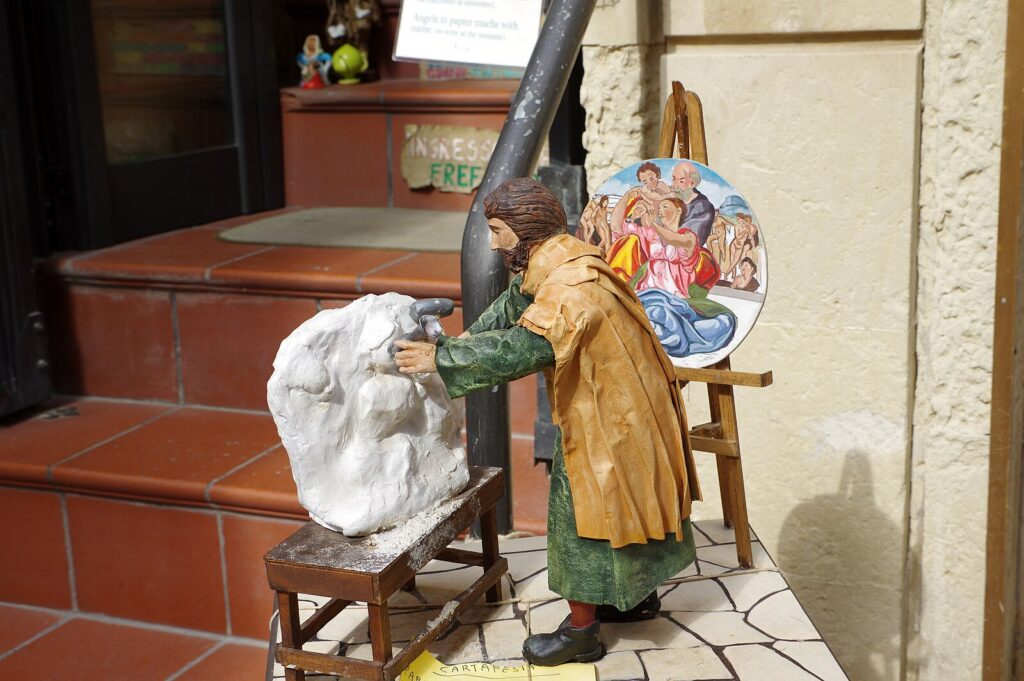
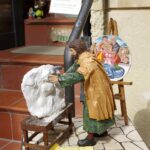
A papier mâché figure outside a shop in Lecce, the city of nativity pupi. Photo by Berthold Werner, Wikimedia Commons, CC BY-SA 3.0 licence.
When it starts
The day changes from house to house. According to the Canosapresepi association, people used to start on the feast of Saint Nicholas, 6 December, and in some towns on 8 December, the feast of the Immaculate Conception. In the tradition of Bari recorded by the Vallisa Cultura association, the nativity scene is set up in churches and homes from 13 December, Saint Lucy’s Day, when the days, so the saying goes, grow longer by «a hen’s step».
Stone nativity scenes have stood in Puglia’s churches for centuries. In homes, according to Coldiretti Puglia, the regional farmers’ organisation, the custom spread in the nineteenth century, built with natural and handmade materials.
Cork, moss and orange branches
After the figures, Vallisa writes, comes «cork without end», used for the grotto and for old Bethlehem. From the farmer or the greengrocer came branches of bay or pine, of orange and mandarin; in the past those fragrant fruits decorated the house and the nativity scene, together with emptied walnut shells wrapped in silver foil. In front of the grotto went candles, paper streamers and moss gathered from the flat roof terraces or from the nearby countryside, so that the Child would be born in a green meadow.
In the old days, Attilio Canta of a Bari nativity makers’ association told the local paper Barinedita in 2015, a large pine branch hung over the scene, with oranges, mandarins and small gifts for the children. Where there was no cork, families used what they had: Rocco Boccadamo remembers the nativity scene his mother built in Marittima, in the Salento, around 1950, out of packing cardboard and wooden crates, lit by a few small candles, with the moss and lichen that the boys brought back from the fields.
The figurines: terracotta or papier mâché
The figurines divide the family too, Canosapresepi writes: papier mâché or terracotta, and for terracotta, painted or left a natural reddish colour. The ones that come out of the box broken are mended with flour paste and touched up with watercolours. In Bari, by tradition, one new figurine is bought every year, so the scene grows a little at a time.
In Lecce the figurines are called pupi. The papier mâché historian Mario De Marco, in a 1977 text quoted by the Corriere Salentino, explains that the terracotta ones were «pupi» commonly called «pastori», shepherds, about 10 to 12 centimetres tall, and that by then some were made smaller than two centimetres. Next to them are the papier mâché pupi, the craft Lecce is known for: the city’s Papier Mâché Museum, in the Castle of Charles V, describes the local technique with a straw core, hands and heads in papier mâché or terracotta, and paper shaped with heated irons. According to De Marco, the craft grew with the taste of baroque Lecce in the seventeenth and eighteenth centuries.
The figures come from everyday life: the shepherd, the washerwoman, farm animals, even wheels of cheese and hanging bunches of small tomatoes, as the website Puglia Mon Amour listed at the Lecce fair in 2014. In the scene that the community of Bari’s old town sets up in a ground floor room, the local broadcaster Telebari lists shepherds, bagpipers, traders, the Three Kings and the «guardastelle», the stargazer, among oranges, mandarins, pomegranates and u chiacone, a dried fig stuffed with an almond.
Did you know? According to Mario De Marco, in Lecce nativity pupi spread above all thanks to barbers, who modelled them in their shops. The best known was Gaetano Podo, whose pupi were caricatures of people in the first half of the nineteenth century; his rival Basilio Bandello made figures so satirical that they got him into trouble with the law.
To buy them, Lecce has a long standing appointment, the Saint Lucy fair, which everyone calls the Fiera dei Pupi. We will write about it in December, once the city council has published this year’s dates and venue.
The night of the Christ Child
In the nativity scene at home, the Child arrives last. In Bari, Vallisa recalls, on Christmas Eve the head of the family gives the scene its final touches, and after dinner some go to Mass while others have Jesus born at midnight at home: the figurine is handed to the youngest child, the others follow with lit candles singing Tu scendi dalle stelle, the Christmas carol by Saint Alphonsus Liguori, and the eldest recites the poem learnt at school. As for the Three Kings, families still argue: on the scene from the start, or only for the last three days before Epiphany?
The Child of the gifts and Candlemas
At New Year, in Bari’s nativity scenes, the swaddled baby makes way for the Bambino della Strenna, the Child of the New Year gift: an older Jesus in a long tunic, which Attilio Canta described holding the globe in his left hand and raising his right in blessing. He was the Jesus of presents, because the strenna, mostly money, was the gift of those days. At Epiphany the swaddled baby returns to the manger to wait for the Kings.
The scene comes down the day after the feast of the Baptism of the Lord, but some families still wait until 2 February, Candlemas: with the candle blessed in church, the family gathers in front of the scene, the youngest takes the Child from the crib, everyone kisses it, and the figurines go back into their boxes, wrapped in newspaper, until next year.
On the scene and on the table. In Bari the dried fig with an almond is both a decoration on the nativity scene and one of the homemade sweets of the holidays. Our online shop has dried figs with almonds.
How this article was written. The customs of Bari come from the Vallisa Cultura association, Barinedita (2015) and Telebari (2024); the family arguments and the extra figurine from the Canosapresepi association; the Marittima scene from Rocco Boccadamo’s memoir in Affaritaliani (2014); the pupi of Lecce from Mario De Marco, La cartapesta leccese (1977), as quoted by the Corriere Salentino, from the Papier Mâché Museum of the Italian Ministry of Culture, from Coldiretti Puglia and from Puglia Mon Amour. The opening scene brings together gestures described by these sources.