From Friday 18 to Sunday 20 September, with one more event on the 27th, Barletta re-enacts the Disfida of 1503: thirteen Italian knights against thirteen French knights, born from an insult at a banquet. Here is what is actually documented about that day — and how to see this year’s re-enactment.
These days, Barletta turns medieval. Heralds in costume walk through the old town, knights play a board game in the castle gardens, and on Saturday night a procession of hundreds of costumed participants sets off from Castle Square to wind through the historic centre. This is the Disfida di Barletta, the most retold episode in the town’s history — and one of the most romanticised, thanks to two centuries of national myth-making.
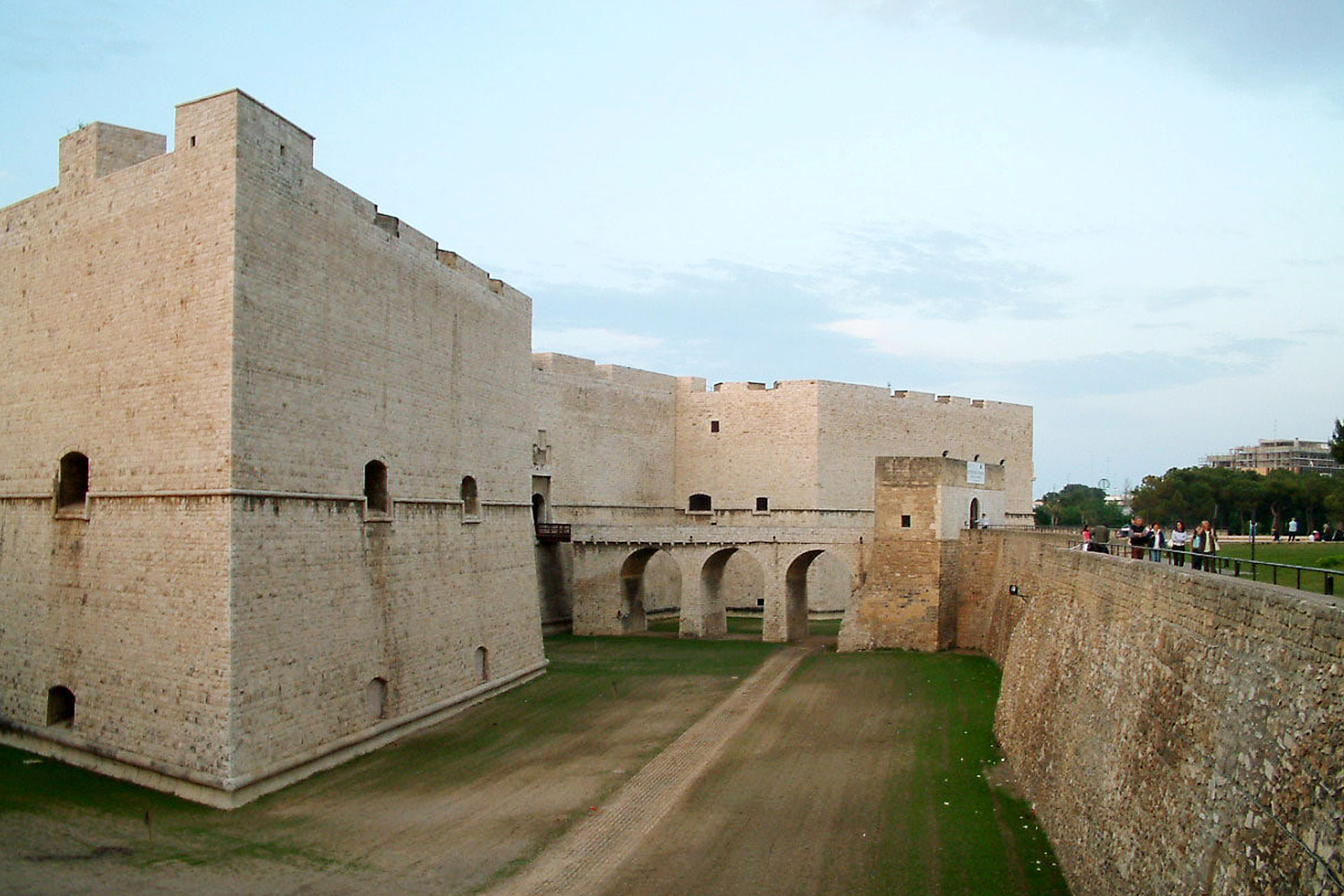
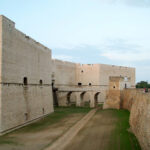
The Swabian castle of Barletta, starting and finishing point of the historical procession.
The insult in the tavern, 15 January 1503
It all begins at a banquet, in a tavern in Barletta, on 15 January 1503. The town was then little more than an armed camp: this was the middle of the war between France and Spain for control of the Kingdom of Naples, and the two powers were fighting over Puglia, town by town — Gonzalo de Córdoba commanding the Spanish forces, Louis d’Armagnac the French. Among the prisoners of war held at Barletta was the French captain Charles de Torgues, known in the chronicles as “Guy de la Motte”.
During the banquet, de Torgues questioned the military worth of the Italian soldiers — who were fighting as allies and mercenaries in the Spanish army — going so far as to call them cowards. A Spaniard, Íñigo López de Ayala, spoke up in their defence. The Italian knights present reacted at once: the challenge was born there, thirteen against thirteen, to settle the insult on the field.
The thirteen Italian knights
Leading them was Ettore Fieramosca, a condottiero from Capua, raised at the court of Naples. The other twelve:
- Francesco Salamone
- Marco Corollario
- Riccio da Parma
- Guglielmo Albimonte
- Mariano Abignente
- Giovanni Capoccio
- Giovanni Brancaleone
- Ludovico Abenavoli
- Ettore Giovenale
- Fanfulla da Lodi
- Romanello da Forlì
- Ettore de’ Pazzis
On the other side, the thirteen Frenchmen answered to the same de Torgues.
What is documented, in four lines. The insult was given at a banquet in Barletta on 15 January 1503. The fight took place on 13 February, on neutral ground between Andria and Corato. The Italians won decisively: every Frenchman was captured or wounded. The episode, of little military weight in itself, only became a national symbol in 1833, when Massimo d’Azeglio turned it into the novel Ettore Fieramosca, or the Challenge of Barletta — written on purpose, during the Risorgimento, to give Italians an episode of pride against a foreign power.
The duel at Sant’Elia, 13 February 1503
The fight took place a month later, on 13 February 1503, not in Barletta itself but in open country, at a place called Sant’Elia, between Andria and Corato, not far from Trani. The ground was chosen deliberately because it was neutral, under the jurisdiction of the Republic of Venice — which was not taking sides in that war.
The rules were agreed beforehand: the winner would take the loser’s horse and weapons, the ransom for a captured knight was 100 ducats, four judges oversaw the contest, and each side left two hostages as a guarantee. The fighting was a series of duels, first on horseback, then on foot, with lance, sword and dagger.
The result was a clear Italian victory: one after another, all thirteen Frenchmen were unhorsed, captured or wounded. The sources disagree on one point — whether a French knight died on the field from his wounds, and even on his nationality — but they agree on the overall outcome. The prisoners were taken to Barletta, where Gonzalo de Córdoba himself personally paid the ransom for Italian knights who had been captured in other engagements of the same war.
Much of what is told about the Disfida today does not come from 1503, but from the nineteenth century. The “Cantina della Sfida” that visitors can still see in the centre of Barletta is almost certainly a symbolic location, fixed centuries after the fact — not the actual site of the banquet. And the episode, which carried little military weight at the time (it was the Battle of Cerignola, three months later, that really decided the war), only became the symbol we know today with D’Azeglio’s novel of 1833.
This year’s re-enactment
The 2026 programme runs for ten days, from 18 to 27 September, with the main events in the first weekend:
- Friday 18 — Castle Gardens: at 5pm the Knights’ Game of the Goose, at 5.30pm Renaissance games, at 8pm the re-enactment of the Insult and the Renaissance encampments; at the same time, heralds cross the old town to proclaim the challenge.
- Saturday 19 — at 8.30pm the Triumphal Procession sets off from Castle Square and winds through the historic centre before returning to the castle; at 11pm a fireworks display at the Rivellino, by the castle, closes the evening.
- Sunday 20 — at 5.30pm, La Carrera della Sfida, through the town centre.
- Sunday 27 — at 7pm, a gathering of historical pageants from local Pro Loco associations across Puglia, from Castle Square through the centre and back.
The Swabian castle of Barletta, starting and finishing point of almost every event, can be visited all year round; it is there, and nowhere else, that the story of Ettore Fieramosca and his twelve companions keeps being told to visitors who arrive in Barletta outside these ten days in September.