For centuries, in the Salento, olive oil was not made in the open but underground: in the trappeti, oil mills cut into the rock a few metres below the village squares. The trappitari worked there all winter, led by a former sailor, alongside the animals that turned the millstone. They also produced lamp oil, shipped from the port of Gallipoli to light up much of Europe. This is what life was like down there, and where you can still go down today.
Older people in the villages of the Salento, the heel of Italy’s boot, remember something that sounds impossible today: in the middle of winter, under the square, it was warm. You went down a narrow stairway, left the December cold behind for still, mild air, and there was a smell you never forget — crushed olives, oil-lamp smoke, animals. Up above, the village slept. Down below, the mill worked through the night.
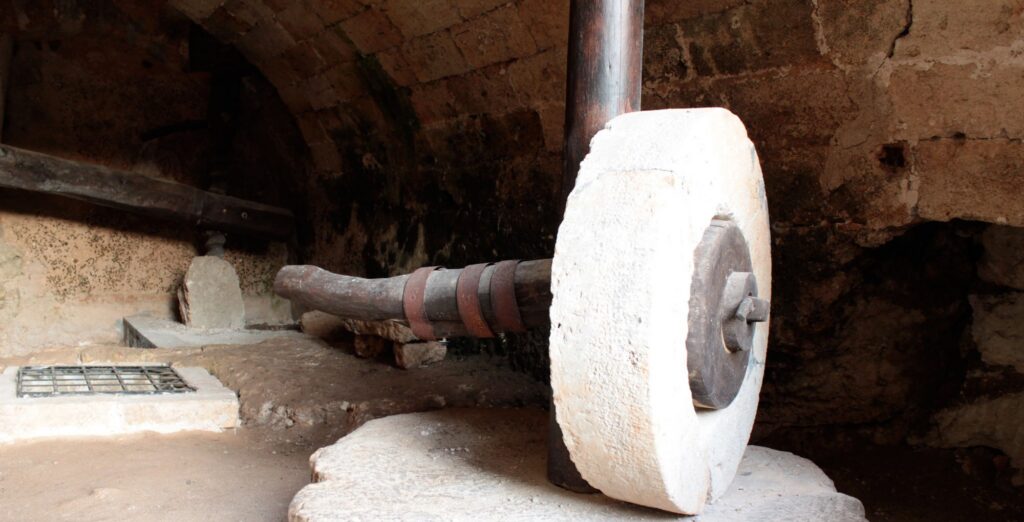
The stone millstone of an underground mill in the Salento: a mule or a donkey turned the wooden shaft.
Under the squares, up to five metres down
Trappeto (trappitu in dialect) simply means oil mill. What makes it unique in the Salento is where it was. As the town council of Vernole puts it, every oil mill built in the Salento between 1500 and 1800 is underground: carved into beds of tufa or Lecce stone, two to five metres below the surface. Italians call them frantoi ipogei, hypogeal mills.
It was not a romantic choice. Digging cost less than building, and above all the rock held a steady temperature all winter, the right one for the oil to separate cleanly from the water. The olives did not come down the stairs: they were unloaded from the street through openings in the ceiling and dropped straight into the sciave, the bays where they waited their turn.
The nachiro and his crew
The head of the mill had a name that came from the sea: nachiro, from the Greek naùkleros, the ship’s master. It was meant literally. In the warm months the nachiro sailed the boats; from October to February, when the olives were pressed, he ran the trappitari, the mill hands. Their team was even called the ciurma, the crew.
The trappitari did not go home in the evening. The mill was fitted out for living in for months: next to the room with the millstones and presses there was a place to eat, a place to sleep and a stable for the animals. They came up on feast days. The rest was work, in shifts, by the light of oil lamps.
The blindfolded mule
The millstone was a great stone wheel that crushed the olives in a basin, and it was turned for hours by a mule or a donkey wearing a blindfold. The paste then went under the presses, and the oil ran along stone channels into the cisterns.
In Calimera, older residents say the crosses scratched into the mill walls were used to count the turns of the millstone, because many trappitari could not write. And in Vernole the mill even has its own legend: the uri, mischievous sprites who one night, to let the mill hand Giuacchinu get some sleep, tied the mule’s tail to the donkey’s — and the nachiro spent the whole night untangling them.
The oil that gave light. The first pressing gave the oil you ate; the second gave lamp oil (olio lampante), burned in lamps and used to make soap. It was in demand all over the Mediterranean, as far as Constantinople, and much of it left the port of Gallipoli for northern Europe. Presicce, between Gallipoli and Leuca, lived on it: the village had 23 underground mills. In Muro Leccese, in the seventeenth-century mill of the Protonobilissimo family, you can still see the bases of two kinds of press: the “Calabrian” ones for lamp oil and the “Genoese” one for table oil.
Why they closed
Towards the end of the nineteenth century the underground mills were declared unhealthy and abandoned for mills built above ground. Many were filled with earth and forgotten. That is what happened to the Caffa mill in Vernole: recorded as working as early as 1576, bought by the town on 27 October 1885 for eighteen hundred lire, it ran until the early 1900s and was then filled in. It was rediscovered and restored between 1995 and 1998.
Where to go down today
October, when the olive harvest starts outside, is a good month to see one. Three places, with one tip: call ahead, because opening times change out of season.
- Vernole, the Caffa mill — under Piazza Vittorio Veneto. Since it reopened in April 2025 it has been run by the Pro Loco “Livio De Carlo” (the local volunteer tourism association), which announced free visits on Sunday mornings outside the summer months when it reopened: check the opening times with the Pro Loco before you go.
- Presicce — eight of the twenty-three mills lie under Piazza del Popolo. Guided visits are run by the Pro Loco.
- Gallipoli — in the old town, under Palazzo Granafei on Via Antonietta De Pace. It opens mainly in July, August and over Easter and Christmas: in October, check before you go.
Read on. All three places are in the Salento. On how the olives are picked, and what new oil is, read the olive harvest; and for today’s oil, made in daylight, see our Apulian extra virgin olive oil.
How this piece was written. The dates, figures, the words nachiro and ciurma and the history of the mills of Vernole, Presicce, Gallipoli, Calimera and Muro Leccese come from the Vernole town council website, the local press and published accounts of the Salento’s underground mills. The opening scenes — the warmth under the square, the smell of olives and lamps — come from oral memory and are told as such. The legend of the uri is a legend, and the town of Vernole presents it as one.
You must be logged in to post a comment Login