In short: the olive harvest began in Puglia in mid-September, and it is a light year: down 40% around Foggia, Taranto and Brindisi, 30% on the Gargano, 20% around Bari. One province is going the other way, and by 60%: Lecce — the Salento — where the trees replanted after Xylella are coming into full production. Quality looks excellent. Prices, however, are unlikely to jump: Italian warehouses are still full of last year’s oil.
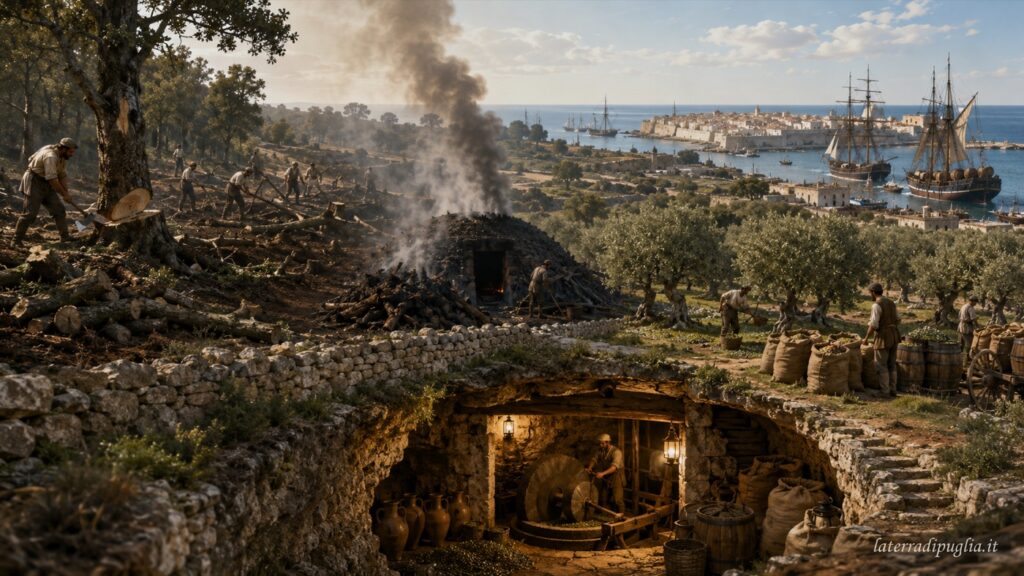
The mills in Puglia have started up again. The 2026-2027 season opened in mid-September and, as always at this time of year, one question goes around the olive-growing towns: how much will there be? The first estimates, released on 18 September by Coldiretti Puglia, give an answer with two faces.
How much oil, province by province
Puglia is not one olive region but five or six, and in some years they move in opposite directions. This is one of those years.
- Capitanata (Foggia) — production estimated down 40%
- Taranto — down 40%
- Brindisi — the sharpest fall, more than 40%
- Gargano — down 30%
- Bari and BAT — down 20%
- Lecce and the Salento — up by around 60%
The first five lines surprise nobody: the olive tree alternates a heavy year with a light one, and on top of that natural rhythm came an endless summer and drought. The sixth line is the news.
The Salento is up, and it is the first good news in ten years
The province of Lecce is the one Xylella fastidiosa emptied: millions of dead trees, a landscape rewritten, a farming economy wiped out in a handful of years. That Salento is now the only part of Puglia picking more olives than last year.
This is not a lucky spell of weather: it is the new groves planted after the disaster coming into full production, with the resistant cultivars giving very good yields in 2026. Coldiretti Lecce calls it, in so many words, a «phase of rebirth for olive growing after the tragedy of Xylella».
Worth reading soberly, though. A 60% rise is calculated on a base that had collapsed: it does not mean the Salento is producing what it produced before. It means that, for the first time in a decade, the direction has changed. This is the beginning of a recovery, not the end of one.
Quality: this year the oil should be good
Small quantity and good quality often go together, and this year there is one specific reason more: the olive fly has barely shown up. That is the insect that lays its eggs in the fruit and sets the olive fermenting before it even reaches the mill — when it has been at work, you taste it in the glass.
The September estimates speak of «healthy olives of high quality, with good conditions for obtaining extra virgin oils with important organoleptic characteristics». In plain terms: there will be little new oil in 2026, but it will be the kind worth tasting freshly pressed. If you want to know what happens between the tree and the press — and why those few hours decide a whole year — we have written about the olive harvest and what olio novello is.
So why aren’t prices going up?
This is the counter-intuitive part, and without it the rest does not add up. Less oil should mean higher prices. This year, probably not — and the reason is in the warehouses.
According to Frantoio Italia (ICQRF), the Italian ministry body that records them, on 31 July 2026 there were still 233,377 tonnes of olive oil in stock in Italy, 43.9% more than on the same date a year earlier. Of that, 73,559 tonnes were sitting in Puglia — 64,101 of them extra virgin: close to a third of all the oil held in Italian warehouses.
It is the legacy of the previous season, which was abundant and pushed prices down: on the Andria exchange, one of the reference markets in the South, the reading of 31 August 2026 put extra virgin at 4.70 euros a kilo at origin — a long way from the double-digit figures of the scarce years.
So a short harvest is arriving on a market that is not empty. For anyone buying, that is good news; for anyone farming, much less so, because the cost of picking and milling has not come down.
The other side of a light year: fraud
Every time Italy picks little, the amount of foreign oil resold as Italian goes up. Farming organisations raised the alarm again this year, asking that checks use the tools that now exist: magnetic resonance, genomic mapping and isotopic mapping, which can say where an oil actually comes from.
If you are buying from abroad, the defence is the simple one: read the label, look for the origin, and distrust a price that is too low. An «Italian extra virgin» sold for a couple of euros a litre, in a year like this, is telling you something about itself.
When the new oil arrives
Picking starts in September with the earliest varieties and runs through October and November: new oil appears in the mills from October onwards, and the first bottles go out while it still has that deep green colour and the peppery catch at the back of the throat that alarms people who have never met it.
That catch, incidentally, is not a fault: it is the signature of the polyphenols, which is exactly the part that does you good. If you want the background, there is our page on Apulian extra virgin olive oil, the questions people actually ask about it, the map of the production areas, and the page on the oil of the Gargano, which has a designation of its own.
When the new oil is bottled, you will find it with us too. Our online shop carries Apulian extra virgin olive oil, shipped from Puglia. The first pressing comes right after the harvest: it is when the oil is at its most alive — and also when it keeps worst if you leave it in the light.
Sources: Coldiretti Puglia estimates for the 2026-2027 olive season, released 18 September 2026; stock figures from Frantoio Italia — ICQRF, as of 31 July 2026; Andria market price reading of 31 August 2026. Production figures are start-of-season estimates: the final number will only be known once milling is over.