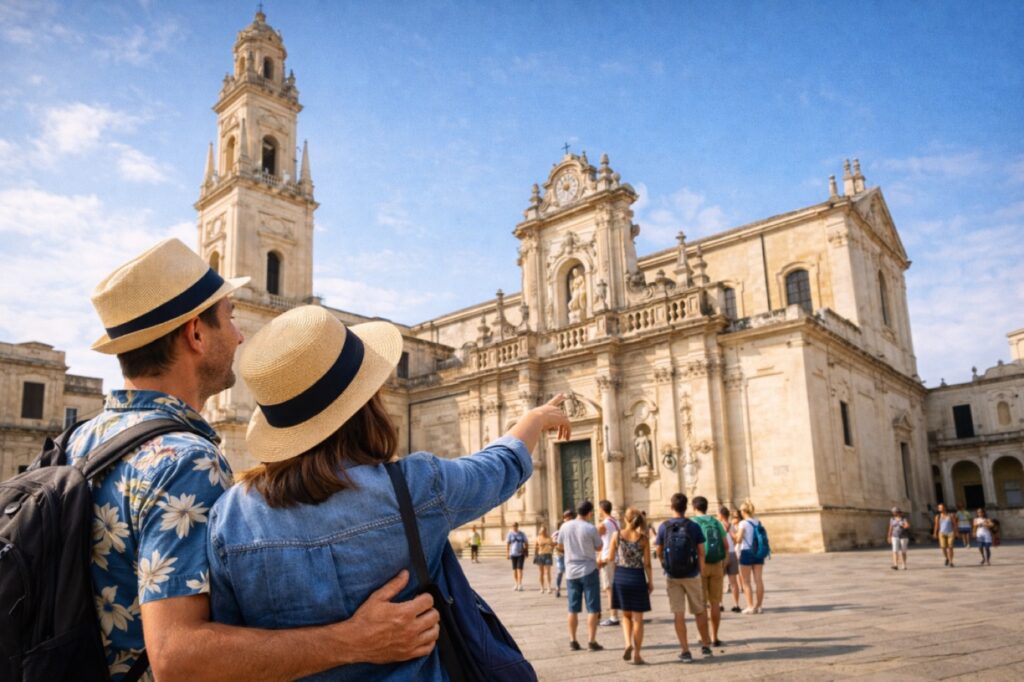
In short. Lecce is called the Florence of the South, and the reason is a stone: pietra leccese, soft enough to carve like wood and hardening in the air. A whole city built in a single golden material, covered in seventeenth-century decoration.
Baroque elsewhere in Italy is a style applied to buildings. In Lecce it is what the buildings are made of — because the local limestone let stonecutters do things they could not do anywhere else.
🧩 Three things that happened at once
Lecce baroque exists because three conditions coincided here and nowhere else:
- The stone. Soft enough to carve like wood, and it hardens with time. No other material would have taken acanthus leaves, cherubs, dragons, mermaids and festoons of fruit at that level of detail.
- Spanish rule. In the seventeenth century Puglia was under the Spanish crown, and the Spanish brought with them a taste for the plateresco — exuberant, theatrical, densely decorated.
- The Counter-Reformation. A church that needed to impress, and the money to do it with.
The result is not a monument. In Lecce the decoration runs past the churches, across the noble palaces, down onto the doorways of ordinary houses and up onto their balconies. The baroque here is the whole city.
🪨 The stone that made the style
Pietra leccese is a calcarenite — a limestone formed in the Miocene, between 5 and 24 million years ago, when the sea repeatedly covered the Salento. It is quarried around Melpignano, Cursi and Maglie, and it is full of what the sea left: shells, shark teeth, and the remains of cephalopods, dolphins, sperm whales and turtles.
Freshly cut it is soft enough to work almost by hand, and it hardens on exposure to the air — which is why four centuries of carving is still legible. The colour moves with the light: cold white at dawn, cream through the day, deep gold at sunset.
The two names on the buildings. Giuseppe Zimbalo — known as lo Zingarello, 1617–1710 — did the cathedral and the facade of Santa Croce. Giuseppe Cino (1644–1722) did Santa Chiara and the Carmine. Same style, two temperaments: Zimbalo the more exuberant, Cino the more restrained.
🏛️ What to see
- Basilica di Santa Croce — the most extravagant facade in the city, and the one everyone photographs
- Piazza del Duomo — an enclosed square you enter through a gateway, unusual in Italy and startling at night
- Roman amphitheatre in Piazza Sant’Oronzo, sitting two thousand years below street level
- Porta Napoli and the old gates
Go after dark. The lighting in the old town is designed for the stone, and the carving reads far better at night than under a flat midday sun — which is also when the temperature becomes civil.
And eat a pasticciotto. Lecce’s own breakfast — warm shortcrust and custard, standing at the bar. Here is what it is.
And it is not only Lecce. The same phenomenon has other faces across the region: Martina Franca, Ostuni, Nardò and Gallipoli. Apulian baroque as a whole is a candidate for UNESCO recognition.
The city itself: Lecce in the guide. Around it, the Greek-speaking villages and Otranto.