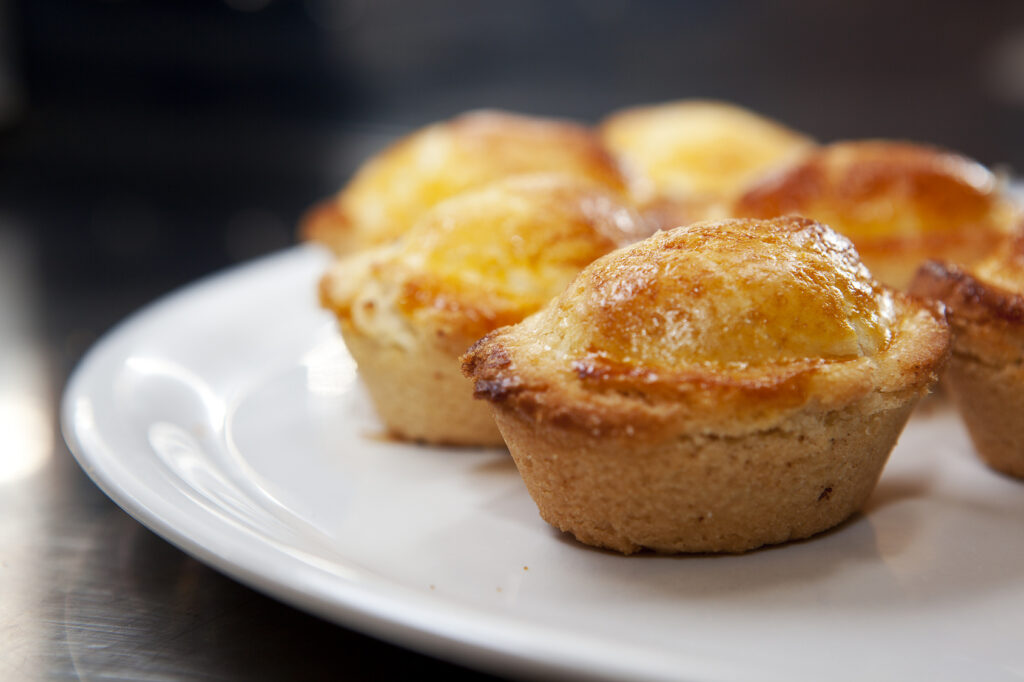
In short. A small oval shortcrust pastry filled with custard, eaten warm, for breakfast, standing at a bar counter. It was invented at Galatina in 1745 by a pastry chef in debt, it is still made by the same family at the same address, and the whole of Italy celebrates it on 4 June.
Ask for a pasticciotto anywhere in the Salento and you will get one still hot from the oven. Ask for it cold and you will be quietly judged.
📜 Galatina, June 1745
It is called leccese, after Lecce, but it was not invented there. Andrea Ascalone ran a pastry shop at Galatina that was going badly — the debts were piling up — and the feast of Saints Peter and Paul was coming, which meant crowds of pilgrims and outsiders in town.
He had very little in the workshop: some offcuts of shortcrust pastry and some custard. He filled small copper moulds with the cream, closed them with the pastry and baked them. He was not convinced by the result, and called it un pasticcio — a mess. That is where the name comes from. Then he gave one to a local notable, don Silvestro Mezio, who ordered more for his family, and within days the whole town wanted them.
280 years, same address. The Ascalone family still runs the shop in Galatina, in Via Vittorio Emanuele II, with the recipe handed down through the generations. John Paul II, after a visit to Lecce, was taken enough with them to want some brought back to the Vatican. In 2026 a tray of them turned up on the table of a bilateral meeting at the Farnesina.
🥐 What makes it the real one
- The shape — an oval boat with a small dome, neither round nor rectangular. It comes from the original copper mould, and it is sized to be held in one hand and eaten in three or four bites.
- Lard, not butter — this is the fundamental difference between the original and the imitations. Lard gives a pastry that is drier, crisper and more crumbly; butter makes something good, but different.
- The custard — thick, scented with vanilla and lemon zest, no industrial starches, and filling the cavity completely: no gaps, no air pockets.
- The temperature — warm, straight from the oven. It is not a display-case pastry. Cold, it loses the contrast between crisp shell and soft cream that is the entire point.
☕ How it is eaten
In the morning, with an espresso — or, in summer, with a caffè leccese: espresso poured over ice with almond syrup, which is the local answer to the heat and worth ordering at least once. Caffè e pasticciotto is a fixed pairing here, and it is not going out of fashion.
The variations you will see. Black cherry (amarena) in the custard is the classic one; chocolate and pistachio are in most bars now. All fine — but the plain custard original is the one to judge a pastry shop by.
🎉 Pasticciotto Day
Every 4 June, in Italy and abroad, the participating bars sell it at a symbolic one euro until six in the evening. It is the one day of the year when it is worth queueing.
Frozen or fresh? Many bars bake from frozen, and it is not automatically a scandal — a well-made frozen pasticciotto baked properly beats a fresh one that has been sitting since six in the morning. What matters is that it reaches you hot.
More sweets: the Apulian desserts.