Cicoria Puntarelle Molfettese is now a PGI: the registration was published in the Official Journal of the EU on 13 November 2026. The name now belongs only to puntarelle grown in Molfetta, Bitonto, Giovinazzo, Bisceglie, Terlizzi and Ruvo di Puglia under the specification, sold fresh or already cleaned in trays. Here is what the official document says and how to recognise them.
After Capocollo di Martina Franca, Puglia has another geographical indication, and this one is a winter vegetable. On 13 November 2026 the Official Journal of the EU published the registration of “Cicoria Puntarelle Molfettese” as a Protected Geographical Indication. The application had appeared there on 20 July, and on Saturday 14 November almost a thousand people celebrated at the Molfetta fruit and vegetable market.
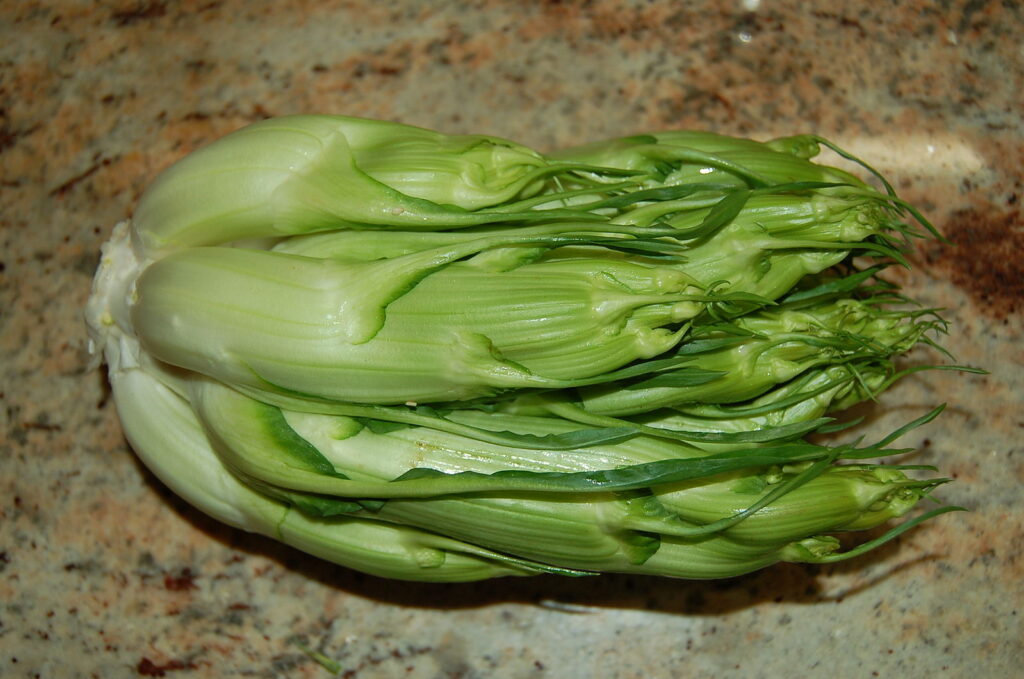
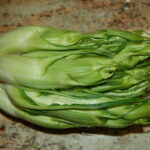
Puntarelle: the inner shoots, long and arranged in a pyramid, are the part you eat.
The growing area
The area covers six towns along the coast and up to the first hills of the Murgia, north of Bari: Molfetta, Bitonto, Giovinazzo, Bisceglie, Terlizzi and Ruvo di Puglia, about 500 hectares in all. Every step up to the harvest must take place there. According to the official application, what makes the area special is a mix of thin, well-drained limestone soils, crossed by the karst ravines known locally as lame, the coastal breeze, cooler nights and a plant selected over the years to withstand winter frosts. These conditions, it says, produce compact plants packed with shoots, unlike chicory grown elsewhere, such as in Galatina.
Appearance and taste
- The plant. Catalogna chicory (Cichorium intybus), only of the “Molfetta”, “Catalogna pugliese” and “Catalogna puntarelle a foglia stretta” varieties.
- Size and shape. 500 grams to one and a half kilos, with a rounded base and a pyramid-shaped tip.
- The puntarelle. The inner shoots, many and elongated, 7 to 15 centimetres long, whitish with shades of green.
- The taste. Crunchy and sweet, with a slight bitter aftertaste that grows as the shoot grows.
The “cicoria spigata”. Molfetta has grown and sold puntarelle for more than a century: the application cites accounts dating back to the early 1900s, a cooperative of growers founded in 1981 and a festival that started in 1985 and lasted until the late 1990s. In town it was also called “cicoria spigata”, spiked chicory, because its shape recalls an ear of grain.
How to recognise it
Cicoria Puntarelle Molfettese PGI is sold in two ways: fresh, as whole plants trimmed of damaged leaves, or ready-cleaned, just the puntarelle in a tray, ready to dress. The pack must carry the EU PGI symbol and the logo of the name: a green circle with a stylised three-pointed chicory and two towers forming the M of Molfetta.
For a recipe, try our sweet and sour puntarelle. Out of season, Apulian tradition preserves them in oil: our puntarelle alla crudaiola are Catalogna chicory shoots in vinegar and oil, a preserve that is not covered by the PGI, which applies only to the fresh product. Every name in the region is in our list of PDO and PGI products of Puglia.