In Puglia, October is not low season in every sense: it is the month when the olive harvest gets going in earnest and the olive mills start up again. For travellers it is a real reason to come: you can see how oil is made, taste it fresh from the press, and plan around the events built on it, from FèXtra in Mattinata (9-18 October) to the Camminata tra gli Olivi on 25 October. Here is what there actually is to see, and how to plan it.
In summer, you look at Puglia from the sea. In October, you look at it from the olive groves: nets spread under the trees, olives on their way to the mills. Same region, different trip.
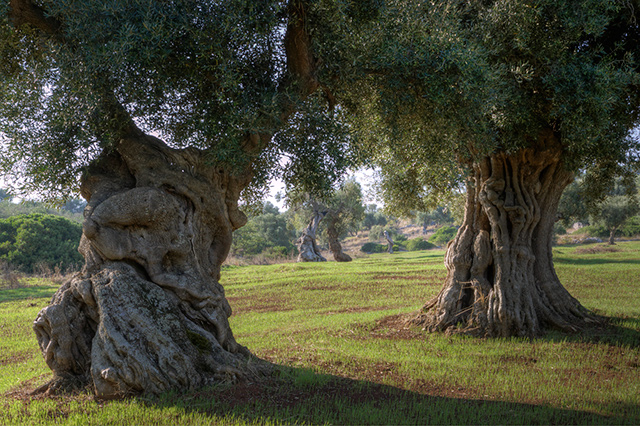
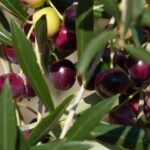
Centuries-old olive trees in a Puglia grove.
Why October
The 2026 olive season began in September. Announcing the start of the harvest, Coldiretti Puglia, the region’s main farmers’ organisation, published its first estimates: a smaller crop in almost every province, down by as much as 40% or more, except in the Salento around Lecce, where production is up by about 60%, and quality that looks excellent. We covered it in the 2026 olive harvest.
1 October is also when picking starts for the region’s most famous table olives, those of the La Bella della Daunia PDO around Cerignola. And the season does not wrap up quickly: depending on the area and the variety, the harvest runs for weeks, and in many parts of Puglia it carries on into November and December. By October, everything is already moving.
What you see inside an olive mill
In Italian an olive mill is a frantoio. Seen from the inside, a modern one is a continuous line. The olives come in, and then:
- Leaf removal and washing: a blower separates leaves and twigs, then the olives are washed clean of soil and small stones.
- Crushing: the olives are ground, stones and all, into a paste.
- Malaxing: the paste is stirred slowly so that the tiny droplets of oil join together.
- Extraction: a horizontal centrifuge, the decanter, separates the solids from the liquid.
- Separation: a second centrifuge splits the oil from the vegetable water.
What comes out at the end is the new oil, olio nuovo. Taste it there, on a slice of bread, and you understand why October and November are mill months in Puglia.
The old mills were underground. In Gallipoli, in the old town, beneath the sixteenth-century Palazzo Granafei, you can visit an underground olive mill, a frantoio ipogeo, with seventeenth-century presses. Entry is free. In the Salento these mills were called trappeti.
October dates for the diary
Three dates, checked with the organisers, to build a trip around:
- FèXtra, in Mattinata, 9-18 October. The extra virgin olive oil festival of Mattinata, on the Gargano promontory in northern Puglia, now in its sixth edition. It is run by the town council with the Puglia Region and the national association of Città dell’Olio (“olive oil towns”): guided visits, tastings and live demonstrations in the mills, plus concerts, workshops and excursions, across two weekends. For the local oil, see our page on olive oil from the Gargano.
- Sagra de la Volìa Cazzata, in Martano, 15-18 October. In the Salento, the festival of cracked olives, now in its 35th edition. A sagra is an Italian village food festival built around one product: here, the part of the olive crop that never goes to the mill.
- Camminata tra gli Olivi, Sunday 25 October. The national day of the Città dell’Olio: walking routes through the olive groves, mill visits and tastings of oil and local produce. The towns in Puglia taking part are listed on the event’s website, where you can filter by region.
Can you join the harvest?
Yes, but not everywhere, and not as a tourist attraction. Some masserie (Puglia’s large fortified farmhouses, many of them now places to stay) and some agriturismi (working farms that take in guests) invite visitors to see or lend a hand with the harvest on their land, between October and December. It is not a standard package, and it depends on each farm’s schedule: ask when you book, and find out which days are planned, because picking stops when it rains and shifts as the olives ripen.
To choose an area, our page on Puglia’s olive oil production areas may help: from the Gargano to the Salento, each one has its own varieties and its own character.
October is also walking season in Puglia: the organisations that run the routes advise walking from autumn to spring, not in summer. Which routes are open, and how much climbing each stage involves, is on our page Puglia on foot.
Oil to take home. If you cannot get to a mill, Puglia’s extra virgin olive oil is in our online pantry, on the olive oil page.
You must be logged in to post a comment Login