In short. Ruvo di Puglia has two things and they do not obviously belong together: a pale Romanesque cathedral over the old town, and four rooms of a nineteenth-century palace holding more than two thousand Greek vases — including one of the masterpieces of Greek vase painting. The combination has few equivalents anywhere in Puglia.
Ruvo sits at 265 metres in the north-west corner of the Murgia, ten kilometres from the Adriatic. It is a small town, and for a few decades in the nineteenth century it was famous across Europe — for reasons that were not entirely to its credit.
The cathedral
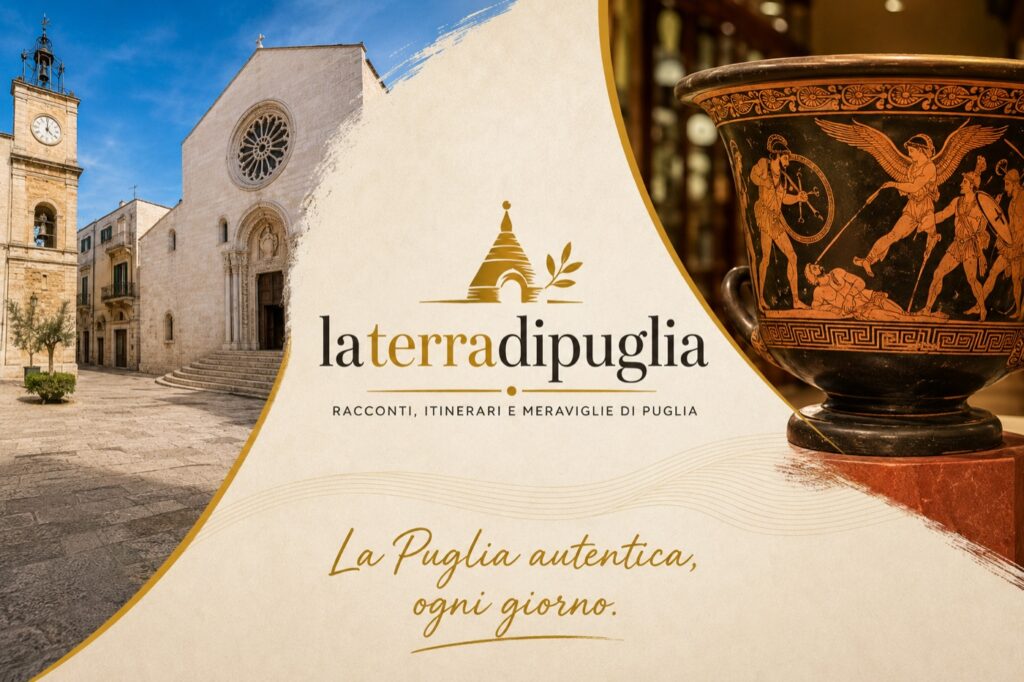
The cathedral in pale stone stands over the historic centre, and it is the first of the town’s two souls: Apulian Romanesque, restrained, and the natural centre of a walk through the old streets.
The other soul: two thousand Greek vases
The most looted town in Italy. Before the nineteenth century, archaeologists knew nothing about Ruvo. Then farmers began turning up vases in their fields while working the land — and smashed them with their hoes, because what they were after was gold coins. Once the value of the pottery was understood, proper excavation companies formed and worked the ground, some of them at night. Within a few years Ruvo was famous across Europe: it was said that no archaeological collection could call itself complete without at least one vase from Ruvo. Its heritage ended up in the museums of London, Paris, Naples and Berlin. What stayed in the town was saved by one family.
The Jatta museum
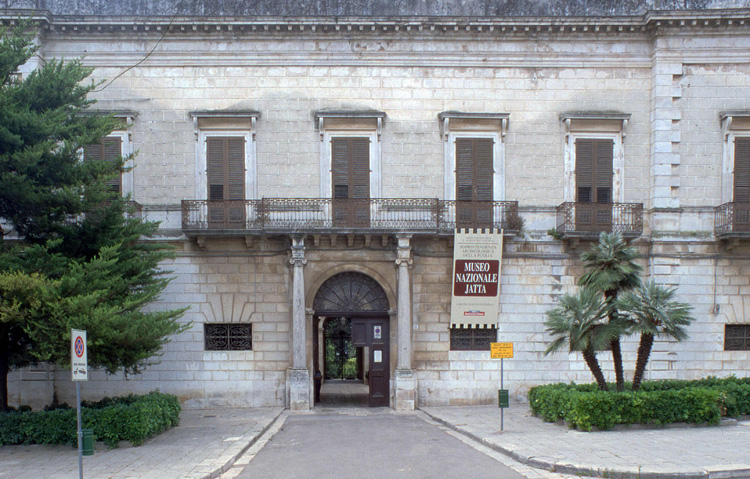
The Museo Nazionale Jatta is one of the very few nineteenth-century private collections in Italy still preserved intact in its original museography. Four ground-floor rooms of Palazzo Jatta — built between 1840 and 1844 expressly to hold it — with the original wooden cases, small columns and red-upholstered benches, and a route through the collection that does not follow chronology at all: it follows the founder’s taste, starting from the lesser pieces and building to the masterpiece in the final room.
The Talos Krater. That masterpiece is an Attic red-figure vase of the fifth century BC, showing the death of Talos, the bronze giant who in Greek myth guarded the island of Crete. It is considered one of the high points of Greek vase painting anywhere — for its colour innovations, its quality and its expressive intensity — and for decades it was the symbol of the town itself. The collection passed to the State in 1991, the museum reopened in 1993, and a major restoration was completed in 2022.
The people who stopped it leaving. At the start of the nineteenth century Giovanni Jatta, a lawyer living in Naples, and his brother Giulio, a Bourbon officer who had retired to Ruvo, began systematically collecting the material surfacing from the local necropoleis, with an explicit aim: to stop it being dispersed abroad. When Giovanni later wanted to sell the collection to the king of Naples, it was his sister-in-law Giulia Viesti who blocked the sale. She decided the vases would stay in Ruvo, and commissioned the palace built to house them. The museum exists because of her.
Around it
Ruvo is on the north-west Murgia, ten kilometres from the coast and about half an hour from Bari. Andria and Castel del Monte are to the north-west, Altamura south across the plateau.
Ruvo di Puglia is the Greek corner of the Murgia — and the best single museum in this guide.