In Puglia the grape preserve is called mostarda — a word an English speaker will read as mustard, and that is not a coincidence. It is also not a mistake: the name comes from the must, not from the mustard seed. The two Italian mostarde share one origin, and each of them lost one of the two ingredients along the way. Here is the story of the word, what the official Puglia Region record says, and why a version with no added sugar works at all.
Ask for mostarda in Cremona, in the north, and you get whole candied fruit in a syrup sharp with mustard, eaten with boiled meats. Ask for it in the Salento and you get a dark, thick grape preserve that goes on bread. Same word, two products that share almost nothing. Both are correct, and the reason is older than either of them.
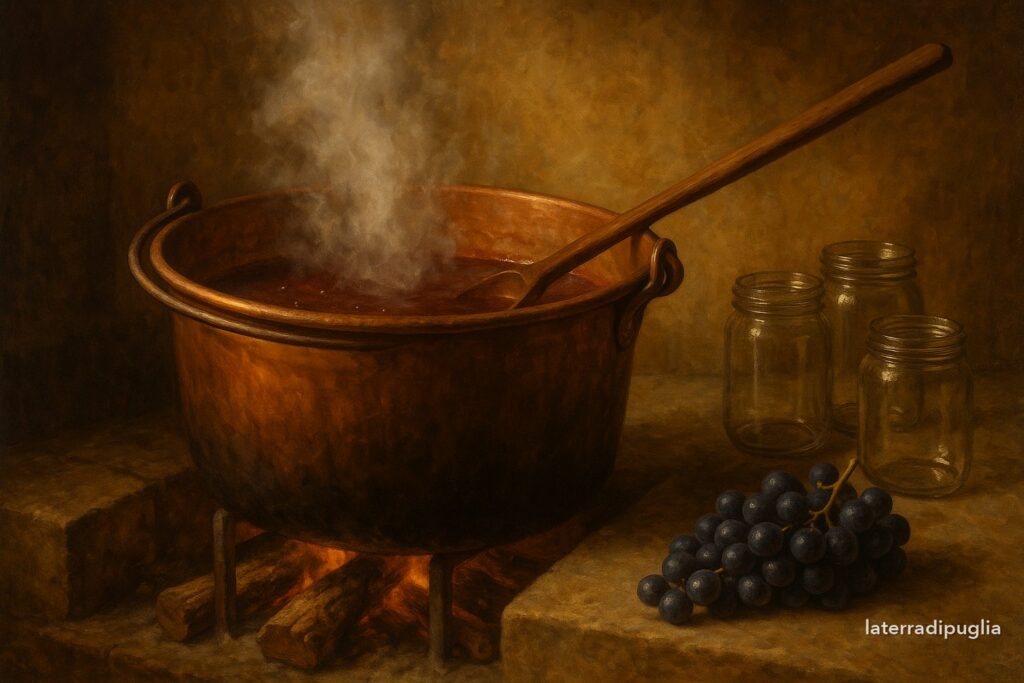
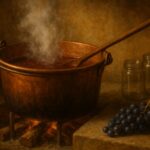
Must reducing for hours in a copper cauldron: this is where vincotto and mostarda both come from. Illustration made with artificial intelligence: a reconstruction of the scene, not a period photograph.
📜 The word comes from the must
It goes back to Latin mustum ardens — «burning must» — and it first appears in a French text of 1288. It meant exactly that: grape must made ardent, that is pungent, by the addition of ground mustard seed. The English word mustard comes down the same line, through Old French.
So the name carries two ingredients: the must and the mustard seed. And that is what explains the rest.
🔑 Every Italian mostarda dropped one of the two. Around Cremona, Mantua, Pavia and in the Veneto, the mustard stayed — and the must disappeared. In Carpi, in Emilia-Romagna, in Piedmont, in Calabria and in Sicily, no mustard is added at all. Apulian mostarda is therefore not a loose use of the word: it is the other half of the name, the half that kept the must.
🍇 What Apulian mostarda officially is
This is not just a family expression: mostarda is listed among the Traditional Agri-food Products of the Puglia Region, in a record that fixes its area, ingredients and method.
- Area — the province of Lecce, in the Salento.
- Season — autumn, right after the grape harvest.
- Grapes — local varieties, mainly Negroamaro and Malvasia.
- How it looks — thick, reddish-brown, sweet-and-sour, with an intense aroma.
- Method — the grapes are washed, taken off the stalks and boiled; seeds and skins are removed; the must goes back on the heat and cooks, stirred continuously, to the density of a jam.
The regional record also calls for quince in pieces, and for cinnamon and clove pepper when the jars are filled. And it calls for 200 grams of sugar per kilo of grapes.
🍯 Then why «no sugar»?
Because these are two different things, and they are worth keeping apart.
The traditional recipe as recorded by the Region does include sugar — but in an amount that has nothing to do with an industrial jam: 200 grams per kilo, against the 400 to 500 of an ordinary preserve. Even so, most of the sweetness is the grape’s.
From there the next step is short, and plenty of families have always taken it: leave the sugar out entirely. It works because must, cooked long enough, concentrates on its own — the water evaporates and the grape sugars stay. It is the same principle as vincotto, which nobody sweetens and which is sweet all the same.
What it costs is yield. With no added sugar the cooking takes longer and a jar holds far less: several kilos of grapes go into one. Sugar in preserves does not only sweeten — it adds bulk and helps them keep. Removing it means accepting less than half the output from the same fruit.
🥄 Mostarda and vincotto: the difference is time
- Vincotto — must reduced to a thick syrup that stays liquid. It is poured: over pastries, over ice cream.
- Mostarda — the same thing taken further, to the consistency of a jam. It is spread.
Both were born on the same day, from must that was never meant to become wine — the day of the grape harvest, five in the morning, the whole family in the vineyard. Six weeks later the same families were back out for the olive harvest, on the same land and with the same rule: one crop a year, and nothing wasted.
🍞 How it is eaten
- on bread, ideally durum wheat bread — the most common way in Puglia;
- in tarts, where the sweet-and-sour note holds up better than a sweet jam;
- with aged cheese — and here the family resemblance to the northern mostarda shows, because that is exactly what the Cremona one is for.
If you have no vineyard. Our grape mostarda is made with 100% Negroamaro grapes from the Salento, with no added sugar and no preservatives, worked by hand. The label says «grape jam», which is the trade name: in Puglia, that jar is called mostarda.
Sources. The etymology and the geography of Italian mostarde — who kept the mustard and who kept the must — come from the Vocabolario Treccani and encyclopaedic entries on mostarda. The area, ingredients, quantities and method of Apulian mostarda come from the record of the Traditional Agri-food Products of the Puglia Region.