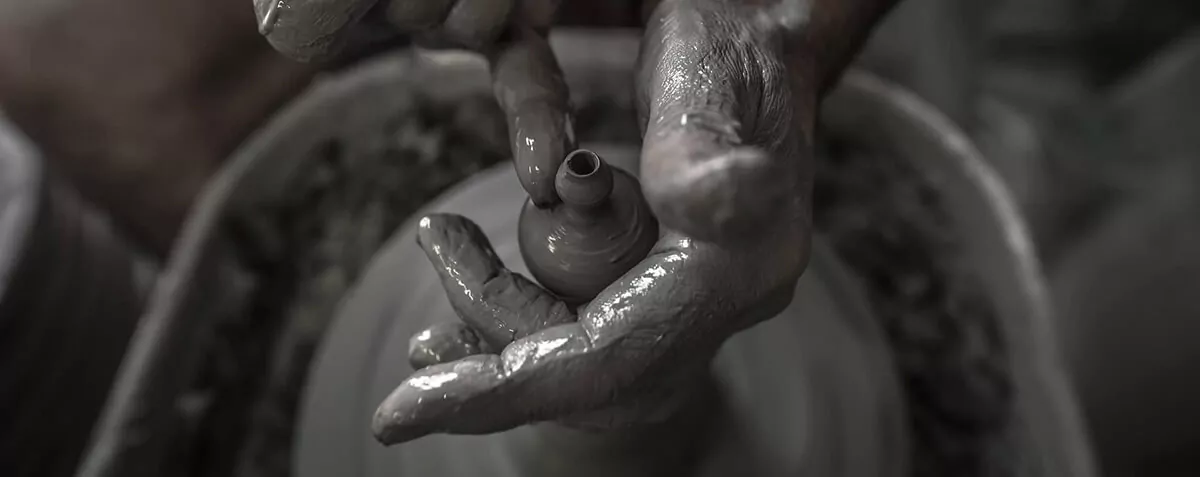
There is a village in the Salento with ceramics written into its name: Cutrofiano, from the cutrubbi, the terracotta vessels once used to collect olive oil. For about ten evenings in August that name becomes a description again — the old centre fills with wheels, stalls and master potters working in front of everyone.
What it is, in two lines
It is a fair and market, not a trade show shut inside a hall: the exhibition moves along the lanes of the old centre, and the fixed points are the stables of the Ducal Palace and the Ceramics Museum. Entry is free, you walk round as you like, and what makes it different from any craft market is that the potters are there in person: you can watch them at the wheel, ask questions, and buy directly from whoever made the piece.
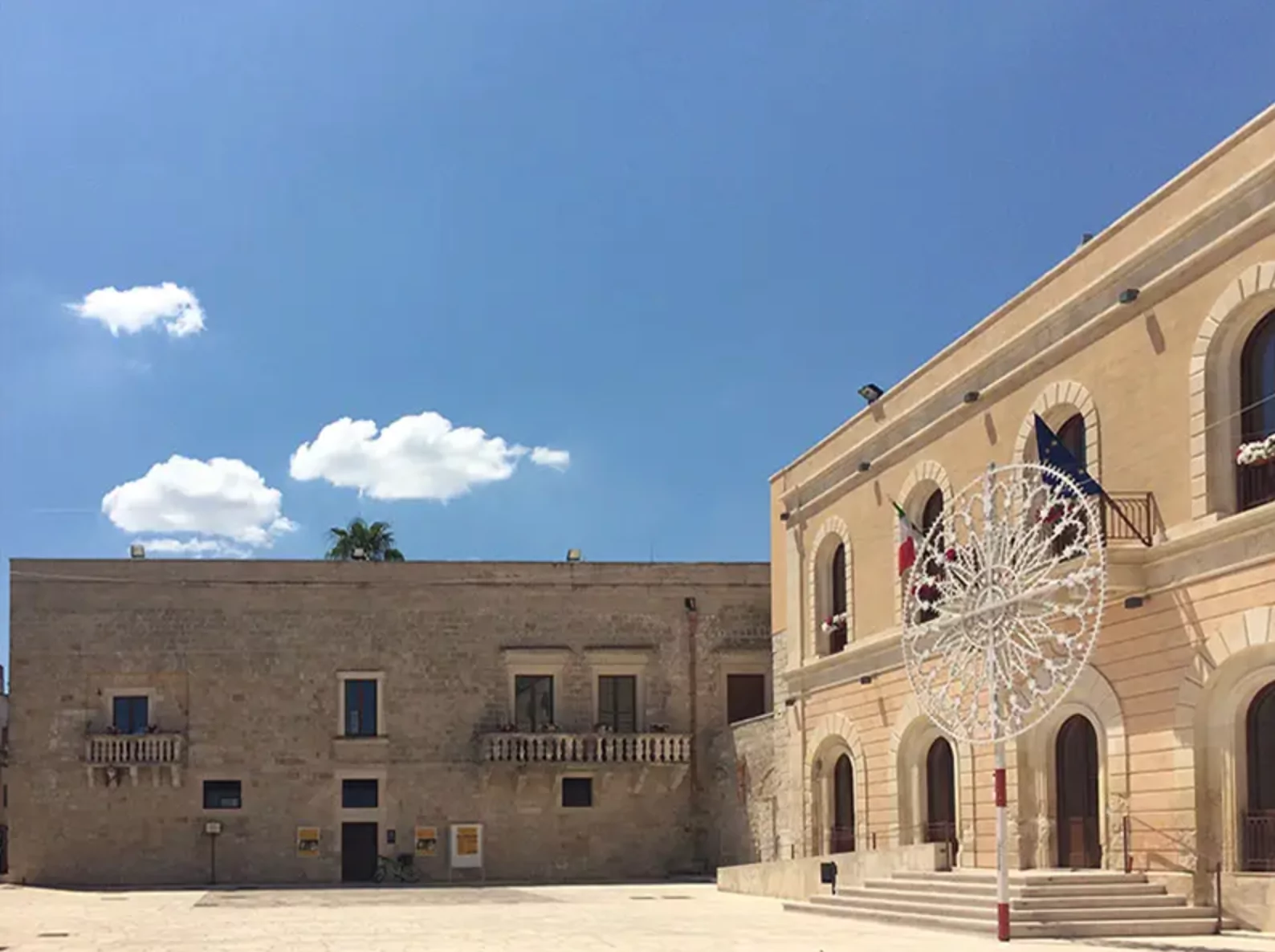
Everything happens within a few hundred metres: Piazza Cavallotti, Piazza Municipio, the Palazzo Ducale Filomarini and the Ceramics Museum.
Why Cutrofiano, of all places
In the whole of Puglia there are three recognised Cities of Ceramics: Grottaglie, Laterza and Cutrofiano. The first two are the better known; the third is the one travellers skip most often, and yet it has the most literal history of the three, because it carries it in its name. Cutrofiano entered the circuit of the Cities of Ceramics officially in 2018.
Where the name comes from. It derives from Greek and points to the working of clay: the root is cutrubbi, the old terracotta vessels used to collect oil. Fragments of locally made ceramics found in the countryside around the village are now kept in the town Museum, and they describe a poor and very practical way of living. There are families who have worked clay here since the nineteenth century.
The village sits in the heart of the Grecìa Salentina — the enclave of the Salento where griko, a dialect of Greek origin, is still spoken — halfway between the two seas: 23 km from Gallipoli, 27 from Otranto, 30 from Lecce. Half an hour’s drive from almost anywhere you might be staying, and easy to reach by seven in the evening after the beach.
The Ceramics Museum
Founded in 1985 and housed in the Palazzo Ducale Filomarini, the former town hall, the Museum holds traditional terracotta, majolica and clay whistles. During the fair it opens with extra hours and guided visits, and it is the quickest way to understand what you are looking at when you then walk round the stalls: half an hour inside changes how you see the pieces on sale.
What an evening looks like
- It opens at 7pm and closes at midnight. The first two hours are the best: the potters are working and there is no crowd yet, so that is when you can actually talk to them.
- Music starts at 9pm, and it is free like everything else. The concerts are held in Piazza Cavallotti and Piazza Municipio.
- You eat in Piazza Cavallotti, where the food area with local produce is set up; other stands appear through the old centre.
- For children there is the carousel, the historic roundabout in Piazza Municipio, and it is free. It is why this is one of the few mid-August evenings you can bring a small child to without regretting it.
- Park outside the centre and walk the last stretch: everything is a few steps apart and a car only costs you time.
What you can buy
Production starts from the old cutrubbi and reaches everything that fills the stalls today: the pumo, the ceramic balloons, plate sets with the cockerel, and then jugs, lamps and chandeliers, decorative pieces. And the terracotta cooking pots, which here are a tool before they are a souvenir.
Each edition also picks a symbol object around which it builds the theme of the year.
If you go home without finding the right piece, the same tradition is in our online shop: the pumo, the coloured ceramic balloons and all the Apulian terracotta, thrown and painted by hand — see the shop.
The editions we have covered
We have followed the fair for several years. These are the editions we have written about, with their actual dates: this is not the complete history of the event, but what we can document from what we saw and published ourselves.
- 2018 — the 46th edition, 12 to 22 August. The year Cutrofiano officially joined the circuit of the Cities of Ceramics.
- 2019 — the 47th, 8 to 18 August. On 12 August the Notte della Taranta stopped at Cutrofiano, and the potters performed on that occasion.
- 2021 — the 49th, 8 to 19 August.
- 2026 — the 54th, 8 to 16 August: it was due to close on the 15th but was extended by one evening for the feast of San Rocco, which in much of the Salento closes the Ferragosto cycle. The symbol object was the terracotta piggy bank, tied to a charitable initiative with the Cuore Amico association. The artistic director, Fabio Blanco, put it this way: the money box speaks of patience, sacrifice and taking care of your own dreams.
A note on method, because the arithmetic works but is not enough. The four numbered editions we have documented — 46th in 2018, 47th in 2019, 49th in 2021, 54th in 2026 — are consistent with one edition a year. You could work back to the year of the first one from that, but it would be our calculation and not a fact: we would rather leave the list incomplete than fill it with deduced numbers.
Before setting off. The dates shift by a few days from year to year, and extensions are decided once the fair has already started. It is always worth checking the official channels of the comune of Cutrofiano.