In short. The pumo is a ceramic bud, hand-turned on the wheel, that has stood on Apulian balconies for centuries as a charm for prosperity and protection. Its name comes from the Roman goddess Pomona; it is not the Sicilian pine cone, whatever the souvenir shops say; and its colour is chosen on purpose, because each one carries a different wish. Here is where it comes from, what it means, when it is given, and how to tell a hand-made one from a mould.
If you have been to Puglia you have seen them, whether or not you knew what you were looking at: two glazed buds at the two ends of a balcony railing, on almost every old house in the Valle d’Itria and the Salento. They are not ornaments added later. They were a statement about the family living behind that railing.
What a pumo actually is
A pumo is a bud on the point of opening — a rosebud, in the way it is usually described — modelled in clay, glazed and fired. It is smooth, turned and rounded, and it comes in every size from a few centimetres to half a metre.
The shape is the whole meaning. A bud is not a flower: it stands for the thing about to happen rather than the thing already finished. That is why it reads as fertility, growth and abundance, and why it was given at the beginning of things rather than at the end.
Pomona, and where the name comes from
Behind the object there is a Roman cult. Pomona was the goddess of fruit, of gardens and of fruit trees — the vine and the olive included — and by extension of fertility itself. Rome gave her a priest of her own, the flamen pomonalis. She was forgotten through the Middle Ages and came back in the Renaissance, when she was painted and sculpted again.
The name of the object follows the goddess. The original root was po-, not pu-: pumo is an evolution of pomo, most likely through the vowel shift that linguists call metaphony. Both forms are correct and both are used; pumo is by far the more common today. In dialect, at Grottaglie, it is lu pumu.
A pumo is not a pigna. This is the mistake we are asked about most, and it is made by people selling them as well as by people buying them. The pigna — the pine cone — belongs to the Sicilian ceramic tradition, Caltagirone above all, and it looks different: not smooth, but covered in small raised leaves. The Apulian pumo is turned, smooth and rounded. Both are good-luck objects; only one of them is from Puglia.
A sign of standing, then a charm for everyone
With its faintly baroque silhouette, the pumo was for centuries a mark of wealth and social distinction. The better-off families of Puglia used them to decorate the railings of their balconies and the handrails of their staircases, often adding a heraldic element so that the house could be told apart from its neighbours. The potters made them in endless variations, and no two families ended up with quite the same materials or colours.
Alongside that there was the popular belief, which had nothing to do with status: that the pumo protected against bad luck. A bud in ceramic stood for the purity of a shoot, for the capacity to regenerate, for fertility and plenty — everything a household would wish for itself, whatever its rank.
Where it goes, and why in pairs
Traditionally the pumo went on the doorway, on columns and gateposts, and above all on the balcony — in pairs, one at each end. Two more were placed on either side of the marriage bed, for the same reason: the pumo is a symbol of prosperity and fertility, and the pair repeats the principle of the fertile duality, two elements that together make life.
The balcony as a message board. Putting two new pumi at the ends of a balcony was not only decoration, it was communication. In a rural society where every family knew every other, certain visible signs carried precise information to the neighbourhood: a new pair could announce a wedding on the way, a birth, a good harvest. Walk through Grottaglie or the Valle d’Itria today and the pairs are still there, on the oldest houses.
Indoors it now goes anywhere — a kitchen shelf, a niche in the bathroom (there are scented ones), a side table, a garden or a porch among the plants. It also works in commercial spaces: a few pumi are enough to give a food shop, a bar or a seaside place an immediately Apulian identity.
The colours, and what each one says
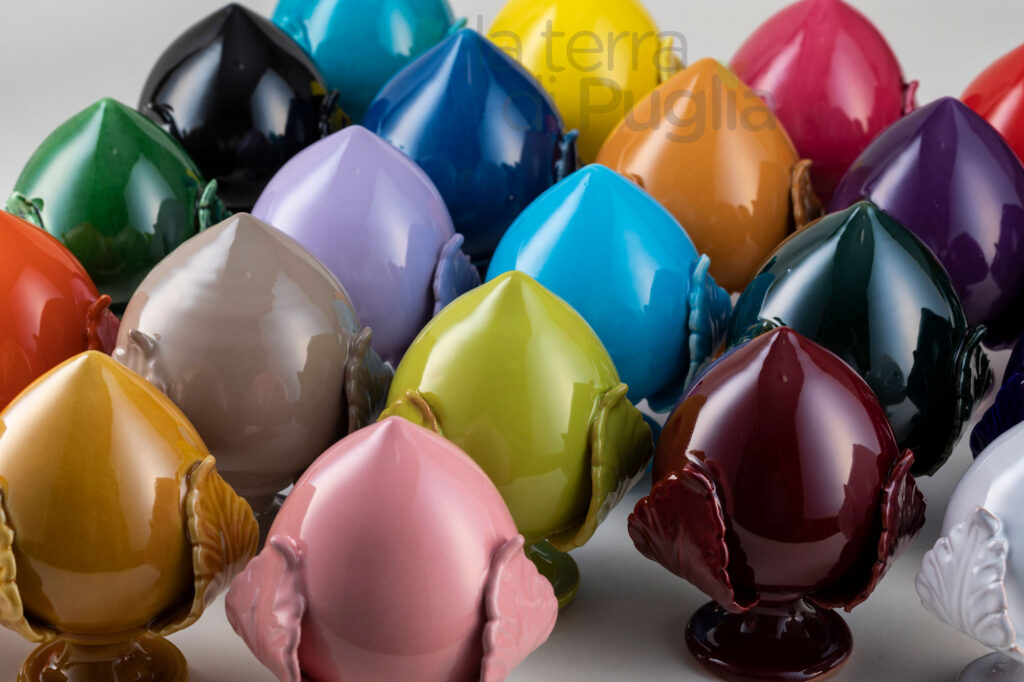
The colour is not a detail. If the pumo is a gift, and especially if it is a wedding favour, it is chosen either to match the tones of the event or to carry a specific wish.
- White — the one that is never wrong: elegant, versatile, suits any occasion and any interior. The choice for people you do not know well.
- Blue and light blue — calm and quiet, the sea and the holidays: right for christenings and for peaceable people.
- Pink — for brides and for little girls; sweetness and femininity.
- Red and burgundy — the colour of love. A red bud about to open is a declaration, at any age. Also much chosen by people with a modern, deliberate taste.
- Black — extremely elegant, for the fashionable and for anyone who likes a firm style.
- Yellow and orange — cheerfulness, good humour, friendship: ideal for mothers, for extrovert people, and for rooms like the kitchen.
- Green — nature, harmony and calm: for the sensitive and the empathetic.
When a pumo is given
A bud about to open is the natural gift for a couple starting out and for a life starting out: weddings and christenings first of all. But it travels further than that — a graduation, where it becomes a charm for the career beginning; a retirement, with the wish that the life after work should flower; a move into a first shared home; a birthday; Mother’s Day or International Women’s Day, since a bud in flower is a feminine symbol.
And if you are the one invited to the wedding, a hand-made ceramic pumo is hard to get wrong: it suits any house and it does not date.
How to recognise a real one
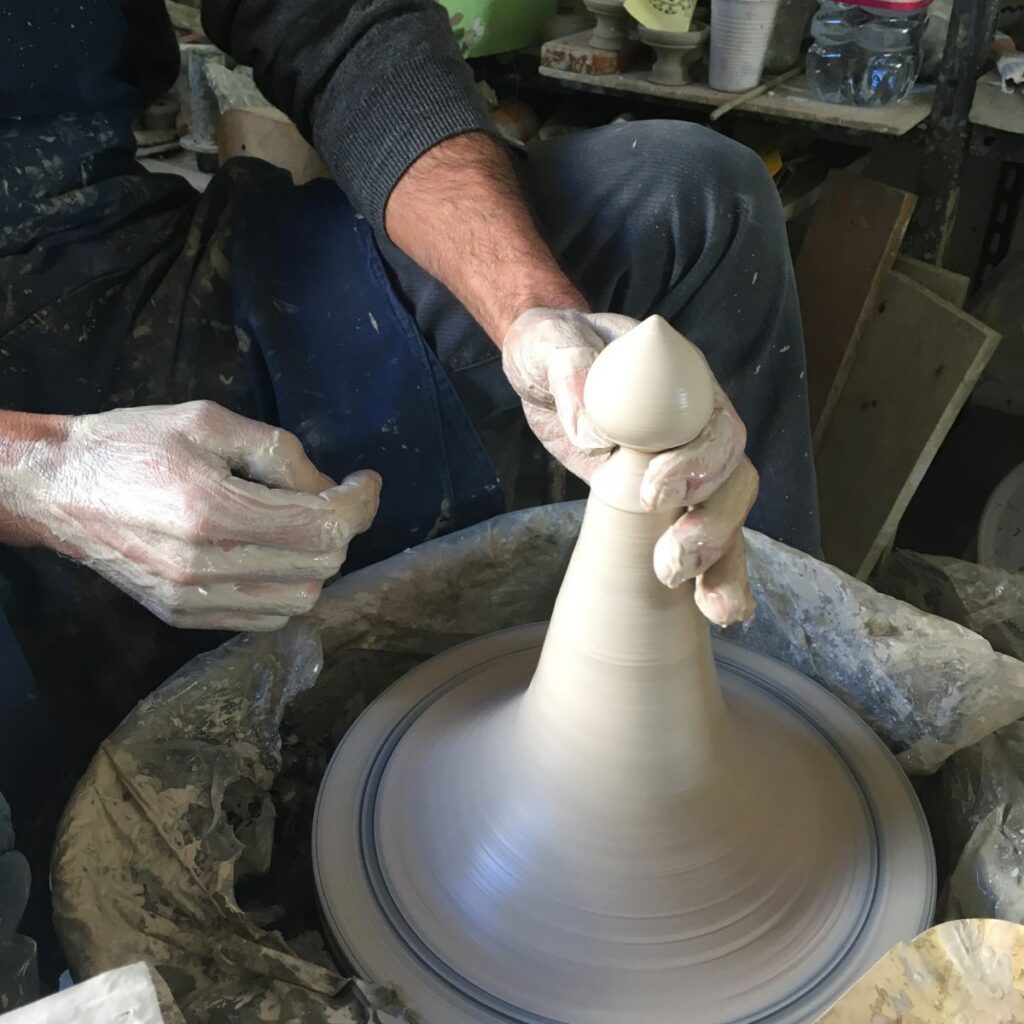
The market — online especially — is full of imitations pressed in series from a mould, often made a long way from Puglia. At a glance they look like the original. In the hand they do not. An authentic Apulian pumo is always hand-turned on the wheel, and four things give the difference away:
- The line. A turned pumo is fine and sinuous; a moulded one comes out thicker, rounder in the belly and coarser. This is the difference you notice first, even with an untrained eye.
- The small irregularities in the glaze and in the proportions. They are evidence of hand work, not flaws.
- The weight. Quality ceramic is more substantial than a resin or industrial version.
- The potter’s mark, almost always present on the base of a hand-made piece.
The pumo today
It has become common in a way it never used to be, and that is not a loss. From an object reserved for the nobility it has turned into a democratic one — bought by anyone, in any size, from a pocket charm to a collector’s piece half a metre high. It turns up at international craft fairs, in design shops, in souvenir boutiques far from Italy, and it has done all that without losing its identity. It is one of the few Italian craft objects to have managed that.
Ours are turned and painted by hand. Every pumo we sell is shaped on the wheel, glazed and coloured by Apulian potters. You choose size and colour and the piece is made for you — including in quantity, and with personalisation, for weddings and ceremonies. See the glazed ceramic pumo in the shop, or the whole good-luck and gift section. Large orders take time to make: for a big quantity, allow about thirty days.
The pumo comes out of the same workshops as everything else described in Apulian ceramics, and the town most identified with it is Grottaglie — though it is made by hand at Cutrofiano and Laterza too.
If you are taking one home, our guide on what to bring back from Puglia explains how to tell a pumo thrown on the wheel from one made in a mould — and what else is worth the space in your case.