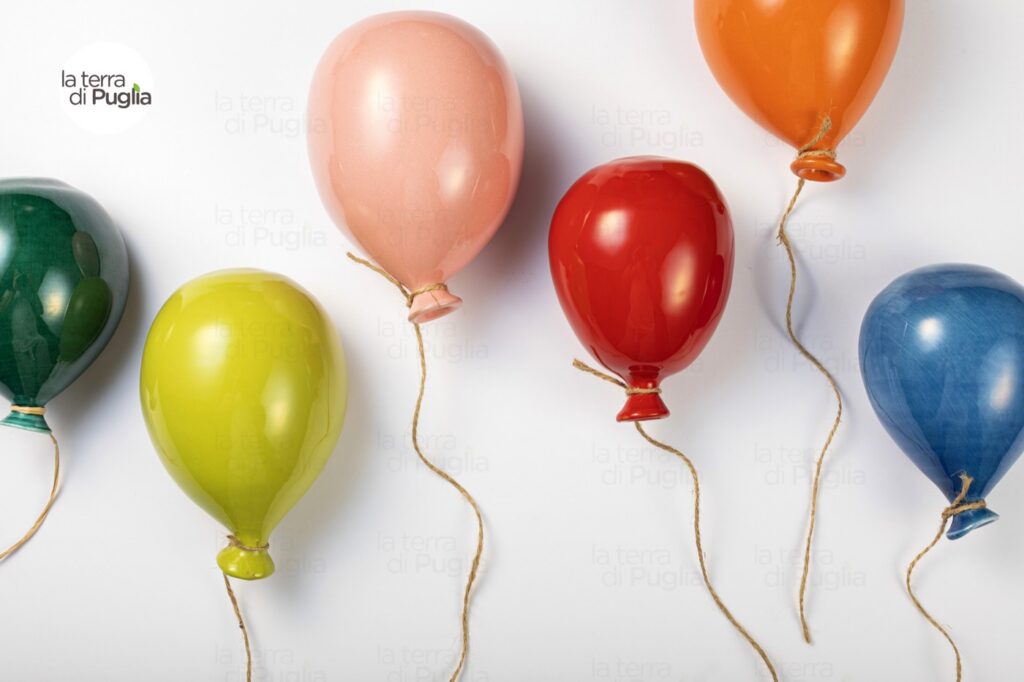
In short. Ceramic balloons are one of the most recognisable things made in Puglia today: the shape of a floating balloon, in the weight of glazed terracotta. Each one is turned on the wheel, glazed by hand — the back included — and fired twice. They run from 8 to 50 cm, they hang from a hole in the back, and in the small sizes they have become a standard wedding and christening favour. Here is how they are made, how to choose the colour, and the questions we are actually asked.
A ceramic balloon does not look like any other object in a room. It reproduces the lightness of a real balloon in the solidity of glazed terracotta, and it is that contradiction — fragile in appearance, solid in substance — that makes people stop and look at it.
An old craft in a new shape
The object is modern; the way it is made is not. Behind every balloon is the same sequence that has defined Apulian ceramics for centuries: modelling on the wheel, where the clay takes its form in the potter’s hands; a first firing, the biscuit; glazing entirely by hand, the back included; and a second firing that fixes the colour and the shine.
It takes experience. Balancing the lightness of the shape against the strength needed to survive two passes through the kiln is not a given, and it is the reason the workshops of Grottaglie, Cutrofiano and Laterza — the three historic centres of ceramics in Puglia — still make them by the same gestures handed down from one generation to the next.
The practical consequence is that no two balloons are truly identical. Every piece carries small variations of colour and form. That is what separates it from an object pressed out of a mould in series.
Choosing the colour
Colour matters as much as size, and it changes with the occasion — or with the room.
- Christenings and first communions — soft tones: cream, white, pale pink, light blue.
- Graduations — red is still the traditional choice for the favour.
- Confirmations and mixed ceremonies — yellow, light blue, green, orange, or mixed colours as you like.
- Modern interiors — tone on tone in white, black or taupe, keeping to the palette of the room.
One practical warning. Do not hang a white balloon on a white wall. A minimum of contrast is what makes the piece visible at all; without it the decorative effect disappears entirely, and you have spent money on something nobody sees.
Hanging them, and where to put them
Every balloon has a hole in the back, made for the purpose: a simple nail or a small hook is all it takes, with no special fitting.
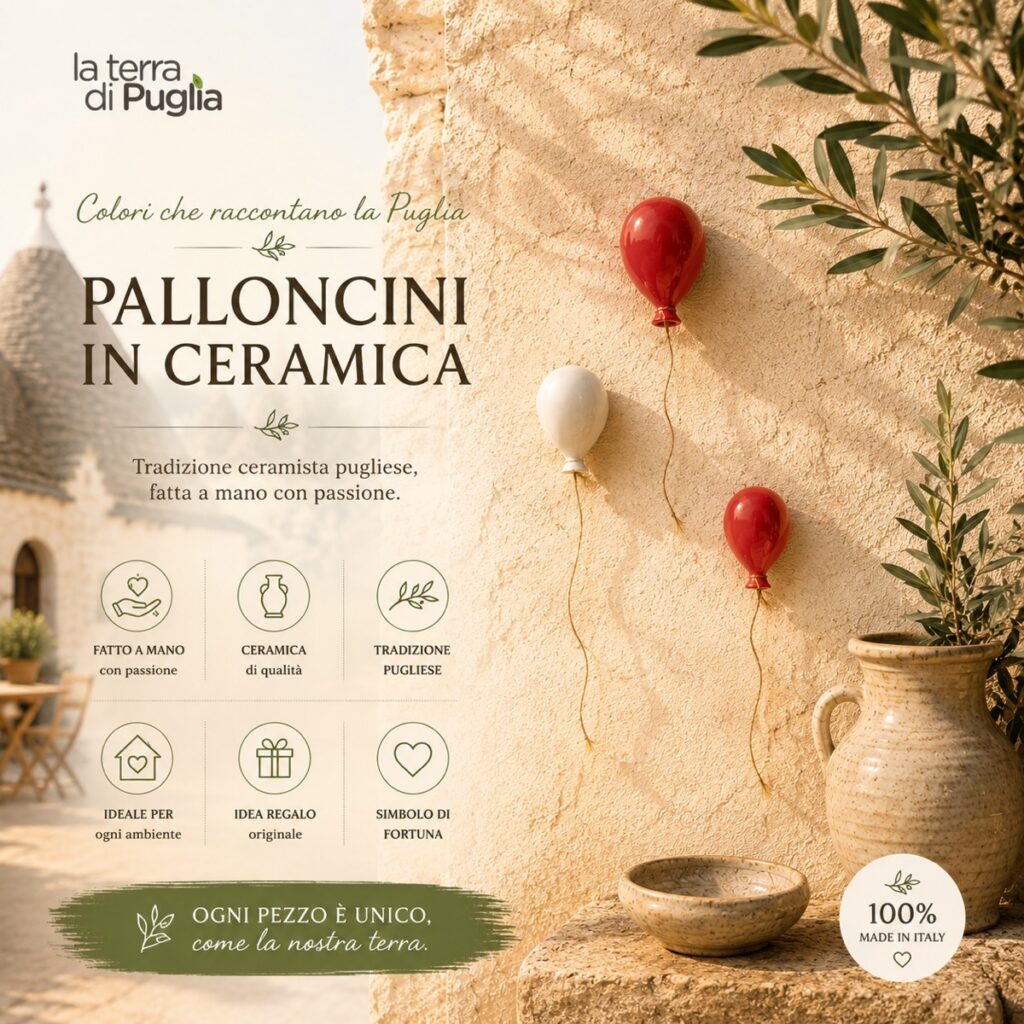
A single one works well to bring colour to an otherwise bare wall, but they are at their best in a group: mixing sizes and colours produces something close to movement, as though they really were rising. A short length of string or a thin ribbon tied at the base — at the point that stands for the neck of the balloon — reinforces the effect.
They suit almost any space: children’s rooms, corridors, entrance halls, and equally shop interiors and window displays. Outdoors — terraces, pergolas, gardens — the combination of green and white is among the most successful.
Sizes, price and personalisation
- 8 to 50 cm — the range of sizes available.
- Entirely hand-made, the turning on the wheel included.
- Two firings in the kiln for every piece.
- From 30 pieces upwards for personalisation.
The price follows the size and the complexity of the decoration. The smallest pieces, the ones used as favours, stay in a range designed to be bought in quantity; the larger sizes, meant to stand on their own as furnishing, cost more, in proportion to the longer work they take.
They can be personalised with a dedication, a name or a small logo from a minimum number of pieces upwards — which also makes them a workable corporate gift.
Why they work as a wedding favour
In the smaller sizes, ceramic balloons have become a recurring choice for christenings, communions and weddings. They are economical to produce in quantity, easy to tell apart by colour according to the theme of the ceremony, and — unlike a good many traditional favours — they have a real use once they reach the home of the person who received them, instead of ending up forgotten in a drawer.
For godparents and witnesses, the elegant solution is the same model in a larger size, which marks the difference in role without changing the look of the set.
Questions we are asked
Are they really made one by one, by hand?
Yes. Every piece is turned on the wheel and glazed by hand by a potter, the back included. They are not produced in series from moulds, and that is precisely why two balloons are never perfectly identical.
Can I order a large quantity for an event?
Yes. For weddings, christenings and other ceremonies there is no limit: you order as many as you need, with personalisation available from a minimum number of pieces upwards.
Is there a wholesale price?
No — and it is better to say so straight away. In trade, wholesale means two specific things: lower prices and compulsory minimum packs. Neither applies to ceramic balloons. The price is the shop price, for everyone, shops and resellers included. These are pieces made by hand by a potter, one at a time, and on that kind of work there is no discount scale that holds up. A wholesale list does exist on our side, but only for food products, and it is a separate catalogue.
What sizes and colours are available?
From 8 cm up to 50 cm, with a palette running from white and the pastel tones through to full colours such as red, light blue and green. The combinations of size and colour are all but unlimited.
What happens if a piece arrives damaged?
The packaging is designed to protect them in transit, but if a piece does arrive damaged, contact the seller directly and it will be replaced.
See them. The full range of coloured ceramic balloons is in the shop, alongside the pumo and the other good-luck pieces. We ship them wrapped for the journey.