The Carciofo Brindisino, the artichoke of Brindisi, has been a Protected Geographical Indication (PGI) since 2011, grown in eight towns in the province of Brindisi, in southern Puglia. Its official rules set the harvest from 1 November to 30 May: by late November the season has just begun. Here are the rules that define it, how to recognise it in a shop and where it comes from.
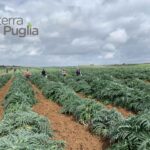
Between late autumn and spring, in the countryside around Brindisi, artichokes are picked by hand, one at a time. Those grown in the eight towns of the protected area, from the local variety and following precise rules, may carry a protected name on the label: Carciofo Brindisino PGI.
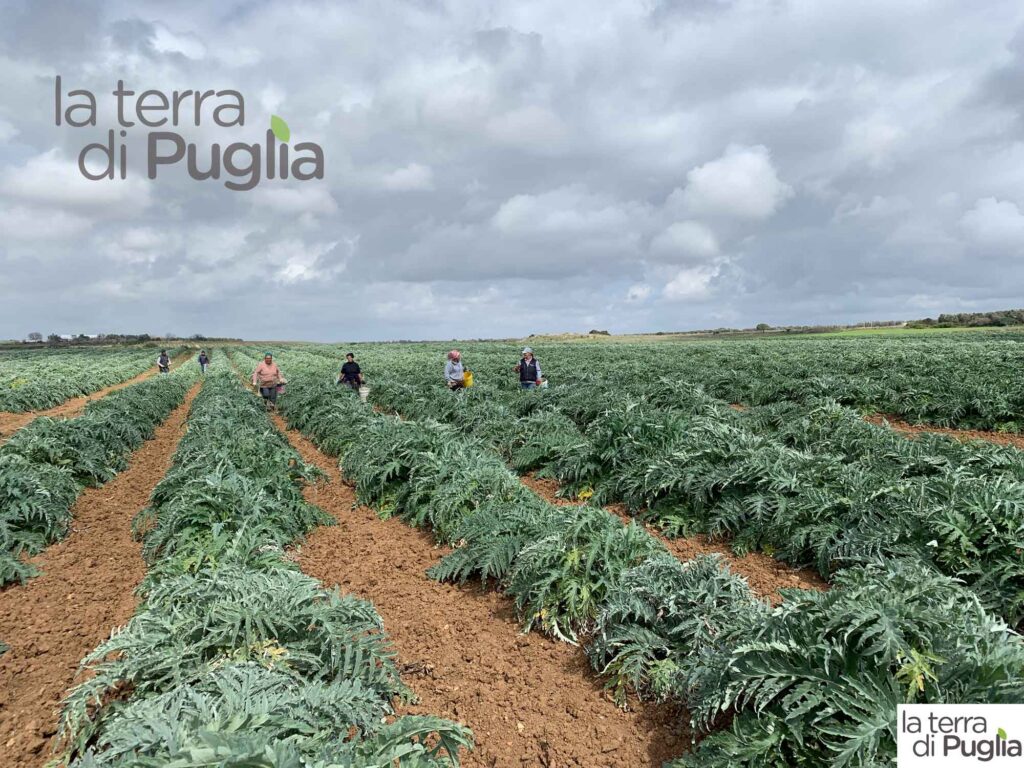
Apulian artichokes. Looks alone will not tell you it is Carciofo Brindisino PGI: the label, with the logo and the EU symbol, is what counts.
A PGI from 2011, for fresh artichokes only
A PGI is an EU label that ties a food to the place it comes from and to a set of production rules, the “specification”. The name was registered by the European Commission with Regulation (EU) No 1120 of 2011, and the Italian agriculture ministry published the specification in the Italian Official Gazette on 3 December 2011. Its first line already says a lot: the PGI is reserved for fresh artichokes.
The artichoke belongs to the species Cynara cardunculus subsp. scolymus and to the “Carciofo Brindisino” ecotype, a local population adapted to the area: a medium-sized plant with green, spineless leaves. When it goes on sale, the head must have these features:
- a cylindrical shape, at least 8 cm tall and 6 cm wide, fairly compact;
- outer bracts (the leaves of the head) green with violet shading, without a spine or sometimes with a small one; inner bracts greenish white;
- a stem no longer than 10 cm;
- tender, full-flavoured heads, with a fleshy base to the bracts and a fleshy heart, and an average total fibre content of 5 g per 100 g of edible part;
- only the trade classes “Extra” and “I”.
When it is in season
Here the specification is precise: the young plants go into the fields between July and October, and the harvest starts on 1 November and ends on 30 May of the following year. The plant’s cycle runs from July to June. The same text notes that the crop is early enough to reach the market from October. So in late November the Carciofo Brindisino PGI is in season, and it stays so until late spring.
Where it grows: eight towns and the coastal “tufi”
The production area covers the whole territory of Brindisi, Cellino San Marco, Mesagne, San Donaci, San Pietro Vernotico, Torchiarolo, San Vito dei Normanni and Carovigno. According to the specification, its tenderness and flavour come from the sandy, chalky coastal soils known locally as “tufi”, which run along the Adriatic coast around Brindisi: soils rich in potassium, on flat land.
The work stays local too. The artichoke is picked by hand, cutting the stem to no more than 10 cm, with one or two leaves at most, and it has to be prepared and packed within the same eight towns: it is a perishable product that travels badly before it has been trimmed and packed.
Did you know? The specification also traces the history. The first record of the artichoke in the Salento, the southern tip of Puglia, dates from 1736, when the seminary of Otranto twice served artichokes grown in the area, in April. In 1773 the abbot Vincenzo Corrado, from Oria, gave about fifteen recipes with artichokes. The first statistics for the province of Brindisi, in 1930, counted about 60 hectares, mainly in Carovigno, Mesagne, Brindisi and San Vito dei Normanni; the figures from Istat, the Italian statistics institute, quoted in the text pass 2,000 hectares in 1961 and reach 9,000 in the 1980s. At the time of registration the province supplied about 20% of Italy’s artichokes.
How to recognise it in a shop
Carciofo Brindisino PGI is sold in closed packs of 1 to 25 artichokes, made of plant material, cardboard or another recyclable material, with a seal that breaks when opened. The label must show:
- the name “Carciofo Brindisino” and the EU PGI symbol;
- the name or code of the packer and of the grower;
- the class, “Extra” or “I”, and the number of artichokes.
The logo is a light orange circle with a toothed edge and, in the middle, a green artichoke with a human look; behind it stands Brindisi’s Monument to the Sailor, with the sky, the sea and the land. The specification forbids adding any description it does not provide for, or any words of praise.
In the kitchen, and the other artichoke of the province
The specification links the artichoke to the local cooking and to the “great number of artichoke dishes” that mark it. Our recipe for artichokes in oil shows how they are preserved in Puglia.
In the same province, Slow Food protects a different artichoke as one of its “Presidia”: the artichoke of the Terra dei Messapi, grown around Carovigno, Ostuni, San Vito dei Normanni, San Michele Salentino and Ceglie Messapica. There the harvest runs from December to May, the smallest May heads are preserved in oil or simply in water and sea salt, and the home recipe is artichokes stuffed with cheese, eggs, stale bread, breadcrumbs, parsley, lemon, mint and a little garlic, cooked slowly in a pan with tomato sauce or broth.
The Carciofo Brindisino is one of the entries in the complete list of PDO and PGI products of Puglia, together with the region’s other protected fruit and vegetables.
Artichokes all year round. When the fresh season is over, there are preserves. In our online shop you will find artichokes in oil “alla crudaiola”: small Apulian artichokes, trimmed, blanched in water and vinegar and covered with extra virgin olive oil. They are not PGI, because the indication only applies to fresh artichokes.