
In summer the Gargano means beaches and sea caves. In October it becomes something else: the Foresta Umbra, the green heart of the promontory, changes colour, the autumn rains soak the woods and the villages go back to the people who live there. Here is what to know before going now — the trails, the World Heritage beech forests, Monte Sant’Angelo and its two UNESCO sites — and why autumn is the season when the Gargano makes the most sense.
The Gargano is the spur on Italy’s boot, in the north of Puglia. If you only know it in August, you know half of it. The other half is inland, a few dozen kilometres from the sea: a forest so dense and so tall that it looks out of place in southern Italy. In autumn, when the beaches empty, that is where to head.
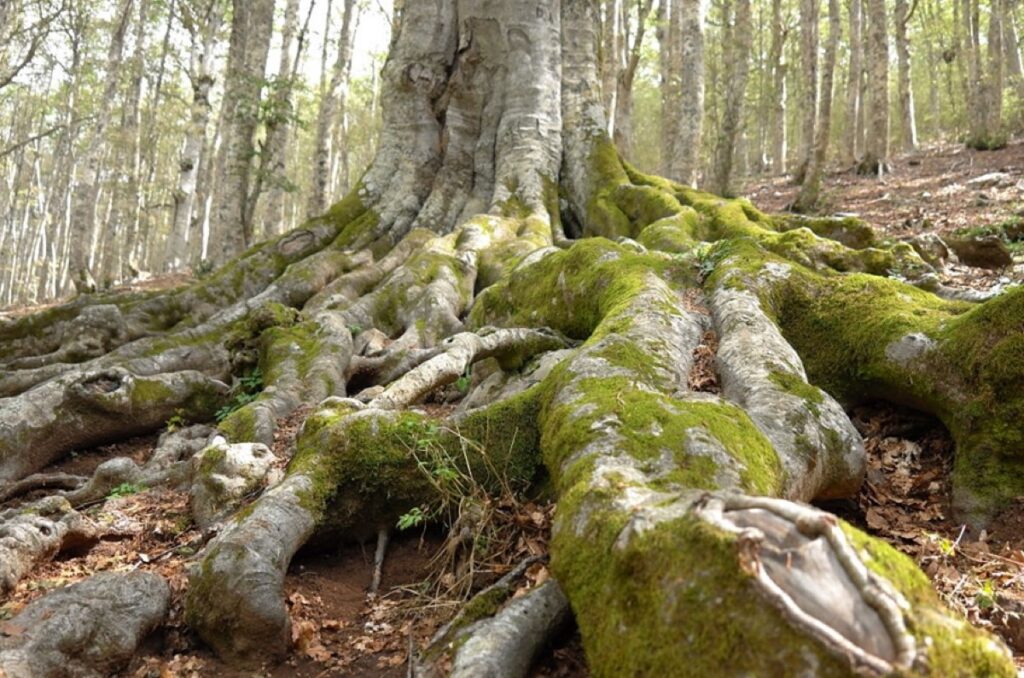
The roots of an ancient beech in the Foresta Umbra, the forest at the centre of the Gargano promontory.
The Foresta Umbra, which has nothing to do with Umbria
First the name, because it is misleading: the Foresta Umbra is on the Gargano, in Puglia, not in the region of Umbria. Nobody knows for sure where “Umbra” comes from: some link it to the ancient Umbri, others, more simply, to the shade (ombra in Italian) of such a thick forest. Neither explanation, says the website of Italy’s UNESCO beech forests, is really proven.
It is what remains of the great ancient forest that once covered the promontory, the Nemus garganicum mentioned by ancient writers from Virgil to Strabo, and today it is the heart of the Gargano National Park. Inside are the Umbra and Falascone reserves, with the oldest beech woods, and Sfilzi, home to the only perennial spring in the Gargano’s mountains. Here beech trees reach 350 years and 45 metres, when elsewhere, in similar conditions, they do not go beyond 250 years and 35 metres. These beech forests are listed by UNESCO as World Heritage, together with Europe’s other ancient beech forests.
The forest has been public land for a century and a half: after the Grimaldi family, the Bourbons and the new Kingdom of Italy, which wanted to sell it, it was declared inalienable and handed to the forestry service in March 1866.
Why go in autumn
The Gargano’s climate changes enormously between the coast and the interior. On the coast it rains little; in the Foresta Umbra about 1,200 millimetres of rain fall each year, mostly between autumn and winter. That is when the woods are most alive: the undergrowth fills out, the beeches change colour before dropping their leaves, and dry leaves carpet the trails.
There are fourteen trails, laid out by the former State Forestry Corps, now the Forestry Carabinieri, along old mule tracks: wooden signs with walking times at every trailhead and junction, and yellow marks on the trees. Two to start with:
- Cutino d’Umbra — 500 metres, half an hour, flat and accessible to people with limited mobility, with panels in Braille too. It loops round the only pond that does not dry up in summer. Open all year, free.
- Fonte Sfilzi – Casalini — 8 kilometres, about 300 metres of climb, four hours: challenging, for experienced hikers only.
By car: A14 motorway, exit Poggio Imperiale-Lesina, then the Gargano expressway to Vico del Gargano and the signs for Foresta Umbra-Monte Sant’Angelo.
Monte Sant’Angelo, the town with two UNESCO sites
On the other side of the forest is Monte Sant’Angelo, which has something unique: two World Heritage sites. One is the Sanctuary of Saint Michael the Archangel, inscribed in 2011 as part of the serial site “The Longobards in Italy. Places of Power”; the other is the Foresta Umbra’s beech woods. Visiting the sanctuary and then walking in the forest on the same day is the easiest way to see both.
Did you know? The Gargano is cut off from the Apennines by the Tavoliere plain, which makes it almost a mountain island in the middle of Puglia. Its highest peak, Monte Calvo, reaches 1,065 metres, and its flora counts about 2,300 species, over a third of Italy’s. Coming down from the north, it is the first complete example of Mediterranean vegetation on the peninsula.
The villages out of season
In autumn the coastal villages become villages again. Vieste and Peschici can be walked without the August crowds. A practical warning if you are thinking of the Tremiti Islands: boats from Vieste, Rodi Garganico and Peschici run only from June to September; all year round, you sail from Termoli.
October is also the month of new olive oil. In Mattinata, the sixth edition of FèXtra, the extra virgin olive oil festival, has just closed on 18 October: ten days of oil mills, tastings and walks.
Read on. To get off the beaten track, read the Gargano you do not know; for the promontory’s oil, see our page on olive oil from the Gargano.




You must be logged in to post a comment Login