In short. The Mediterranean diet is recognised by UNESCO as intangible cultural heritage of humanity. What appears in nutrition books, though, is usually a stylised version. This is the real one — the Apulian one: the ten foods that make up the everyday table of people who have lived here for generations.
There is a substantial difference between the Mediterranean diet as nutritionists describe it and the one actually eaten in Puglia. The first is an optimised dietary pattern, with macronutrient percentages and calibrated portions. The second is a culture — handed-down habits, seasonal produce, poor recipes that became excellent cooking.
Puglia is probably the Italian region that embodies that culture in its most authentic form. Not because it was chosen as a model, but because historical, economic and geographical conditions produced a table that coincides almost exactly with what science now considers best for health.
In this article: the ten cardinal foods of the everyday Apulian table, why they are good for you, how they are used in the kitchen — and where to find them if you are not in Puglia.
1️⃣ Extra virgin olive oil — the base of everything
We start with oil not out of rhetorical habit, but because in Puglia extra virgin olive oil is not a condiment, it is a structural ingredient. It goes on the morning bruschetta, it finishes the broad bean puree raw, it dresses boiled vegetables, it closes a pot of pulses. An Apulian household gets through something like 15 to 20 litres a year — not as a statistic, but as a concrete measure of how central it is.
Nutritionally, Apulian extra virgin — the Coratina and Ogliarola cultivars in particular — is among the richest in polyphenols anywhere. Hydroxytyrosol, oleuropein, oleocanthal: molecules with documented anti-inflammatory effects, protective of the cardiovascular and nervous systems.
→ Apulian extra virgin olive oil in the shop — delicate, fruity and organic
2️⃣ Broad beans and chicory — the poor dish nutritionists study most
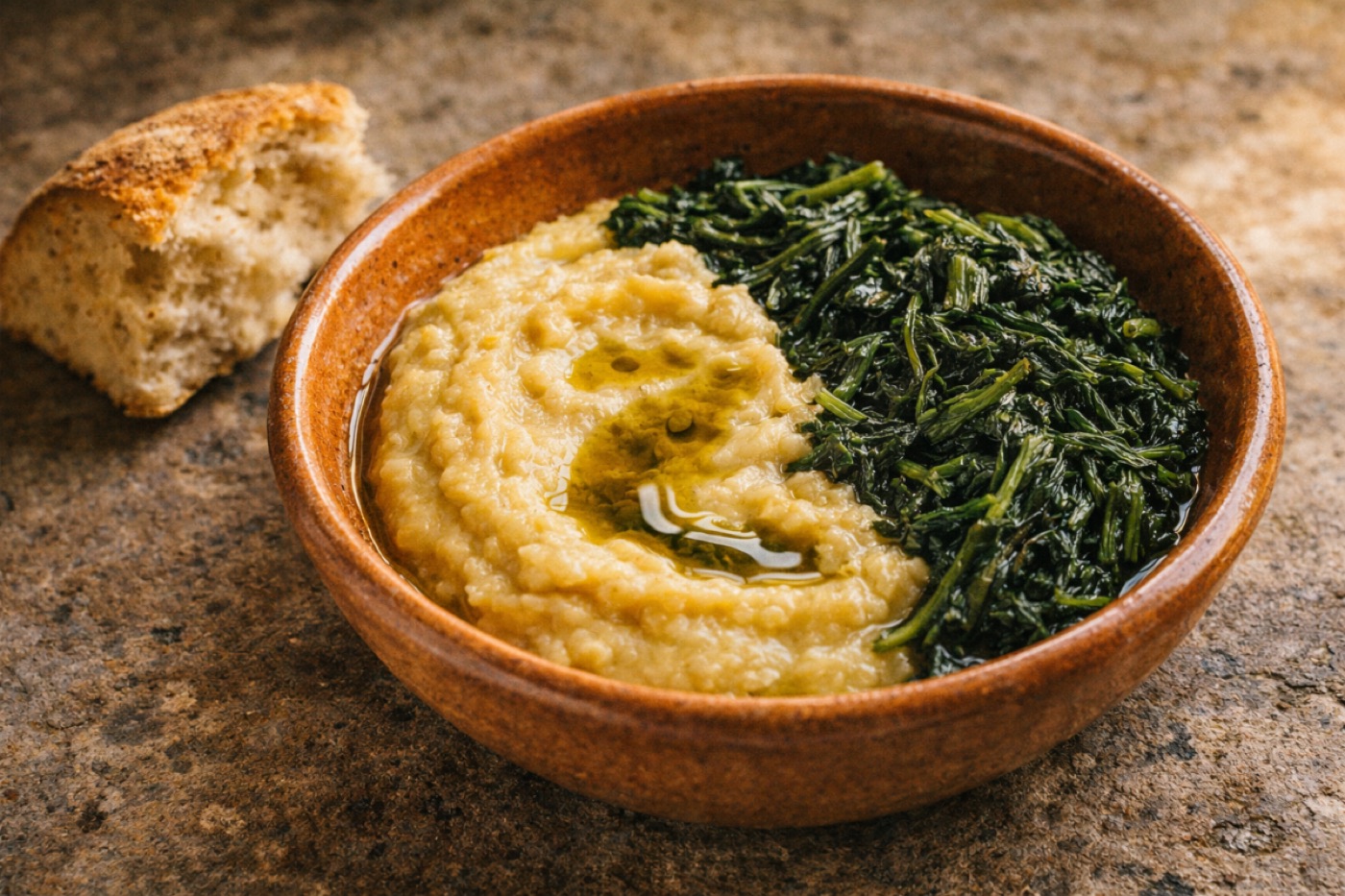
If you had to choose one dish as the symbol of the Apulian Mediterranean diet, it would be this: a puree of dried broad beans with wild chicory. A peasant dish by definition, born of the need to eat with whatever there was. Today it is recognised as one of the most nutritionally complete combinations in traditional Italian cooking.
Broad beans bring plant protein, fibre, iron and folates. Chicory adds polyphenols, antioxidants, vitamin K and inulin — a natural prebiotic that feeds the gut microbiome. The raw extra virgin poured over the top increases the absorption of the fat-soluble vitamins. It is a complete dish that works on every front of modern nutrition — and it costs a few euros.
→ Shelled fava cuccia of Zollino — grown from native seed
3️⃣ Pulses — not once a week, every day
In traditional Apulian cooking pulses are not a lean dish to be put on the table on a Friday. They are the daily protein. Before affordable meat and the freezer arrived, pulses were the main source of protein for the great majority of families.
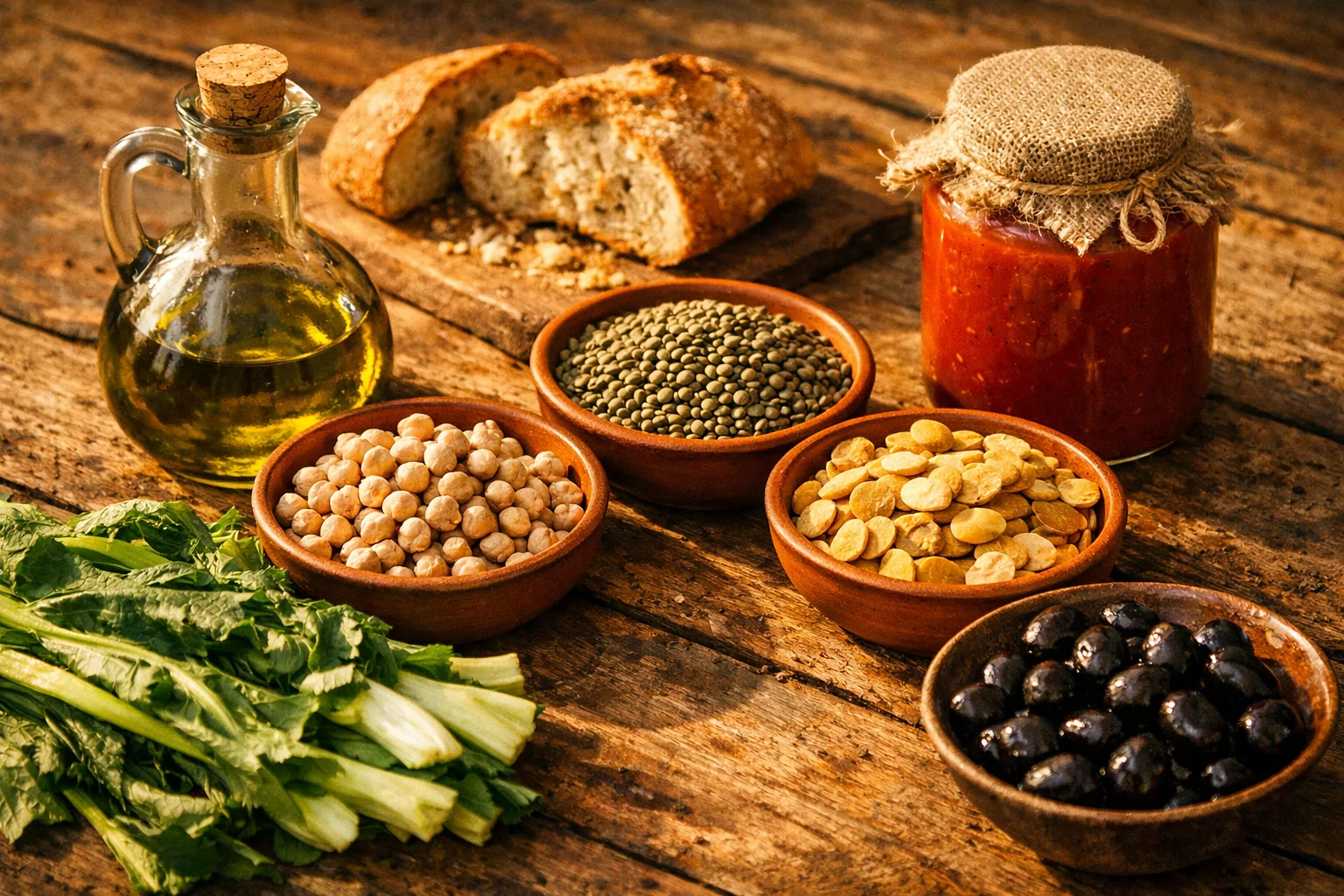
Chickpeas, lentils, black-eyed beans, grass peas, the dwarf peas of Zollino: every part of Puglia has its own native varieties, often grown from seed handed down through generations. The biodiversity of Apulian pulses is extraordinary — and many of these old varieties have better nutritional profiles than the standardised commercial ones.
🫘 The native pulses of Puglia
A native Salento variety from handed-down seed. A more intense flavour than the commercial chickpea.
Rich in plant protein, fibre, phosphorus and potassium. Made for soups and quick side dishes.
An old Salento variety: complex carbohydrate and plant protein. Ideal for Apulian pasta and beans.
Protein, magnesium and fibre. The base of the most classic pasta e fagioli in the region.
An ancient pulse that had nearly disappeared and is now being rediscovered. Rustic, excellent in winter soups.
Peas, chickpeas, grass peas, beans and lentils in one bag. The shortest way to put this tradition on the table.
4️⃣ Tomato — not the supermarket one
The Apulian tomato is not simply “tomato”. We are talking about local varieties: the fiaschetto of Torre Guaceto, the yellow tomato of the Salento, the long tomatoes dried in the sun. The opposite of the watery, tasteless thing sold twelve months a year.
The Apulian habit of making the sauce in summer — the bottles of passata put up by the family between July and August — is a cultural act before it is a culinary one. Tomatoes picked ripe, at full biological maturity, carry concentrations of lycopene up to five times those of an out-of-season tomato. Lycopene is one of the most powerful antioxidants in the Mediterranean diet, with documented protective effects on the cardiovascular system.
→ Artisan Apulian passata — red and yellow, no preservatives
→ Apulian peeled tomatoes
5️⃣ Wild and field greens — the ones you cannot buy
This is probably the hardest thing to reproduce outside Puglia: the greens of the fields. Wild chicory, turnip tops, lampascioni, friarielli, poppy leaves, borage, samphire. These are not supermarket vegetables — they grow wild or in small family plots, and they are picked with the seasons.
Wild chicory, the base of the broad bean dish, is among the richest European greens in inulin. Turnip tops, the stars of the most famous orecchiette in the world, have an extraordinary profile: vitamin C, vitamin K, folates and glucosinolates with documented anti-cancer effects. Lampascioni — the bitter wild bulbs typical of the Salento and the Murgia — are rich in flavonoids and have anti-inflammatory properties that make them unique among Mediterranean vegetables.
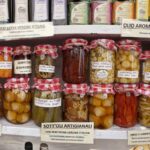
→ Apulian vegetables preserved in oil — lampascioni, turnip tops and local specialities
6️⃣ Durum wheat pasta — the kind that holds its cooking
In Puglia pasta is not one dish among others: it is the dish. And Apulian pasta has precise characteristics — local durum wheat, bronze dies, slow drying. The result has a lower glycaemic index than industrial pasta, a higher concentration of gluten protein, and above all a firmness in the pan that changes the whole experience of eating it.
Orecchiette are the iconic shape, made by hand from nothing but durum wheat flour and water, no eggs. But the repertoire is enormous: troccoli, sagne ‘ncannulate, cavatelli. Each shape exists for a particular sauce, and that logic is not arbitrary — it comes from surface, porosity and the ability to hold a dressing.
→ Artisan Apulian pasta — orecchiette, troccoli and local durum wheat
7️⃣ Bread and frise — the slow carbohydrate
Real Apulian bread — durum wheat semolina with a sourdough starter — has a distinctly lower glycaemic index than industrial white bread. Durum semolina has a more compact protein structure that slows the digestion of the starch and releases glucose more gradually. That is not a nutritionist’s footnote: it is the difference between a carbohydrate that fills you and one that leaves you hungry an hour later.
The frise — twice-baked bread discs, softened with water and dressed with tomato and oil — concentrate the same logic: complex carbohydrate, the fibre of wholemeal semolina, lycopene from the tomato, good fats from the oil. A complete meal in one simple object, and Apulians have known it for centuries.
→ Apulian frise and friselle — to soak and dress as tradition requires
8️⃣ Oily fish — omega-3 from down the road
Puglia is washed by two seas, the Adriatic and the Ionian, and the tradition of oily fish is as deep-rooted as the tradition of pulses. Anchovies, mackerel, sardines, bonito: small fish high in omega-3, with a very low environmental cost and a price that has always been within reach.
Apulian oily fish is not served under elaborate sauces. It is grilled, marinated, or preserved in oil. Marinated anchovies on the Adriatic coast, sardines done the Sicilian way in the Salento: simple cooking that keeps the nutrients and respects the raw material.
→ Apulian specialities in oil — fish and seafood from the local tradition
9️⃣ Olives — the snack nobody thinks of
In Puglia olives are not only the raw material of oil. They are an everyday snack, a starter, something to eat with bread. Olives in brine, dressed with oregano and chilli, crushed with garlic and wild fennel. Every family has its own recipe.
Nutritionally, olives are one of the most concentrated sources of oleic acid and polyphenols in their most bioavailable form — whole and unprocessed. Eating them whole means taking in those bioactive compounds without the extraction that inevitably reduces their concentration, even in the best oil.
→ Apulian olives — local varieties, preserved as tradition has it
🔟 Apulian red wine — in moderation, but every day
In the traditional Mediterranean diet red wine is present — not as a concession, but as part of the meal. A glass of Primitivo or Negroamaro at dinner is a well-established habit in adult Apulian life. Not out of a habit of drinking, but because Apulian red — with its resveratrol, anthocyanins and tannins — carries antioxidants that research associates with cardioprotective effects in moderate consumption.
Primitivo from Manduria and Negroamaro from the Salento are among the Italian reds with the highest concentration of polyphenols — a direct effect of the hot climate and intense sunlight, which stress the vine and push it to produce more protective compounds. One glass with food — not on an empty stomach, not as a compulsive aperitivo.
→ Apulian red wines — Primitivo, Negroamaro and local blends
✅ Why the Apulian diet works
It is no accident that Puglia is historically one of the Italian regions with the highest average longevity and the lowest rates of cardiovascular disease. The traditional Apulian table is what it is not through a conscious choice about health, but because generations of people ate what the land produced, in the right season, without waste.
The result is a diet whose structure coincides precisely with what nutritional science now considers optimal: an abundance of vegetables and pulses, good fats from extra virgin olive oil, complex carbohydrates from whole grains, protein mainly from plants and fish, and red wine in moderation.
No supplements, no imported superfood, no special regime. It is enough to know what Apulian grandmothers ate — and why it made sense.
cardinal foods of the everyday Apulian table
the year UNESCO recognised the Mediterranean diet as intangible heritage
Puglia is the leading region of Italy for olives and for oil
native varieties of pulses still grown in Puglia today
🏠 How to bring the Apulian diet home
If you do not live in Puglia, reproducing this cooking needs one fundamental ingredient: the right raw material. Not industrial passata, not anonymous oil, not dried pulses of unknown origin. You need what Apulian grandmothers use — and it can now be shipped to you.
- Apulian extra virgin olive oil — delicate, fruity, organic: the base of everything
- Native Apulian pulses — Zollino chickpea, Zollino bean, lentils, grass peas
- Artisan passata — red and yellow, no preservatives
- Artisan durum wheat pasta — orecchiette, troccoli, traditional shapes
- Frise and friselle — the twice-baked bread of the tradition
- Preserves and typical products — lampascioni, turnip tops, specialities in oil
- Apulian red wines — Primitivo and Negroamaro
Everything in this guide is in the shop, shipped straight from Puglia and chosen from small artisan producers: go to the shop.
Read next: what to eat in Puglia, our collection of Apulian recipes, and the pages on Apulian olive oil and Apulian wine.
The Mediterranean diet was inscribed on the UNESCO Representative List of the Intangible Cultural Heritage of Humanity in 2013, with Italy, Spain, Greece, Morocco, Cyprus, Croatia and Portugal as the nominating countries.