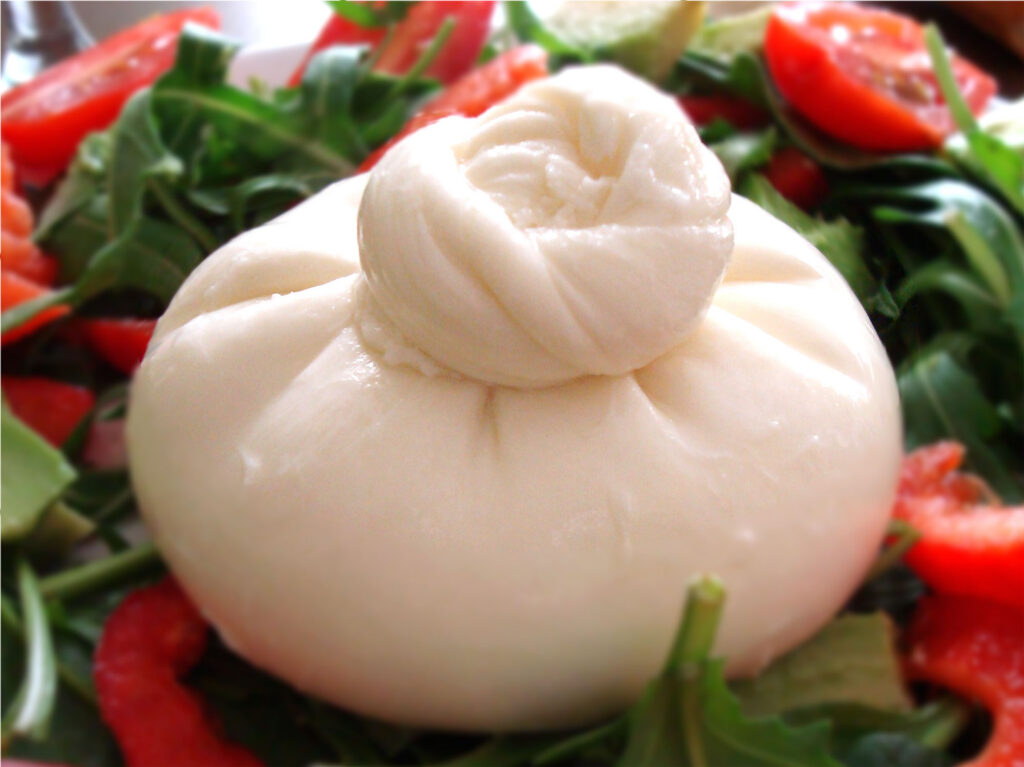
In short. Burrata was invented in 1956, on the Murgia between Andria and Castel del Monte, by a cheesemaker snowed in with milk he could not move. He wrapped cream and shreds of stretched curd inside a pouch of mozzarella. Burrata di Andria now carries an IGP, and its useful life is 24 to 48 hours.
Italian regions usually argue about who invented what. Not with burrata: we know where it came from, and roughly when.
❄️ Invented because of the snow
The year was 1956, and it was a year of extraordinary snowfalls on the Murgia, in the country between Andria and Castel del Monte. Lorenzo Bianchino, working at the masseria Piana Padula, found himself with roads blocked, supplies difficult and milk on his hands.
He borrowed an idea from the manteca, an older cheese that keeps butter inside a shell of curd: he made a pouch of stretched mozzarella and filled it with stracciatella. Nothing was wasted, and the queen of Apulian dairy was invented by accident, out of a snowstorm.
🏷️ What the IGP actually guarantees
Burrata is made in Basilicata too, but the known one is Burrata di Andria, which carries a protected geographical indication. The mark covers both the area — the Murgia between Bari and the BAT province — and the method: fresh cow’s milk of quality, curd stretched by hand, and the pouch closed with the characteristic knot.
The green tie is a date stamp. The pouch is tied with asphodel leaves or a green ribbon, and green means made today. Burrata lives 24 to 48 hours: after that the shell hardens and the stracciatella inside loses its cream. Freshness is not a detail here, it is most of the product.
🧀 Artisan or industrial: how to tell
- Artisan burrata is sweeter, more delicate, rounder in flavour
- Industrial burrata is saltier — salt is added as a preservative
- Artisan is more fragile, inside and out; the commercial version is firmer and less creamy
Mozzarella, stracciatella, burrata — three different things. Mozzarella is compact stretched curd, even all through, with the delicate taste of fresh milk. Stracciatella is curd torn by hand and mixed with fresh cream: rich and creamy, and sold on its own in tubs — extraordinary on hot bruschetta or through fresh pasta. Burrata is the two combined: a thin mozzarella shell holding the stracciatella. Cutting it open and watching the middle run out is one of the iconic moments of Apulian food.
Eat it the day you buy it. Burrata does not keep and it does not travel well — which is why the one you have had abroad, however good, is not the one people mean here. At room temperature, with bread and oil, nothing else.
What else to eat: a first-timer’s guide to Apulian food.