
New olive oil, fresh from the mill, is recognised above all in the mouth: a scent of grass and fruit, a bitterness on the tongue and a pungency that comes after, in the throat. These are not faults: the official tasting method of the International Olive Council counts them as positive attributes, and the sting even has a chemical culprit, oleocanthal. As the months pass they fade, and that is normal.
In Puglia the olive mills started up again in mid-September, and between October and November the oil of the new season reaches the table. This year, as we reported, the harvest is smaller almost everywhere, except in the Salento. Anyone tasting new oil on their first try is often surprised: it is bitter and it stings.
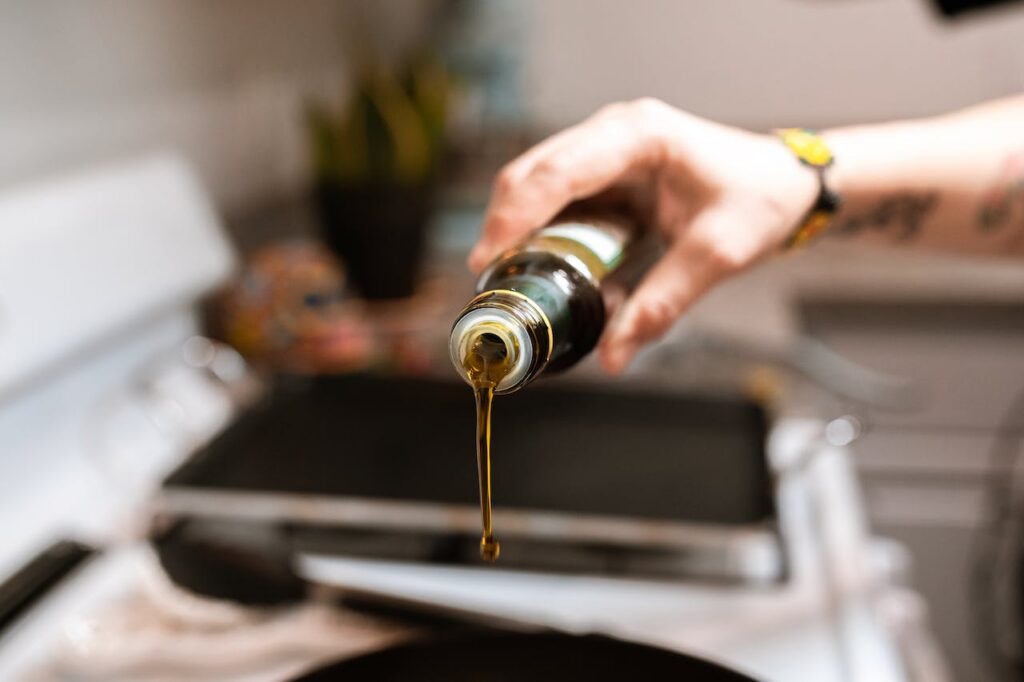
The dark glass of the bottle is not for show: light is one of olive oil’s enemies.
The colour does not tell you if it is good
Freshly pressed oil is often a bright green, and the green comes from chlorophylls: research on the colour of virgin olive oils explains that it ranges from intense green to yellow-brown depending on the composition of the olive, and that chlorophyll content is linked to how ripe the fruit was when it was picked. Greener olives, greener oil.
But colour tells you when and from what the oil was made, not how good it is. In official tastings the oil is served in a dark glass, chosen precisely so that tasters cannot see its colour and be swayed by it: the International Olive Council’s standard for the tasting glass requires it.
The aroma: fruitiness
The official method of sensory analysis defines fruitiness as the set of smell sensations that depend on the olive variety and come from sound, fresh olives, perceived directly through the nose or, in the mouth, through the back of the nose. It distinguishes green fruitiness, reminiscent of green fruit, from ripe fruitiness, reminiscent of ripe fruit. New oil from early-picked olives is almost always on the green side: grass, artichoke, fresh almond.
Bitterness: on the tongue, straight away
In the same method, bitter is the characteristic taste of oil made from green olives or olives turning colour, and it is perceived by the taste buds at the back of the tongue, arranged in a V. It depends on phenolic compounds: a 2025 study of an extra virgin oil stored for a year links it in particular to two of them, oleuropein aglycone and oleacein.
Pungency: why it catches in the throat
Pungent, in the official definition, is a biting tactile sensation characteristic of oils produced at the start of the crop year, mainly from olives that are still unripe, felt throughout the mouth and especially in the throat. In practice, it is the signature of new oil.
The culprit has a name. In 2005 a team at the Monell Chemical Senses Center in Philadelphia reported in Nature that freshly pressed extra virgin olive oil contains oleocanthal, a phenolic compound that produces a stinging in the throat very similar to that of ibuprofen dissolved in water. In 2011 the same line of research explained why it stings there and not on the tongue: oleocanthal activates a single receptor, TRPA1, which inside the mouth is found almost only in the pharynx.
Bitter and pungent are not faults. The International Olive Council’s method lists them, together with fruitiness, among the positive attributes, at three intensities: delicate, medium and robust. An oil is called well balanced when bitterness and pungency are no more than two points above fruitiness, and mild when both stay at 2 or below. The real faults are different ones: rancid, fusty, musty. There is more in our olive oil questions and answers.
Why it softens as the months pass
The compounds that give bitterness and pungency are the same ones the oil uses up as it ages. In a study published in Food Chemistry, seven virgin olive oils kept in the dark at room temperature for 21 months lost between 43% and 73% of their total phenols, and the loss was greatest in the oils that started with the most. That is why an oil that stings in November is rounder by spring: it has not necessarily got worse, it is simply less young.
How to store new oil
- Away from light. Even a little ultraviolet light oxidises the oil: phenols, bitterness and fruitiness drop, rancidity rises. Dark glass or a metal tin, inside a cupboard, is best.
- Somewhere cool. An 18-month study found that phenols break down at similar rates at 5 and 15 degrees Celsius, but much faster at 25: so keep it away from the hob and the oven.
- Closed. Oxygen does the rest: keep the container stoppered; the most delicate compounds last longer in closed bottles with little air.
- If it is cloudy, sooner. Unfiltered new oil is the most eagerly awaited, but at room temperature it loses quality faster than filtered oil: buy it to use in the first few months. And do not leave it sitting on the deposit that forms at the bottom: one of the official faults is precisely the flavour of oil left in contact with fermenting sediment.
For everything else, see our page on Apulian extra virgin olive oil, and our piece on the olive harvest and what olio novello is.
Apulian oil in our shop. In the extra virgin olive oil section of our shop you will find oils from Puglia, from robust and fruity to more delicate.
Where this information comes from. The definitions are those of the International Olive Council’s sensory analysis method (COI/T.20/Doc. No 15, 2024) and its standard for the tasting glass (Doc. No 5); oleocanthal comes from studies published in Nature (2005) and the Journal of Neuroscience (2011); the loss of phenols and the storage advice from studies in Food Chemistry, the Journal of Agricultural and Food Chemistry and Foods. Grass, artichoke and almond are examples of how green fruitiness is described, not measurements.





You must be logged in to post a comment Login