In October, before the olive groves went to the mill, many families in Puglia set aside the biggest olives to make cracked olives (olive schiacciate): one sharp tap to split them open, a week or more of fresh water changed every day to draw out the bitterness, then garlic, wild fennel and chilli. The Puglia Region lists them as a traditional food. This is how they were made at home.
In autumn, in many kitchens across Puglia, the same sound came back every evening for a few days: a dull knock on the table, then another, then another. Nothing was being broken. The olives were being opened one by one, and the basket next to the table never seemed to get any emptier.
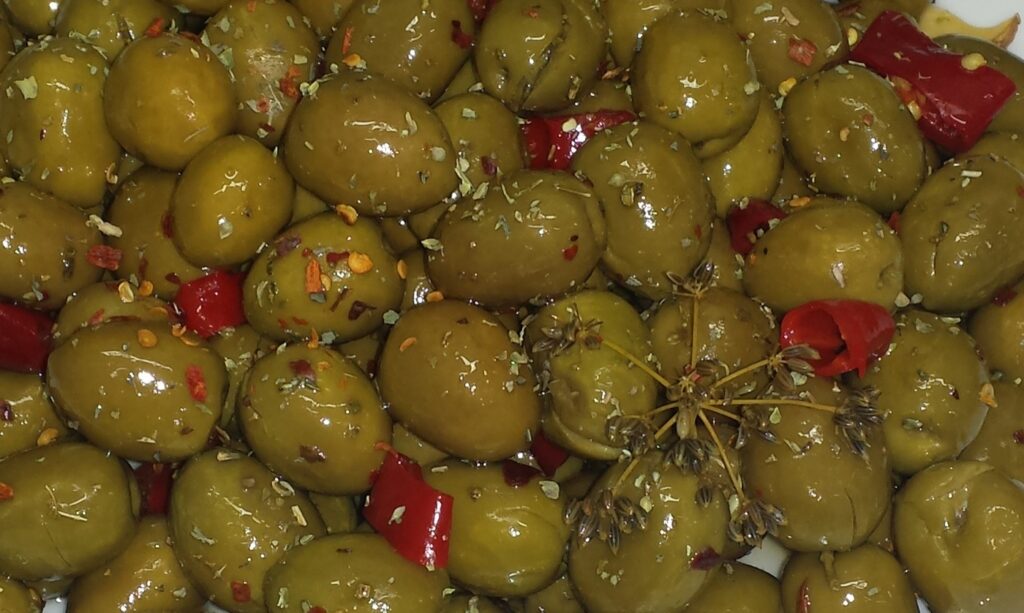
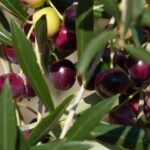
Cracked olives, dressed: the green has turned darker, and the fennel seeds cling to them.
October, the olives that never went to the mill
Every Italian region keeps an official list of its traditional food products: foods made the same way for at least twenty-five years. Puglia’s entry for cracked olives gives the season plainly: October and November, using local varieties picked green or just as they start to change colour. Their official name is Olive cazzate o schiacciate.
Not every olive qualified. The biggest ones were picked out, called ulie pasule in the Salento dialect, and the rest stayed on the tree for oil. The variety named in the entry is Ogliarola leccese, but in practice every family used whatever grew on its own patch of land.
October is also when the harvest begins for Puglia’s most famous table olive. The rules of the protected designation La Bella della Daunia (a PDO, the European label that ties a food to its place of origin), made from the Bella di Cerignola variety, set the start of picking at 1 October, straight from the tree and onto nets, so the olives never touch the ground. Green ones are picked when the skin turns from leaf green to straw green.
One sharp tap, without cracking the stone
The whole technique is a single movement. The regional entry calls for a wooden mallet: the olive is struck just hard enough to split it, without breaking the stone, or else it is scored with a knife. In many homes the mallet was replaced by a smooth stone, kept for the purpose, always the same one, and handled like a family tool.
The tap had to be sharp and measured. Too light, and the olive stayed shut; too hard, and it filled with splinters. People who had done it for years could do it without looking, and the children who were allowed to try soon learned it was not a game.
Fresh water, every single day
Once the olives are open, the part that takes patience begins. According to the regional entry they go into fresh water inside a limba, a wide-mouthed glazed earthenware basin, and the water is changed at least twice a day for seven to ten days, until the bitterness is gone. Only then are they squeezed dry and dressed with salt, chopped garlic, wild fennel and chilli; a few hours later, they are ready.
It was a fixed part of the day: in the morning before going out, in the evening on the way back in. The water poured away was a little less dark each day, and that was how you knew how far along you were.
Did you know? Olives have more than one entry on Puglia’s list of traditional foods. Besides cracked olives there are olives in brine, green olives, the table olive of Bitetto, near Bari, called ualie dolc in dialect, and Cellina olives from Nardò cured the traditional way, also known as volie alla capàsa after the earthenware jar they are kept in.
Then the jar
Cracked olives were eaten soon, sometimes the same evening, with bread. The ones meant to last until winter went a different way: into brine, in glass jars lined up in the pantry. These are two different preparations with different timings and rules, and those rules matter: home-preserved olives, done badly, are a real health risk.
That is why we do not give a recipe here. For home preserving, our page on salted olives sets out the steps. Soaking times vary from house to house, and that is normal: this is a family preparation, not a fixed formula.
Where it is still celebrated
In Martano, in the Salento, cracked olives have a whole sagra to themselves. A sagra is an Italian village food festival, with food stalls and music in the evenings. The Sagra de la Volìa Cazzata, now in its 35th edition, runs from 15 to 18 October 2026 in Largo 1 Maggio, with concerts every night and, on Sunday 18 at 1 pm, a tasting lunch that has to be booked in advance.
At the same time, out in the groves, the harvest for oil gets under way: we wrote about this year’s harvest in the 2026 olive harvest.
No olive tree of your own? Puglia’s table olives, from Bella di Cerignola to Leccine, are also in our online pantry, on the olives page.
How this piece was written. The season, the variety, the mallet, the limba, the soaking times and the dressing come from the Puglia Region’s entry for this traditional food; the picking rules for Bella della Daunia from its official specification; the Martano festival from the organisers’ website. The home scenes — the knocking on the table, the family stone, the water changed before going out — come from oral memory: they are recollections, not records, and they vary from village to village.
You must be logged in to post a comment Login