
Vincotto is freshly pressed grape must boiled for twelve to fifteen hours, until it loses a third of its water and turns into a dark syrup that tastes of caramel. In Puglia it was made at home for generations, in October, in a large cauldron set over a fire in the courtyard: a whole day of flames, wooden spoons and waiting. This is the story of that day, and of where the vincotto ends up: in cartellate, in mostaccioli, in the wheat of the dead.
There was a day, after the grape harvest, when the courtyard turned into a kitchen. The biggest pot in the house was carried outside, a fire was lit underneath, and the must that had just come out of the pressing was poured in. From that moment on, someone had to stay beside it. Not for an hour: for the whole day, and often into the evening.
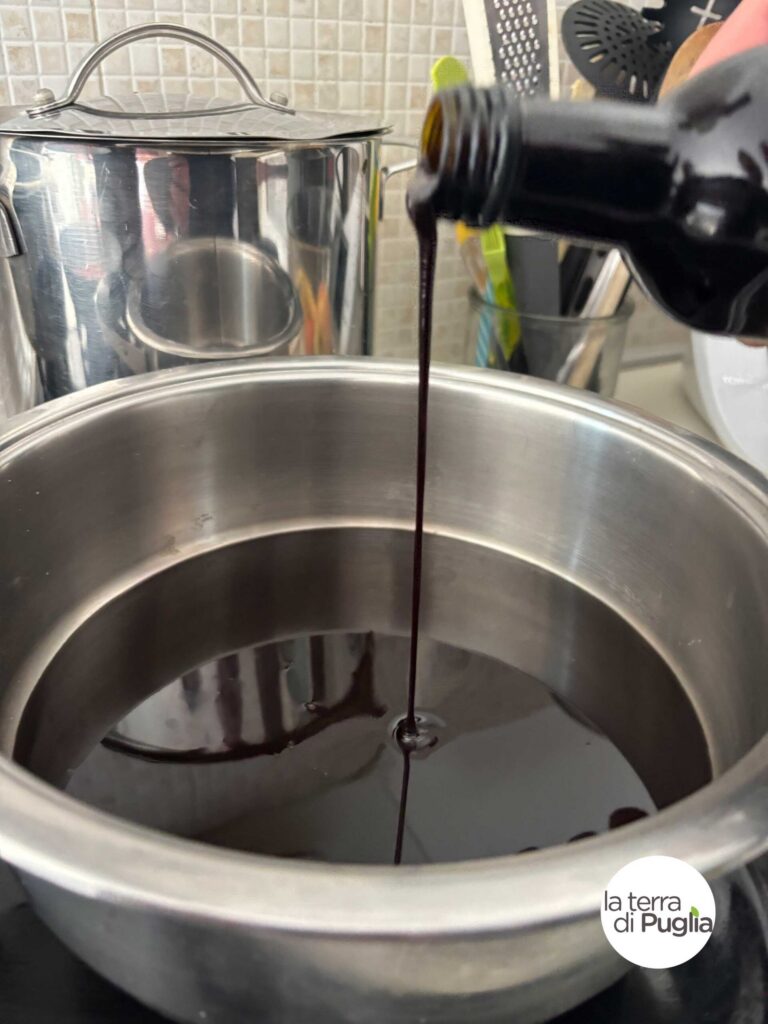
Finished vincotto: dark and dense, it pours like a thread of syrup.
What it is, in the words of those who record it
Each Italian region keeps an official list of its traditional food products: recipes and methods recognised as old and local, without being protected designations like PDO. Vincotto has been on the Puglia list since 2001, and its entry reads almost like a recipe. You start with must from grapes picked late, so they carry more sugar; you boil it over a direct flame in a copper or steel cauldron for about 12 to 15 hours, until a third of its water has boiled away. It turns brown with red glints, sweet and dense, with the caramel note of sugars cooked slowly for hours. Then it is left to cool and rest for about ten days in earthenware jars before bottling.
The technique is very old. Latin already had a word for cooked must, sapa, which the Italian Treccani dictionary defines as must “cooked and concentrated by boiling, used in the past (and still today in some regions) as a condiment”. In Puglia that condiment never went away.
The day of the cauldron
People who watched it being made remember the hours above all. The must has to be stirred so it does not catch on the bottom; the foam that rises has to be skimmed off; the fire has to stay lively but never too high. It is a job you cannot leave halfway and cannot hurry: boil it harder to finish sooner, and the vincotto tastes burnt.
So people took turns. The women of the house passed the spoon from one to another in front of the cauldron, the children were sent for wood, and anyone walking down the street stopped to see how far along it was. The courtyard filled with a heavy, sweet smell, and that smell told the whole neighbourhood that in this house, on this day, vincotto was being made.
The moment of truth came towards evening. There was no thermometer: someone took a spoonful of must, let it run onto a plate and watched how it moved. If it ran like water, there was more waiting to do. If it slid down slowly, like a thread, it was ready.
The lentil test. The same plate trick works for its summer cousin, cotto di fico, a fig syrup made by boiling ripe figs, squeezing them through a linen bag and putting the juice back on the heat. The regional entry for traditional products puts it like this: pour a little onto a saucer, and if it does not slide and holds a lentil in place, it has the right thickness. We have a page on Italian fig syrup.
What it was for: sweetness when sugar was dear
Vincotto was made in autumn, but mostly used later. The regional entry recalls it as a condiment for the winter feasts, and sometimes even as a remedy. It was the sweetener of families who bought sugar sparingly: a bottle of vincotto in the pantry meant the Christmas sweets could be made.
And that is where you still find it today, in almost every traditional sweet from Puglia:
- Cartellate, the fried pastry rosettes of the Christmas season, drizzled with vincotto or fig syrup. The full recipe is on our cartellate page.
- Mostaccioli, small spiced biscuits with almonds and cocoa, whose recipe in the regional entry calls for a whole litre of vincotto.
- The wheat of the dead, boiled wheat from the province of Foggia made for All Souls’ Day on 2 November and dressed with vincotto, fig syrup, walnuts and pomegranate.
- Pettole, balls of fried bread dough which, in their sweet version, are covered in vincotto or honey.
And today, without the courtyard
The cauldron in the courtyard has become rare, because only people who harvest grapes have fresh must. Vincotto was born in the same week as the grape harvest the old way, and without it there is none. Another preserve born from the same harvest is the one we wrote about in grape mostarda.
Vincotto for the pantry. Our shop has Cuettu, sweet cooked grape must: what you need to drizzle over cartellate and knead into mostaccioli when December comes.
How this piece was written. What vincotto is, how it is made, how long it boils and which sweets it goes into all come from the Puglia Region’s entries for traditional food products (vincotto, cotto di fico, mostaccioli, wheat of the dead, pettole, cartellate), and from the Treccani dictionary for the word sapa. The courtyard scenes — the turns at the cauldron, the smell across the neighbourhood, the spoon test on the plate — come from oral memory and are told as such: they change from family to family and from village to village.


You must be logged in to post a comment Login