The harvest is under way in Puglia: Primitivo and Negroamaro are coming in, and Coldiretti expects around 10% more grapes than last year. Two generations ago the same week looked nothing like this. Families reached the vineyard at five in the morning, the grapes travelled on ox carts in fifty-kilo baskets of woven reed, and the must was made by treading barefoot in a stone palmento. Here is how it worked — and what still comes out of it, in a jar.
Ask anyone in Puglia over sixty what the grape harvest was, and the first answer is not a picture. It is a smell: the whole village, for days, at the end of September, when somebody was treading grapes in every courtyard and the must was fermenting behind every front door. It was a public smell, and it belonged to everyone. Today wine is made in wineries, and the smell belongs to the winery.
🍇 What is happening right now
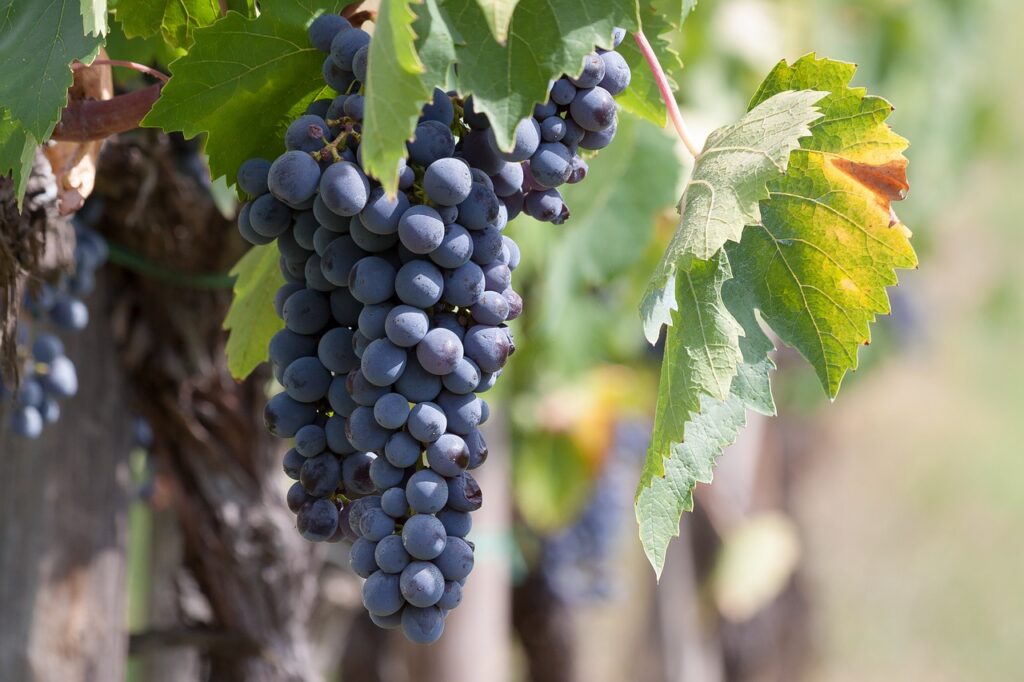
The 2026 harvest in Puglia began with grapes for sparkling wine bases, Chardonnay first, then the early white varieties. In early September it is the turn of Moscato, Primitivo and Negroamaro, picked in staggered passes; the late ones — Nero di Troia, Bombino Nero, Susumaniello, Aglianico — will come in between the end of September and October.
According to Coldiretti Puglia, whose first estimates came out on 11 August, the grape crop is expected to be around 10% larger than last year, thanks to winter and spring rain that left good water reserves in the vineyards. The fruit is healthy and the quality looks excellent; what stays uncertain, the organisation says, are prices and the market.
🌅 Five in the morning, and that is not a figure of speech
In the vineyards of the Salento, families arrived at five. Not out of zeal: you went in the dark because grapes picked cool arrive cool, and because by midday, under the September sun, nobody could stand between the rows.
The work was divided, and the division was not up for discussion. Women cut and picked the bunches — singing, on a rhythm that kept the line together. Men and sons carried the full containers, which is the heavy part. Around noon everyone went home, and the next morning it started again: the harvest was not one day, it ran into late October.
🧺 The words of a trade
The tools had exact names, and that is where you see how organised this was:
- Cofane — baskets woven from rushes and cane that held about fifty kilos of grapes when full. They were made for the job and lasted years.
- Tineddhre — the wooden vessels carried on the shoulder to the cart.
- The cuf’natore — the man who carried the baskets and emptied the buckets. The job had its own name, which tells you it was not given to just anyone.
- Traìni — the animal-drawn carts that took the grapes from the vineyard to the palmento. The sound of the wheels on the white road meant the day was ending.
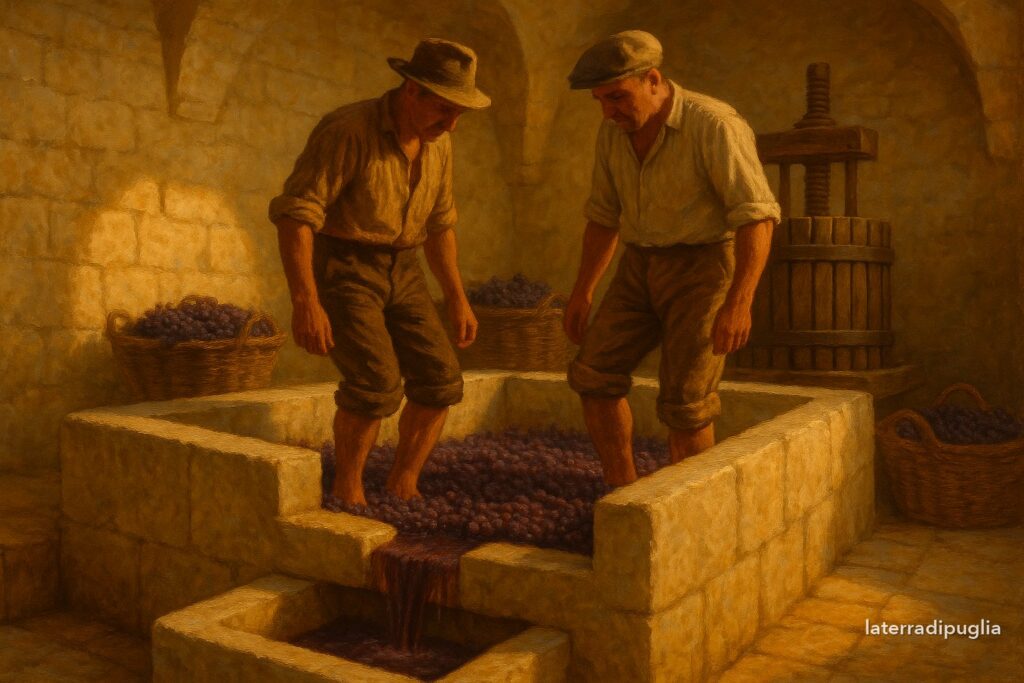
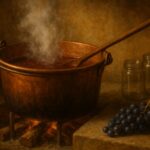
The upper basin, the must running into the lower one, the press at the back: the palmento as it worked. Illustration made with artificial intelligence: it is a reconstruction of the scene, not a period photograph.
🦶 The palmento: you went in barefoot
The palmento was where grapes became must — every family’s own small wine factory. In the Salento it was called paramiènte or palummiènte, from the Latin: some trace it to palmes palmitis, the vine shoot, others to paumentum, the act of treading.
The design was simple and used nothing but a slope. Two basins, one high and one low. The bunches went into the upper one and were trodden barefoot; the must ran down by itself into the vats below. No pump, no motor: gravity.
This is where the children came in. Treading was the one part of that week that was not hard labour, and the fact that they were genuinely useful — light enough to crush the fruit without breaking the seeds — made it the most sought-after job of the day. Purple legs lasted several days, and in many villages that is how the school year started.
Mosto fiore, the free-run must. The first must to collect in the lower vats had its own name: mosto fiore, flower must. It is what comes out of treading alone, before anything has been pressed — the cleanest and sweetest part, and the one families kept back. Only afterwards did the skins go into the press, an upright wooden cylinder with a central screw. The good wine and the everyday wine were born in the same hour and the same room, one step apart.
🍷 Twenty-four hours, and then the wine was on its own
The must fermented in the vats and moved on to the vessels where it would become wine. No thermometers, no selected yeasts, no temperature control: there was the experience of someone who had done it thirty times, and the vintage decided the rest. Some years the wine came out well, some years less — and a family lived with the difference for the following twelve months.
That house wine was nothing like today’s. It was drunk at lunch and dinner, watered down even for children, and its job was to help the bread go down. That Puglia is now a region of serious reds — from Primitivo to Negroamaro — is a later story, and largely one that happened somewhere other than these family cellars. We have written separately about Primitivo and Negroamaro and about the wines of Puglia.
🫙 What was left after the wine
The harvest did not end with wine, and this is the part almost nobody connects to the other any more. Some of the must never became wine at all: it went on the fire.
Cooked low and stirred for hours, must reduces, concentrates and darkens. Two things come out of it that are still in Apulian cupboards: vincotto, the liquid version, and mostarda — the thick grape preserve, which has nothing to do with mustard, and nothing to do with the mostarda of Cremona in the north.
It was a way of wasting nothing and having something sweet in a house where sugar cost money. The point is worth keeping: the sweetness is the grape’s own, because there was no sugar to add. The same weeks, the same hands, also put away grapes in alcohol and grape preserves for the winter.
If this sounds familiar, it should: it is the same logic as the olive harvest, six weeks later on the same land, with the same families and the same idea — one crop a year, and nothing thrown away.
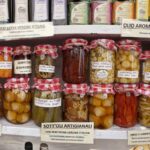
Mostarda today. If you have no vineyard you can still have that taste: our grape mostarda is made with 100% Negroamaro grapes from the Salento and no added sugar — which is precisely why in Puglia it is not called jam.
🚜 What actually changed
Nearly everything, and for the better if you are the one doing the work. Today’s wine is cleaner, more stable and better than what came out of home palmenti: controlled fermentation removed the lost vintages, and Puglia went from a region that sold wine in bulk to a region that bottles it.
What was lost is not quality: it is that it used to be everybody’s business. The harvest took a whole family for weeks, children had a real task, and the old decided the picking day. Today it is a job, done well, by people who know how. And at the end of September the village no longer smells of must.
How this article is written. The 2026 harvest figures and the order of the grape varieties come from the Coldiretti Puglia release of 11 August 2026. The names of the tools, the roles and the workings of the palmento are documented in studies of traditional Salento harvesting. The scenes — the smell of the village, the purple legs — come from oral memory and are told as such: they are recollections, not records, and they change from village to village.