Cycling in Salento means riding on quiet back roads and coast roads, almost always flat — dedicated cycle tracks do not exist here. One official route does, and it is new: the Ciclonica, a 304-kilometre loop around the Ionian side, created by the local councils with recovery-plan funding. The classic circuit from Lecce, by contrast, is signposted by nobody. On this page: the Ciclonica, the loop and its stages, the gravel option, and the coast road between Otranto and Leuca.
Flat country, and a traffic problem
The Salento is a low peninsula between two seas, with no relief worth the name: you ride flat almost everywhere, and the few climbs are on the Adriatic side between Castro and Leuca, where the rock lifts above the water. For a cycle tourist it is easy ground, manageable without training. The difficulty here is different, and it is not physical: it is summer traffic. From July to the end of August the coast roads that are the best part of the place turn into queues.
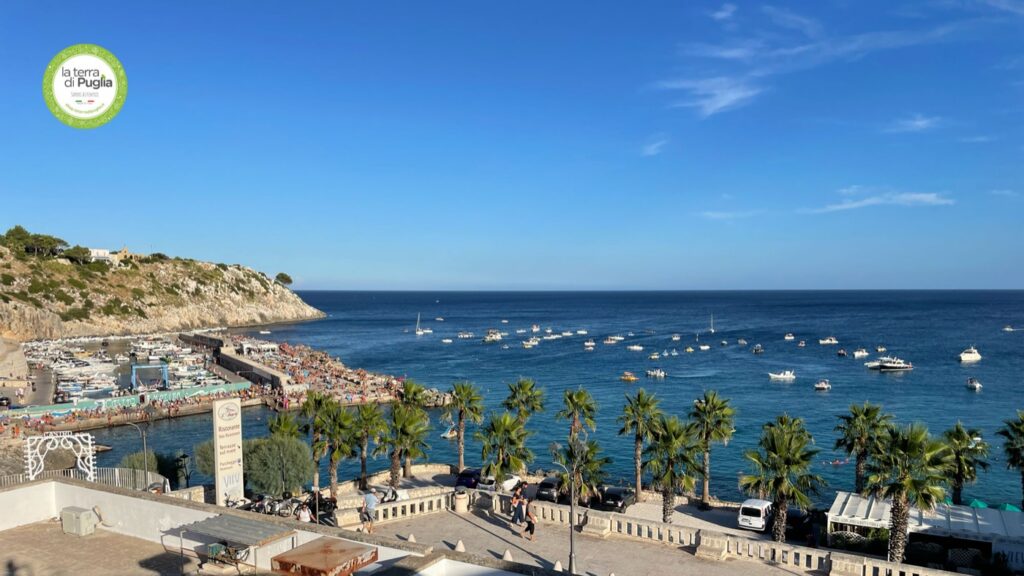
Out of season the picture reverses. The same roads are empty, the interior is a grid of straight minor roads between olive groves and dry stone walls where three cars pass in an hour, and you cross a village every six or seven kilometres — meaning you are never far from a tap, a bar or a railway station.
There is no traffic-free greenway in the Salento, and it is better to know that before booking. The southern section of the Apulian Aqueduct Cycle Route, which should run from Grottaglie down to Santa Maria di Leuca over 157 kilometres, is still being designed. Everything below is therefore on roads open to traffic: very lightly used roads, but roads.
The Ciclonica, the Salento’s only official cycle route
This is the real development of recent years, and it came from the councils. The Ciclonica – Ionian Salento Cycle Route is a loop that starts and finishes in Lecce and runs right round the Ionian side: measured on the official track, 304.6 kilometres with barely 1,183 metres of climbing, and never rising above 114 metres. In other words, it is flat — probably the easiest route in Puglia relative to its length.
It is not one association’s project: it comes out of the Green Community Ionico-Adriatica programme, funded by Italy’s national recovery plan, led by the municipality of Nardò alongside Alliste, Avetrana, Galatone, Gallipoli, Manduria, Porto Cesareo, Racale, Taviano and Ugento. In 2025 it came third in Italy’s cycle tourism awards.
And it is built to be used, not just announced. There is a free app for iOS and Android — Ciclovia del Salento Ionico — plus a web version; a printed guide published by Ediciclo; and a stamp passport for the villages along the way.
It is divided into day loops, so you do not need to give it a week: ride one piece at a time from wherever you are staying.
The Salento loop: four stages from Lecce
This is the classic circuit, and it has the advantage of starting and finishing in the same place — Lecce, which is also the railhead you arrive at. According to the account published by Bikeitalia it is 210 kilometres in four stages, all manageable for an untrained cycle tourist.
The profile of the Otranto to Leuca stage. No climb reaches 132 metres, and yet there is not one flat stretch on the drawing: that is what makes it the hardest of the four.
- Lecce – Otranto, 48 km — out of the baroque and across farmland to the Adriatic. The easiest stage.
- Otranto – Santa Maria di Leuca, 55 km — «the most scenic and the most demanding»: a continuous roll of ups and downs along the high coast, sea always below. A GPS track of this stage gives 58.4 km with +681 metres, with no climb reaching 132 metres of altitude: it is not a mountain stage, it is a stage that never lets you sit flat.
- Leuca – Gallipoli, 54 km — over to the Ionian side: sand, dunes, shallow water.
- Gallipoli – Lecce, 53 km — inland again, through the villages of the plain.
On this loop the distances vary, and the reason is interesting. The stages above total 210 km; a GPS track of the same circuit published on Wikiloc gives 255, with 1,165 metres of climbing. Neither is wrong: there is no official line, so everyone picks their own way between the same four towns. The forty-five kilometre gap is itself the information — it tells you this loop is not a waymarked route but an idea for a trip.
The Salento Trail, if you ride gravel
There is a third option, and it is the one growing fastest: bikepacking — self-supported riding on mixed surfaces. The reference loop starts and finishes at Maglie, measures 296.9 kilometres and carries 1,848 metres of climbing: fifty metres more than the Ciclonica over eight kilometres less, which tells you immediately that this is where the tarmac stops.
Do not mistake it for an official route: it is not, and it says so itself. The Salento’s bikepacking itineraries are collected and shared by enthusiasts; the best known presents itself in its own words as having «no official status, no certification». No signage, no body maintaining it, nobody to call if a track is blocked. That is its strength and its limit: you need to be self-sufficient.
Grecìa Salentina, if you prefer the interior
A few kilometres inland there is another Puglia, and from a bike you see it better than from a car. Grecìa Salentina is the group of villages where Griko was spoken — a language of Greek origin that survived for centuries: Corigliano d’Otranto, Martano, Calimera, Sternatia, Zollino, Martignano. They sit close together on almost deserted minor roads and link up in a circuit of a few dozen kilometres.
It is the route for a windy or very hot day: the interior is cooler than the coast, there are trees, and every village has a square with a bar.
Getting there with a bike
Lecce is the end of the national rail network, and beyond it the Salento is served by the Ferrovie Sud Est, reaching Otranto, Gallipoli, Nardò and Maglie. On Apulian regional trains marked with the bicycle pictogram, carriage is free — which in Italy is the exception, not the rule.
That changes how to plan: you do not have to ride the whole loop. Take the train in the morning, ride a stage, come back in the evening. The details are on the cycling in Puglia page.