In short. Gnummareddi are small rolls of lamb offal, wrapped in caul fat and tied with the animal’s own gut, cooked over coals. They are the most local thing on any Apulian grill and the one visitors most often walk past. The name means «little ball of yarn». This is what is inside them, why they have six different names, and how they are cooked.
Go to a village sagra anywhere in the Salento and you will smell them before you see them. On the board they will be written in dialect, in a spelling that changes from one town to the next, and nobody at the stall will translate. Here is the translation.
🍢 What is actually in one
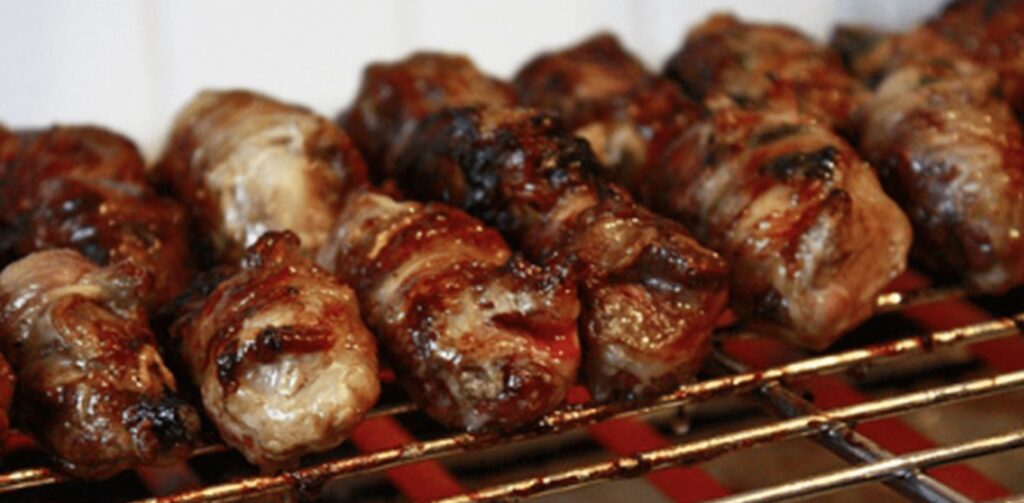
A gnummareddo is a small roll of lamb offal — heart, lung, spleen and liver — wrapped in the caul, the natural lacy membrane from the animal’s abdominal cavity, and tied with its own intestine.
They are small: about two or three centimetres thick and ten long, though you will meet bigger ones. They come off the grill several at a time and they are eaten with the fingers.
Should you be squeamish about this? That is a fair question and the honest answer is: try one before deciding. The texture is firmer than a sausage and the flavour is intense rather than strong — the caul melts as it cooks and bastes what is inside. People who arrive certain they will not like them very often order a second plate.
🗣️ Why they have six names
Depending on which town you are standing in, the same thing is called gnummareddi, gnommareddhi, turcinieddhi, turcinelli, gnummaredde or mboti. The spellings are not sloppiness: they are different dialects, and they split into two families with two different ideas behind them.
🐑 Where you find them
They are a classic of the Salento, but you will find them without difficulty around Bari too, and beyond Puglia altogether — they are eaten in Basilicata and in Abruzzo. Which region invented them is disputed, and every one of them claims it.
What is not disputed is where they come from socially. They are poverty food. Offal is what was left when the good cuts went elsewhere, and a great deal of the best Italian cooking was built exactly there — on the parts nobody else wanted, made worth eating by technique and patience.
🔥 Four ways they are cooked
- Over coals — the standard, and the best. The outside crisps while the caul melts inside. This is what you will get at a sagra.
- In the oven — the fallback if there is no grill. It works on one condition: high heat and a short time. Slow and moderate ruins them.
- In a pan — a little oil, onion and bay leaf, about twenty minutes. Halfway through you deglaze with wine, preferably red, let the alcohol go, turn them and finish. Served with roast potatoes and a seasonal salad.
- In tomato sauce — the long one. Oil, rinds of pecorino, celery, onion, bay, tomato and water, and it can go on for up to five hours.
The town that has its own word for the slow one. At Locorotondo, in the Valle d’Itria, the stewed version is called gnummaredde suffuchete — «smothered» — and it has a festival of its own. It is the same dish as the grilled one and it tastes nothing like it.
🍽️ If you want to try them
The easiest way is a village festival between June and September: they are on almost every grill, they cost a few euro, and they are cooked by people who have made them since they were children. The calendar and how it works is here — Apulian sagre: what to eat and how they work — and the rest of what to order in Puglia is here: what to eat in Puglia.