In short. Puglia has been working clay for thousands of years, and still does it for a living. Three towns carry the title of City of Ceramics — Cutrofiano, Grottaglie and Laterza — and each of them makes something different: everyday terracotta in one, white glaze and good-luck buds in the second, painted majolica in the third. This page explains who makes what, how a piece is actually made, and what is worth bringing home.
Ceramics in Puglia are not a heritage display. They are a trade that never stopped: the workshops are open, the wheels turn on weekday mornings, and most of what is sold in them was made by the person selling it.
An art with a Latin name
The old word for it is arte figulina, from the Latin fingere — to model, to shape. It is a fair description of what happens: a lump of clay pulled into a form by hand, on a wheel, and then fixed by fire.
The tradition here goes back to antiquity, and it is documented rather than assumed: a Roman kiln was found at Cutrofiano, and ceramic finds from the classical period show how central the craft already was. In these towns clay was never a decorative sideline. It was the container the household ran on — for water, for wine, for oil, for grain — and the trade organised the working life of whole quarters.
Three towns, three different things
Cutrofiano was one of the first towns in Puglia to be recognised in the national circuit of the Cities of Ceramics, followed by Grottaglie and Laterza. They are the three that hold the title in this region, and they are not variations on the same style. They are three distinct vocations.
- Grottaglie is the internationally known one. It makes both the Bianchi di Grottaglie — pure shapes under a plain white glaze, no decoration at all — and the decorated tradition of pumi, flowers and traditional motifs.
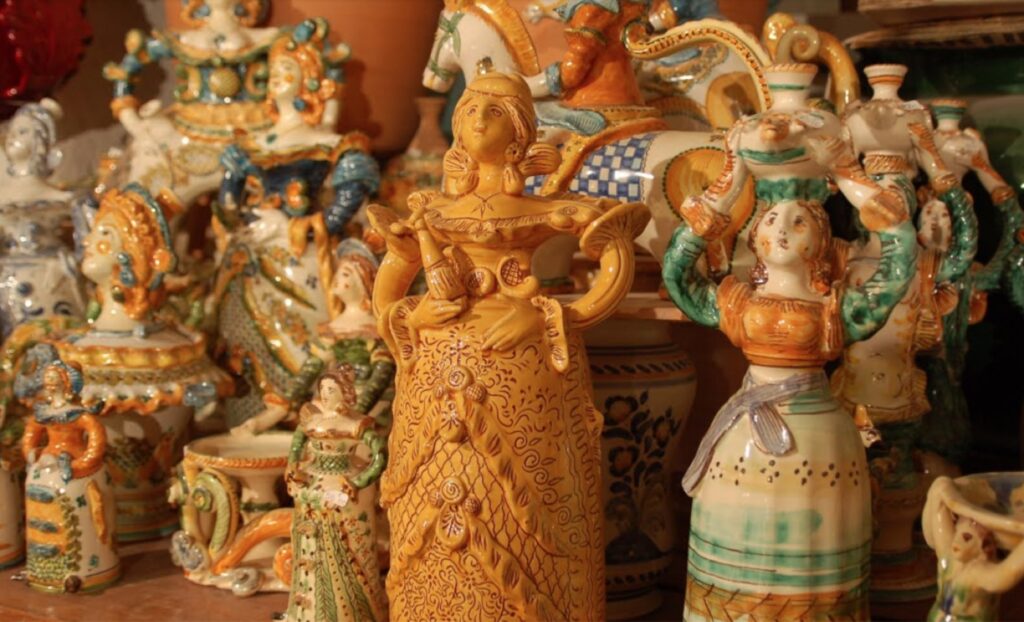
- Laterza is the home of majolica: a white tin glaze, hand-painted in strong colours — cobalt blue, ochre yellow, copper green. The style is pictorial, with scenes of country life and baroque floral motifs.
- Cutrofiano is the capital of everyday terracotta — jars, jugs, cantari — a more rustic tradition, less decorated, and technically outstanding.
How a piece is made
Whatever comes out at the end, the sequence is the same, and it explains both the price and the fact that no two pieces are identical.
- The wheel. The clay is shaped by hand. This is the step that decides the line of the object, and the one that cannot be faked.
- The first firing — the biscuit — which hardens the piece.
- Glazing by hand, the back included. On a small object this is slower than it sounds.
- The second firing, which fixes the colour and the shine.
Two passes through the kiln on a thin-walled object is not a given: it takes experience to balance a light shape against the strength it needs to survive the fire twice. It is also why hand-made pieces carry small irregularities in the glaze and in the proportions. Those are evidence of the method, not defects.
What comes out of the workshops
The two objects people ask about. The pumo — the ceramic bud that sits on balconies all over Puglia and means good fortune — and the ceramic balloons, a modern shape that has become one of the most popular things made here. Both have a page of their own.
Beyond those, the range is wide and mostly practical in origin:
- Cantari and capase — the jars. The cantari are so identified with Cutrofiano that the townspeople themselves are nicknamed after them. The capase are the enormous vessels used in kitchens and larders to hold liquids and food — olive oil above all. An old one, today, can cost a fortune.
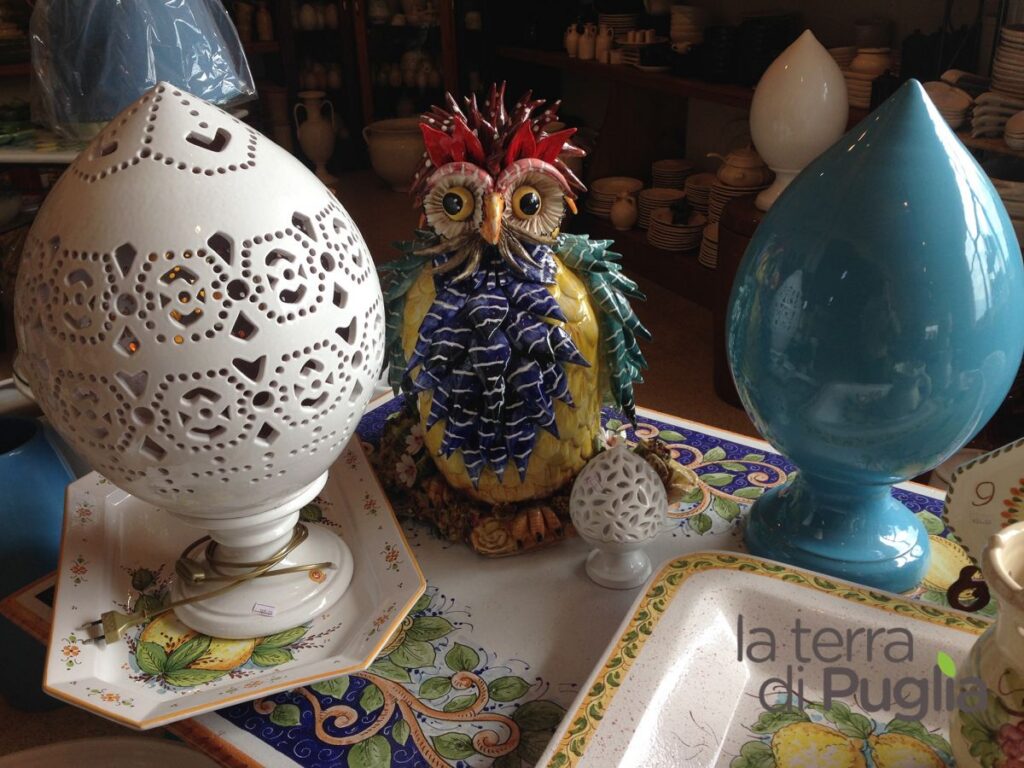
- Terracotta lamps, worked and glazed by hand and pierced all over with small holes, so that the light comes through the object rather than past it.
- Whistles and small figures, historically made from the leftover clay, brightly painted and cheap.
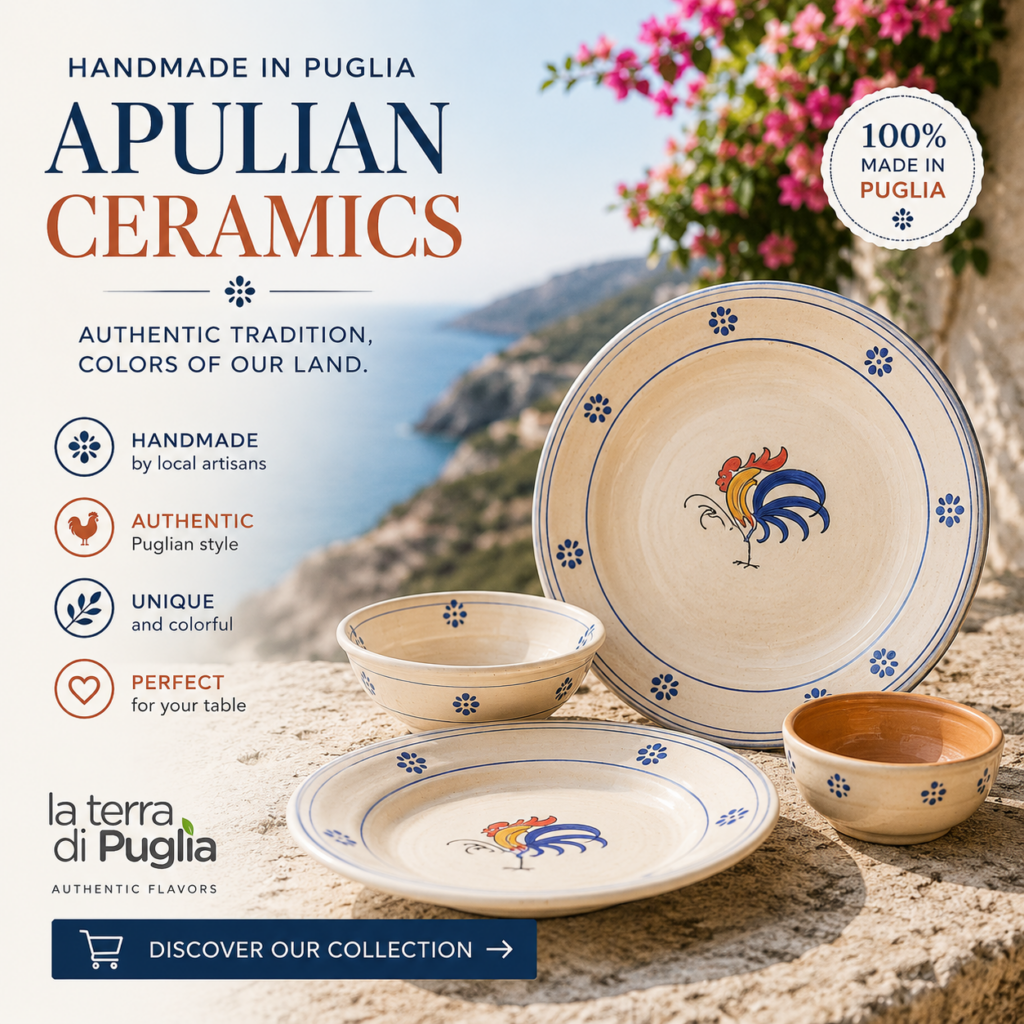
- Owls and other good-luck charms in terracotta, and hand-painted tableware — plates, dishes, jugs.
Where to see it being made
Grottaglie has an entire quarter given over to the trade — the Quartiere delle Ceramiche, one workshop after another along the lanes of the old town. Each has its own decoration and its own identity, and in most of them you can watch the potter at the wheel. It is the single best place in Puglia to buy something made where you are standing.
Cutrofiano, the district few visitors know. While Grottaglie has become an established destination, Cutrofiano — in the Salento, province of Lecce, and the most important terracotta centre in that part of the region — stays quieter. Its workshops have not turned into souvenir bazaars: they are still working laboratories, producing tableware, jars and household objects for local markets. The town also has a ceramics museum, a historic art-ceramics manufactory with roots in the eighteenth century, and a ceramics fair in August with potters working in the squares.
Buying a piece, and getting it home
Glazed ceramic travels badly loose in a bag. Workshops will wrap a piece properly if you ask, and the small sizes — around 8 to 12 cm — are the ones that reach home in one piece. The other option is not to carry it at all: our own pieces are turned, glazed and painted by hand by Apulian potters, and we ship them.
The terracotta section of the shop has the everyday pieces; the gift section has the pumi, the balloons and the good-luck charms, in a range of sizes and colours.
If you would rather buy from the potter directly, there is one week a year for it: the ceramics fair of Cutrofiano, eight nights every August with the craftsmen working in the street.
Ceramics are one of several things Puglia has gone on making by hand in the same towns for centuries. The others — the dry-stone building, the pizzica, the Greek-speaking villages — are under traditions of Puglia.