In short. The longest and most spectacular cave system in Italy: 3 km of underground route, 70 m deep, ending at the Grotta Bianca — the White Cave — considered one of the most beautiful cavities in the world. Two hours for the full tour, one for the short one, and a lift back to the surface.
Castellana Grotte is a small town in the Bari hinterland, about 40 km south-east of the city, on the karst plateau of the Murgia — the same country as the trulli. The town takes its name from the caves, which is a rare inversion.
🕳️ How they got there
Puglia was once entirely under the sea, except the high Murgia. What was left behind is porous rock — limestone and tufa, almost everywhere — and water, fresh and salt, above and below ground. Over millions of years that combination produced collapses, fissures and caves of every size, which is why the south-east of the Bari province is so full of them.
The plateau formed around 100 million years ago; the caves began about 90 million years ago, in the Cretaceous, when an underground river ran towards the sea. The river is gone, its tunnels are not, and there are marine fossils in the walls to prove where all this came from. The work is still going on, at its own pace: to alter a single centimetre of rock takes fifty to a hundred years.
Found in 1938 — officially. The speleologist Professor Anelli first explored and documented the system that year. Local people had of course known about the hole for a long time, and had not always put it to good use.
🎫 The visit, chamber by chamber
You go with a guide. The route opens in La Grave, the huge entrance cavern with its stalagmite group known as the Cyclops — the only point where daylight reaches. From there it runs through the Black Cave, the Corridor of the Angel, the Cavern of the Owl and the little Crib cavern, where a stalagmite has taken the shape of a Madonna.
- 3 km of underground route on the full itinerary, and 70 metres below the surface at the deepest point
- The Corridor of the Desert, opening into the brightest shapes and colours of the whole system
- The Cavern of the Duomo of Milan and the Cavern of the Tower of Pisa, named for what they look like
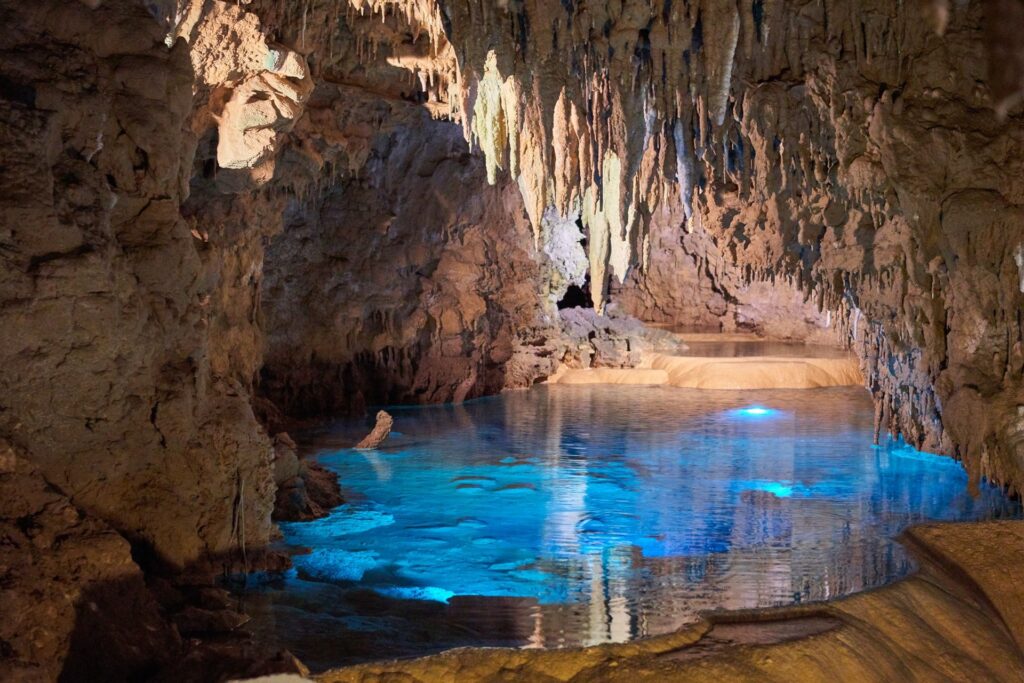
- The Crystal Lake, a pool fed drop by drop into sculptural forms
- And at the end the Grotta Bianca: white crystal, alabaster columns, and a purity of concretion considered among the finest anywhere
Practical. Full route about two hours, short route about one, and you come back up by lift. The temperature underground stays steady all year, so take something with sleeves whatever the month. Tickets can be bought online — worth it in high season to skip the queue — and there is paid parking beside the entrance and a second car park with a shuttle. Bari airport is about 45 minutes away by car; the Bari–Taranto railway stops at Castellana Grotte, close to the entrance.
Two routes, one decision. The short version saves an hour and misses the Grotta Bianca — which is the reason people come. If you have the time, take the full one.
🚶 Back on the surface
An hour in the old town of Castellana Grotte is worth it: the churches of San Leone Magno and Maria Santissima della Vetrana, and the town hall with its clock tower of 1848.
Nearby: Alberobello and Locorotondo.