In short. Alberobello has over 1,400 trulli — cone-roofed stone houses — concentrated in two old quarters, Rione Monti and Aia Piccola. UNESCO World Heritage since 1996. Even the church is a trullo.
The trulli are not ruins to look at from outside. Many have been restored and are now houses, restaurants, wine bars and spas — and the atmosphere inside has survived all of it.
🔨 What a trullo actually is
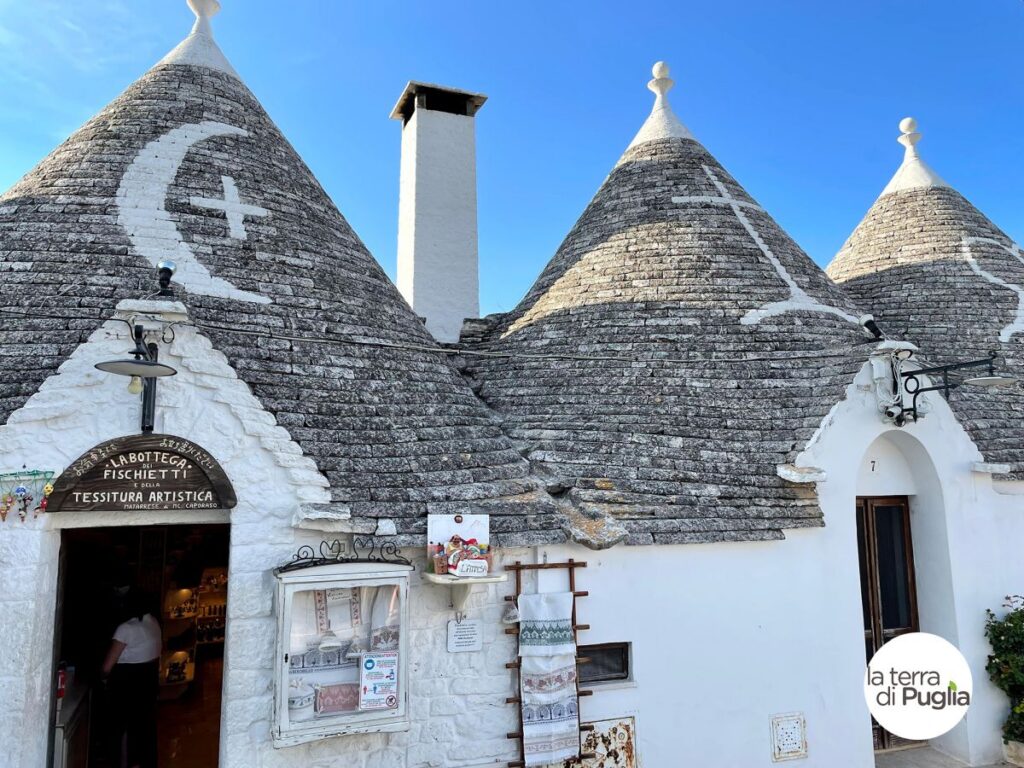
The word comes from the Greek trullo, dome. The building is dry stone — no mortar — round in plan, with a conical roof, and the technique is thought to go back a very long way, possibly to the Bronze Age. The trulli standing today are not that old: they were knocked down and rebuilt whenever they were damaged, which is what the method allows. The oldest survivors, on the Murgia, date from the Renaissance.
- Modules, not rooms. A trullo is one circular module; more can be added around it, which is where the multi-coned ones come from.
- Chianche and chiancarelle — the rough stone slabs it is built from. They give the cone its look and, laid properly, keep the water out.
- Thick walls. A trullo looks bigger outside than it is inside; the rooms are smaller than you expect.
- Almost no openings beyond the door, and a small window at the top of the cone to move the air.
🏘️ Where the trulli are
The Valle d’Itria is the rural pocket of Puglia caught between the provinces of Taranto, Brindisi and Bari, and it is full of them. The greatest concentration runs between Locorotondo, Castellana Grotte, Putignano, Cisternino, Fasano, Ostuni, Ceglie Messapica and Martina Franca.
But it is at Alberobello that the trullo stops being a farm building and becomes a town. The Salento has its own versions of the same idea, under different names — furneddhi, pajare, caseddhi — and they are field shelters, not houses.
🏛️ A town of 1,400 cones
- Rione Monti and Aia Piccola — the two historic quarters where the trulli cluster
- Sant’Antonio da Padova — the church, itself built as a trullo
- UNESCO World Heritage since 1996
- The name comes from an ancient oak forest
Younger than it looks. Alberobello was founded in the sixteenth century, when the Counts of Conversano allowed settlement here. The dry-stone building technique is far older than the town.
🛏️ Staying in one
Trulli are now among the most sought-after places to stay in Puglia, and in high season they go quickly. The thick stone walls do something air conditioning cannot: they stay cool through an Apulian August.
Look up at the roofs. Many trulli carry painted symbols on the cone — some Christian, some magical, some far older than either. Scholars have catalogued about two hundred of them and still have no single key to reading them: the symbols on the trulli, and the tax dodge that explains why they were built dry in the first place.
The town, street by street: Alberobello in the guide. Nearby: Locorotondo and Ostuni. And the map of the region is here.