In short: five days and four nights based in Taranto, on the trail of Magna Graecia. The temple of Metaponto, Taranto’s museum and swing bridge, the rock-cut churches of Massafra, the cave village of Petrùscio, the Primitivo wine of Manduria, and Castellaneta, the hometown of Rudolph Valentino.
Taranto was one of the great cities of Magna Graecia, the name given to the Greek colonies of southern Italy. This five-day, four-night itinerary starts from the city and fans out across its province: the Doric columns of Metaponto, the gravine (the deep limestone ravines typical of this part of Puglia) with their churches and villages cut into the rock, and then the vineyards of Primitivo.
Day 1: Back to the Greek origins
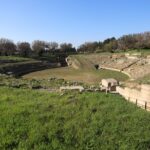
Leave your hotel in Taranto for a visit to the temple of Metaponto, an ancient witness to Magna Graecia. Its Doric columns give an idea of an age of greatness and culture, and of the deep historical roots of this land. After a morning in the ancient world, return to Taranto for a free afternoon, to explore the city at your own pace or rest at the hotel. The day ends with dinner in a traditional Tarantine restaurant, where you can try the local cooking, then back to the hotel.
Day 2: Taranto and its treasures, then Grottaglie
After breakfast, a guided tour of Taranto. It includes the National Archaeological Museum, which holds precious finds from Greek and Roman history, and the Romanesque cathedral, an architectural gem and an important religious site for the city.
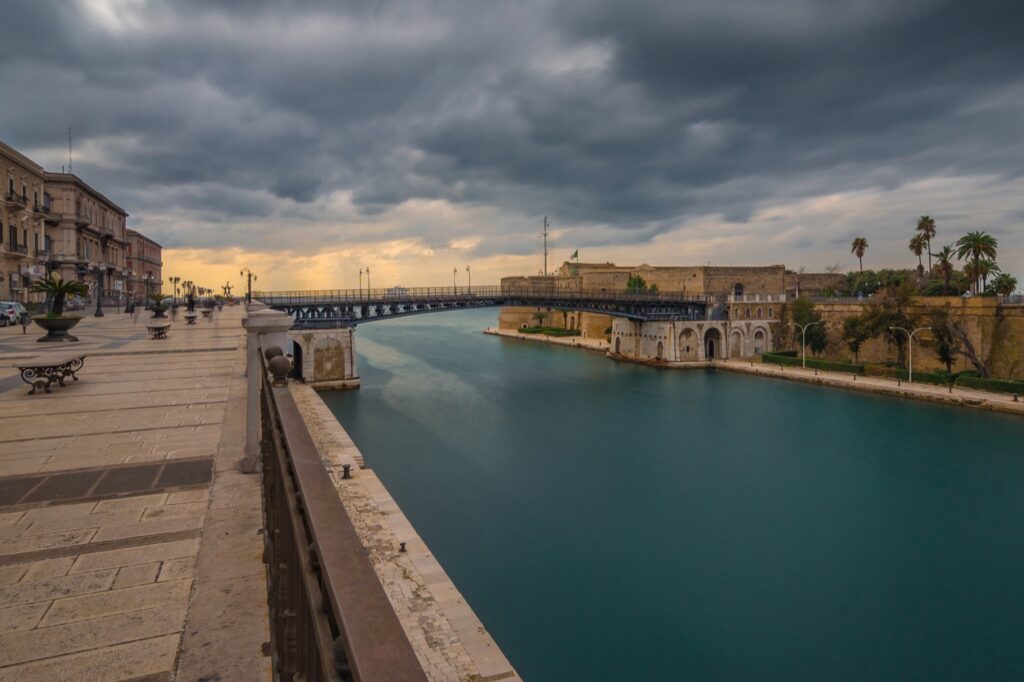
The panoramic tour also takes in the famous swing bridge and the elegant seafront, with wide views over the city and the sea. After lunch at the hotel, the route continues to Grottaglie to visit a ceramics workshop and see the potters at work. Back to the hotel for dinner and overnight.
Day 3: Ravines and cave villages
After breakfast, the route moves to Massafra to visit its so-called Basilian crypts, churches cut into the tufa walls along the ravine. It is a striking place, where you come close to the history and the spirituality of the early Christians.
After lunch in a traditional restaurant, the route goes on to Mottola to explore the cave village of Petrùscio: a cluster of crypts dating from the ninth to the thirteenth century, some of them on several connected levels, set in wild vegetation along the ravine. It is a rare chance to understand how people lived in that distant age. Back to the hotel for dinner and overnight.
Day 4: Wine, Baroque and traditions
After breakfast, set off for Martina Franca, a town rich in Baroque buildings with a strong eighteenth-century character. It is known for its white wine, also used for sparkling wines and vermouth, and for the local breeding of the Martina Franca donkey and the Murgese horse.
After lunch at an old masseria (a large farmstead, now a farm stay), the route continues to Manduria to visit a cooperative winery, see how the wine is made and taste the celebrated Primitivo di Manduria. Manduria is one of the main wine-producing towns in the region, and it is probably the place Pliny had in mind when he described the Fonte Pliniano, a natural cave sacred to a water deity.
The day continues with Oria, a town clustered around its Swabian castle and its eighteenth-century cathedral, and the small town of Erchie, a place of devotion linked to Saint Lucy. Back at the hotel, dinner is a spread of Apulian cured meats and cheeses such as smoked caciocavallo, a pear-shaped stretched-curd cheese, followed by the night’s rest.
Day 5: Castellaneta and back to Taranto
On the last day, after leaving the hotel, the morning is spent in Castellaneta, the hometown of the actor Rudolph Valentino. After lunch there, the route returns to Taranto, where the tour ends. It is a journey through the history, culture and nature of Puglia, following the trail of the Greeks between ravines and sea.
This tour is one of our multi-day itineraries in Puglia. The gravine itinerary shares Taranto, Grottaglie, Massafra and Mottola with it, and adds Altamura and Gravina.