
In Puglia, autumn is when the pantry of sweet things fills up: the dried figs and almond-stuffed figs put away at the end of summer, October’s quince paste, freshly made vincotto. Then come the dates: the wheat of the dead for 2 November, the first pettole on St Martin’s Day and St Cecilia’s. Mostaccioli and cartellate are Christmas sweets, but they are born from what is prepared now. Here is the season, one sweet at a time.
Ask which sweets belong to autumn in Puglia and the honest answer is that the region has no great October dessert, the way it has cartellate at Christmas. It has something more interesting: a season in which almost everything eaten in the cold months gets made, and in which each week of November brings a particular sweet.
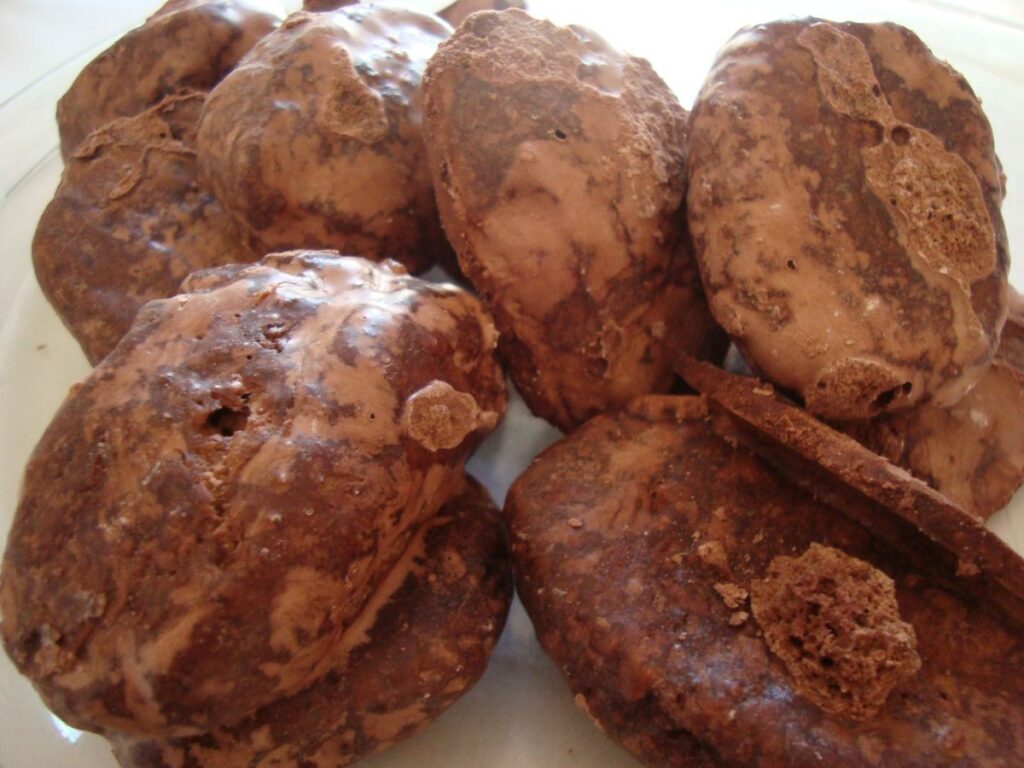
Mostaccioli, dark with vincotto and cocoa: Christmas sweets that start in autumn.
The pantry: dried figs and almond figs
Figs are dried at the end of summer and eaten in winter. The Puglia Region’s entry for traditional products describes them as once “made in every house”: dried in the sun for a week on wooden boards, then opened, filled with toasted almonds, chocolate, honey and lemon zest, closed with a second fig and baked. They were packed while still warm into earthenware pots called capasidde, with fennel seeds and bay leaves. In the Murgia, the entry notes, dried figs were an essential part of household supplies and often took the place of bread.
The almond-stuffed dried fig even has a home town: San Michele Salentino, near Brindisi, where the habit of filling figs with almonds spread just after the war, in 1946 and 1947. Figs of the Dottato variety are picked between late August and early September, dried in the sun on reed mats, paired around an almond and baked in a slow oven for at least an hour. Made this way, they keep for five or six months: in other words, exactly through autumn and winter.
October: quince paste
If one Apulian sweet has a month written next to it, it is cotognata, quince paste: quinces cooked, pushed through a sieve, returned to the heat with sugar until firm, then poured into moulds and sliced. According to the regional entry, it is made in October.
2 November: the wheat of the dead
The first sweet with a date belongs to All Souls’ Day. In the province of Foggia people make the wheat of the dead, cicc cuòtt in dialect: soft wheat grains soaked for three days, boiled until they split, and dressed an hour before eating with vincotto (a syrup of cooked grape must), fig syrup, toasted almonds and walnuts, candied fruit, chocolate, cinnamon, cloves and pomegranate seeds. It is not sold: it is made at home.
The regional entry also explains where it comes from. The name derives from the Byzantine kolba, from the Greek kollyba, “cooked wheat”, and the custom descends from the Greek-rite Christian tradition of eating blessed boiled wheat when commemorating the dead, enriched over time. The pomegranate, the same entry says, is there as a symbol of rebirth.
The All Saints’ ring. In San Nicandro Garganico they make pupurât, a large, dark, spiced sweet ring about twenty centimetres across, made with fig honey. Today it is baked all year, but the regional entry recalls that it was once made for Carnival, All Saints’ Day and the October fair, and that women kneaded it mostly at night, singing.
St Martin and St Cecilia: the first pettole
Pettole, little balls of fried bread dough, are eaten all year and above all at Christmas, but they have a starting day, which changes from one area to another. According to the regional entry, around Lecce the first frying is on 11 November, St Martin’s Day; in Taranto the first pettole are fried on the night of 22 November, St Cecilia’s; in some towns south-east of Bari, such as Rutigliano, on 25 November, St Catherine’s. In their sweet version they are covered in sugar, vincotto or honey.
Mostaccioli and cartellate: they arrive in December, they start now
The two sweets everyone links with a Puglia winter are, for the regional entries, Christmas sweets. Mostaccioli, small spiced biscuits with almonds and cocoa, are made all year but above all for the holidays, particularly in the province of Foggia; cartellate, fried pastry rosettes, are the December dessert. Yet both depend on autumn: the mostaccioli recipe in the regional entry calls for a whole litre of vincotto, and cartellate are drizzled with vincotto or fig syrup. No cooked must in October, no sweets in December. Our recipes: cartellate and Italian fig syrup.
In the Salento there is another version, the mustazzueli of the province of Lecce: cubes of almond and cocoa dough covered in a glaze called naspro in dialect, sold for more than a century by street vendors at fairs and village festivals. All our sweet recipes, from almond sweets onwards, are gathered in our desserts section.
For anyone who cannot wait for December. Our shop has mustaccere, chocolate mostaccioli.
Where this information comes from. Recipes, seasons, areas and dates come from the Puglia Region’s entries for traditional food products: dried figs, almond-stuffed dried fig, quince paste, wheat of the dead, pupurât, pettole, mostaccioli, mustazzueli and cartellate. We have not added other “autumn” sweets without a source that genuinely ties them to the season, to All Souls’ Day or to St Martin’s: customs change from village to village.

You must be logged in to post a comment Login