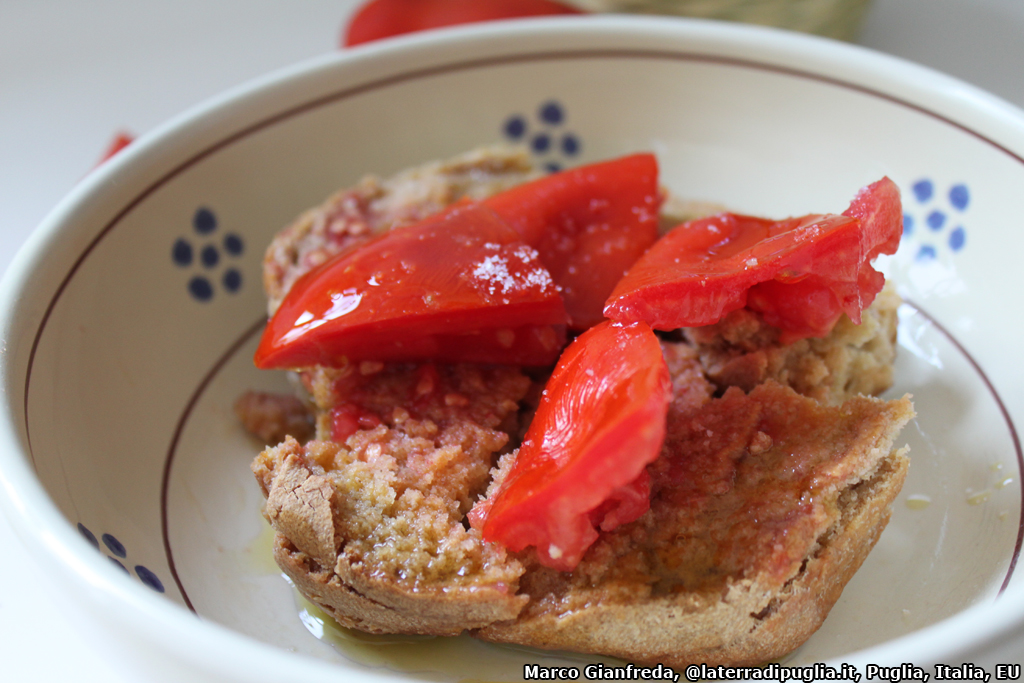
In short. A ring of durum wheat bread, cut in two with a thread and baked a second time until it is hard as a biscuit. It keeps for months. You wet it, dress it with tomato and oil, and that is lunch.
Legend says Aeneas ate frise when he landed at Porto Badisco. What is certain is that a bread which survives a summer without a fridge was worth inventing, and that it is now the emblem of a Salento August.
🍞 How it is made
The loaf is baked as a ring, then cut horizontally in two with a thread rather than a knife — a thread leaves the rough, porous surface that will later drink the water. The two halves go back into a cool oven to dry out completely.
That second baking is what makes a frisella keep, and it is also why you cannot eat one straight from the packet.
🌾 Wheat, barley, or an old grain
- Durum wheat — the classic Salento frisa: firm flavour, crisp crust, and the one that takes any dressing
- Barley — more rustic, crunchier, higher in fibre, and the older of the two
- Senatore Cappelli — an old Apulian wheat, low glycemic index and more protein, with a fuller taste
💧 The dunking
Dip it in water for a few seconds. Not longer. Salento arguments about exactly how long are genuine and unresolved: too little and it breaks your teeth, too much and it collapses. Start with three seconds.
Then dress it. Rub with a clove of garlic, crush ripe tomatoes over it by hand, add oregano, salt and a serious amount of extra virgin olive oil. Nothing else is required. The full recipe is here.
Peasant food, then Mediterranean diet. The frisa was the packed lunch of whoever left the house at dawn and came back many hours later — sometimes days later. It had to fill you, taste of something and not go off. Water for the soaking (sea water did the job too), a piece of cheese, a tomato, and that was the meal. It has since been reclassified as a healthy Mediterranean staple, which would have amused the people who lived on it.
Its second life. The frisa has come back as something close to gourmet food: it is on the menu at the beach lidos, in restaurants and in delicatessens across Puglia, dressed with a good deal more than tomato. In the Salento, though, it remains what it has always been — the summer dinner, and a complete meal ready in five minutes.
More summer food: cialledda.
And if you want to make them yourself — the pre-ferment, the proportions and the three times in the oven: how to make friselle from the Salento.