In short. From 21 August to 3 September 2026, Taranto hosts the 20th Mediterranean Games: more than 4,000 athletes from 26 nations, 29 sporting disciplines and 21 Apulian towns involved. It is the largest international sporting event ever held in Puglia since Bari 1997. Here is what you need to know — dates, disciplines, venues, tickets and how to organise a day around it.
🏅 The Mediterranean Games closed on September 3, 2026, after fourteen days of competition in Taranto and across Puglia. This page keeps the final medal table and the diary of every day.
The final medal table — Italy finish on top with 74 golds, 78 silvers and 72 bronzes: 224 medals in all, ahead of Türkiye (41 golds, 111 medals).
| Nation | 🥇 | 🥈 | 🥉 | Total | |
|---|---|---|---|---|---|
| 1 | 🇮🇹 Italy | 74 | 78 | 72 | 224 |
| 2 | 🇹🇷 Türkiye | 41 | 28 | 42 | 111 |
| 3 | 🇬🇷 Greece | 26 | 26 | 19 | 71 |
| 4 | 🇫🇷 France | 25 | 21 | 42 | 88 |
| 5 | 🇪🇬 Egypt | 23 | 16 | 19 | 58 |
Updated at 18:55 Italian time on Thursday 3 September. Source: OA Sport.
The Games diary, day by day
Thursday 3 September, the closing — The final day opened with the two half marathons. Turkey’s Ali Kaya won the men’s race in 1:02:06, breaking away at the eighth kilometre, ahead of Algeria’s Mohammed Sief Boukartaba and his compatriot Ramazan Bastug. In the women’s race Morocco’s Fatima Ezzahra Birdaha won in 1:09:59 with a Games record, her second title after the 5000 metres. In the afternoon the last gold of the Games went to water polo: Italy beat Montenegro 18-14, the Italian team’s seventh title in the sport at the Mediterranean Games and its first in thirty-three years, since the 1993 edition in Languedoc-Roussillon. In the evening, the closing ceremony at the Stadio Iacovone.
Thursday 3 September — Wednesday was the busiest day of the Games, with athletics alone awarding fourteen titles. Italy took the hammer through Sara Fantini (73.03 m), the women’s 200 m through Vittoria Fontana (22.93) and the 400 m hurdles through Ayomide Folorunso (54.22), as well as both relays; France’s Mathieu Collet won the pole vault and Lucie Schoonheere the women’s street skateboarding, ahead of two Italians. Greece’s Danai Pontifix took the women’s iQFOiL sailing title and Egypt’s Hana Goda the women’s table tennis singles. Today, Thursday, is the final day: the two half marathons start together at 8.30am, the men’s water polo finals run from 9am with Italy meeting Montenegro for gold at 1.30pm, and the closing ceremony takes place at the Stadio Iacovone in the evening.
Wednesday 2 September — Tuesday belonged to Gianmarco Tamberi, who won the high jump gold with 2.25 m ahead of Greece’s Antonios Merlos, with teammate Christian Falocchi taking bronze. Italy also topped the podium in the women’s triple jump through Erika Saraceni (14.21 m, ahead of Serbia’s Ivana Spanovic) and in the men’s shot put with Nicholas Ponzio (21.21 m); the women’s handball team beat Tunisia 25-23 for gold, while in karate Egypt’s Feryal Abdelaziz beat Italy’s Silvia Semeraro in the 68 kg final. Today, Wednesday, is the last full day of competition — tomorrow brings only water polo and the closing ceremony — and it is also the busiest of the whole fortnight: forty-five titles across eight sports, with athletics awarding fourteen between 5.15pm and 8.25pm (hammer, 200 m, pole vault, relays), artistic gymnastics closing its programme with ten apparatus finals from 10.30am, and rowing handing out its last medals in the morning.
Tuesday 1 September — Monday delivered a French one-three in the men’s 110 m hurdles: Erwann Cinna took gold in 13.22, ahead of Cyprus’s Trajkovic, with teammate Thomas Wilkes in bronze; in the women’s 100 m hurdles Italy’s Celeste Polzonetti and Elena Carraro went one-two, with France’s Sacha Alessandrini third. Italy also took gold in tennis with Noemi Basiletti, in the women’s 10,000 m with Federica Del Buono and in the men’s 4×100 m relay, but lost the women’s football final 4-0 to Portugal. Today, Tuesday, belongs to Gianmarco Tamberi, in the high jump final at 6.55pm, alongside rowing, women’s artistic gymnastics, karate and weightlifting.
Monday 31 August — Sunday ended with a tennis gold for the hosts: Vittoria Paganetti and Filippo Romano beat Spain’s Cortez Llorca and Sanchez Quilez 6-4, 6-2 in the mixed doubles, while the Italian pair in the women’s doubles took silver behind Greece. On the track Sacha Alessandrini of France won the 100 m hurdles in 13.17, and in the football final Algeria beat Tunisia 2-0 for the men’s title. Today, Monday, twenty-four titles are decided across eight sports, eleven of them in athletics: the women’s 800 m at 6.45pm, the men’s at 7pm, the women’s 10,000 m at 7.15pm and then the two 4×100 m relays, women at 8pm and men at 8.15pm. Add six weightlifting titles, the men’s artistic gymnastics team final at 2pm in Grottaglie, both tennis singles finals and the women’s football final, Portugal against Italy, at 7pm.
Sunday 30 August — Sunday belonged to the track. The athletics programme opened with two Italian golds — Francesco Inzoli in the long jump (8.19 m) and Giovanni Frattini in the javelin (81.59 m) — while France’s Gémima Joseph took the women’s 100 metres. Italy also won the women’s artistic gymnastics team title ahead of Spain, and the judo team event 4-1 against France. The volleyball finals split the honours: Turkey beat Italy 3-0 for the women’s gold, France beat Greece 3-0 for the men’s, with Italy taking bronze at the tie-break. In the football third-place match Morocco won 4-1, leaving Italy fourth.
Saturday 29 August — Friday night belonged to the volleyball court: Italy beat France 3-0 (25-21, 25-17, 25-23) to finish the preliminary round unbeaten, five wins out of five. Today, Saturday, eleven titles are decided: seven in judo, the women’s 10 m air pistol, the two individual triathlon races — men at 4.45pm, women at 6.30pm — and the mixed doubles in table tennis, with the team semi-finals running through the afternoon.
Friday 28 August — Boxing handed out all fourteen of its titles in one day, and Italy took three of the four women’s golds — Irma Testa beating France’s Amina Zidani in the 57 kg final on her return after a two-year break, with Sirine Charaabi (54 kg) and Melissa Gemini (75 kg) also on top of the podium. Finswimming added four more Italian golds, led by Lorenzo Caronno‘s games record in the 200 m surface. Today, Friday, the second weekend opened with the first finals in judo, archery, padel and table tennis: Italy’s Danilo Dennis Sollazzo won the 10 m air rifle ahead of Croatia’s Maricic, and Francesco Gregori took silver in the individual recurve after beating Turkey’s Gazoz on his way to the final, while the Italian squads finished just off the podium in all three team events. In the football semi-final Tunisia came from behind to beat Italy 3-1 and reach the final.
Thursday 27 August — The day of the boxing finals: all fourteen titles are decided in one go, seven bouts at 1 pm and seven at 5. From 6 pm finswimming puts nine more finals up for grabs, and the afternoon adds the mixed-team trap and the 10 m air pistol — twenty-five titles in all. In the evening Italy’s handball team face Egypt and the women’s football team meet Morocco.
Wednesday 26 August — The pool changed trade: with the swimming over, finswimming handed out its first finals — Italian golds for Viola Magoga and Filippo Pavoni, a Greek win for Ifigeneia Teliousi in the 200 m surface. Fabio Caponio took the badminton men’s singles for Italy, beating Croatia’s Aria Dinata in two tight sets; Turkey’s Hatice Gökçe Emir won the rhythmic gymnastics all-around and Spain’s Andrés García García the men’s trap.
Tuesday 25 August — The last night in the pool, and the swimming programme closed with an Italian on the podium in thirty-four of its thirty-five finals. Alberto Razzetti took the 200 butterfly in 1:55.29, a Games record and his third individual title of the week, with further wins for Spediacci, Franceschi, Guatti, Borrelli and Diodato. In the bowls Laura Picchio completed a raffa double — the singles, then the pairs with Kety Crescenzi — while Diego Rizzi won the pétanque precision shooting. Laura Godino took the women’s 68 kg in wrestling, and at Francavilla Fontana the Italian women’s football team were pegged back by Slovenia, 1-1.
Monday 24 August — Road cycling day, and Italy won both road races along the Taranto seafront. In the women’s race the home team took all three medals — Rachele Barbieri ahead of Martina Fidanza and Barbara Guarischi — while Tommaso Dati won the men’s title in a sprint against Portugal’s Gomes Antunes. In the pool the titles went to Noemi Cesarano, Lisa Angiolini, Alberto Razzetti and Giada Alzetta; the fencing programme closed with Egypt taking both foil golds.
Sunday 23 August — The busiest day of the programme, with thirty titles across thirteen sports. Italy kept winning: Luca De Tullio in the 800 m freestyle and Samuele Veglianti in the 1000 m sprint canoe, alongside more podiums in fencing and swimming.
Saturday 22 August — The first titles, and Italy did all of it in the pool: thirteen medals, every one in swimming. The three golds went to Benedetta Pilato in the 100 m breaststroke — a Taranto native winning at home, ahead of her compatriot Lisa Angiolini — to Gabriele Mancini in the men’s 100 m breaststroke and to Noemi Cesarano in the 1500 m freestyle.
Friday 21 August — The Games opened at the Erasmo Iacovone stadium, with a two-hour show directed by Angelo Bonello and seventy performers. Italian President Mattarella declared the 20th edition officially open, in front of more than 3,800 athletes from 26 countries. Italy’s 497-strong team paraded behind Irma Testa and Filippo Tortu.
There is one event that, in the Apulian summer of 2026, risks being pushed into the background behind the village festivals, the concerts and the patron saints’ feasts — and that would be a mistake, because it is probably the most important thing to happen to this region in thirty years.
From 21 August to 3 September 2026, Taranto becomes the sporting capital of the Mediterranean, hosting the 20th Mediterranean Games, the multi-sport event that brings together the nations of the Mare Nostrum every four years.
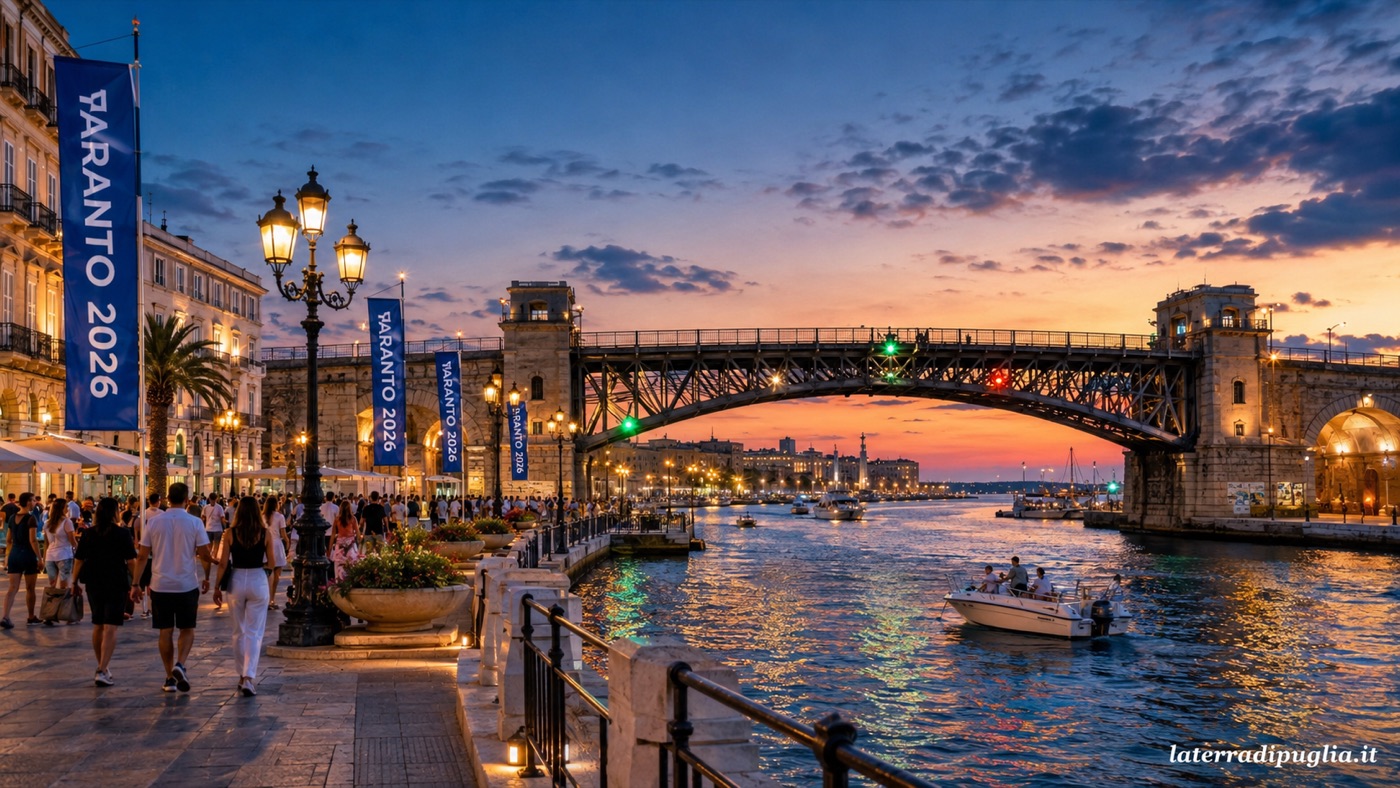
This is not a local affair: we are talking about more than 4,000 athletes and 1,700 officials from 26 nations across Europe, Asia and Africa, competing in 29 sporting disciplines spread between Taranto and twenty other Apulian towns. For Puglia it is only the second time — the first was Bari in 1997 — and for Italy the fourth edition hosted in all.
In this article: the history of the Mediterranean Games, the dates and ceremonies of Taranto 2026, the disciplines, the towns involved, how to get there and how to buy tickets.
🏛️ What the Mediterranean Games are
The idea was born in 1951, when the IOC vice-president Mohammed Taher Pasha proposed a sporting event dedicated exclusively to the peoples living around the Mediterranean. The first edition was held that same year in Alexandria, Egypt, with only 734 athletes from 10 founding nations. The International Olympic Committee formally recognised the event the following year, in 1952.
The ten founding nations, Alexandria 1951: Egypt, France, Greece, Yugoslavia, Italy, Lebanon, Malta, Syria, Spain and Turkey.
The Games have been held every four years since. Italy is the nation that has hosted them most often — four times, including Taranto 2026 — and it is also the one that has most often topped the medal table, having won 14 editions.
🗓️ The dates and the ceremonies
- Opening ceremony — 21 August, 8 p.m., Stadio Erasmo Iacovone, Taranto
- Competitions — 21 August to 3 September
- Closing ceremony — 3 September, 8pm, Stadio Erasmo Iacovone, Taranto
The stadium has been completely refurbished for the occasion.
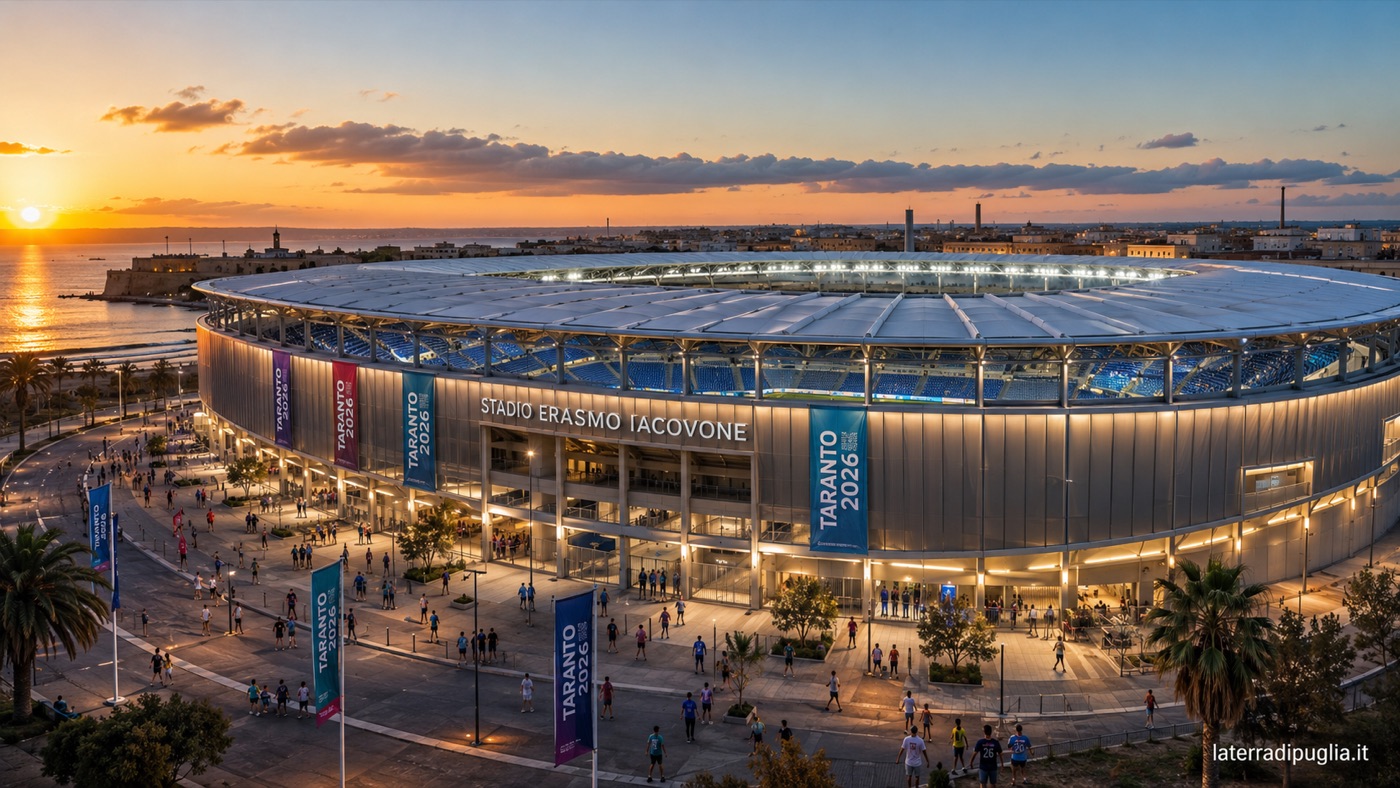
The Games were awarded to Taranto on 24 August 2019, when the International Committee of the Mediterranean Games, meeting at Patras, chose the Apulian city as the venue for the 20th edition.
🏅 The disciplines
- 5 team sports — water polo, football, handball, volleyball and 3×3 basketball: ten tournaments, men’s and women’s
- The rest are individual — from athletics and swimming to padel, skateboarding and inline speed skating
- Non-Olympic and demonstration disciplines round out the programme alongside the Olympic sports
The official programme counts 29 disciplines in all, between Olympic sports, non-Olympic disciplines and demonstration events. The definitive breakdown — sport by sport, with times and venues — is the one published on ta2026.com.
The official draw for the five team sports was made at the end of May 2026, in the Aula Magna of the Ionian Department of the University of Bari, with guests including the former water polo player Amaurys Perez, Olympic silver medallist at London 2012, and the former captain of the Italian volleyball team Franco Bertoli.
📍 Where the events are held
Although Taranto is the official host and stages most of the competition, the Games involve 21 Apulian towns in the provinces of Taranto, Brindisi, Bari and Lecce, across some 30 competition venues and 41 sports facilities. Among them: Lecce and Brindisi (football and volleyball), Fasano and Conversano (handball), Martina Franca (judo, karate and wrestling), Grottaglie (artistic and rhythmic gymnastics), along with Francavilla Fontana, Statte, Massafra, Castellaneta, Torricella, Montemesola, Crispiano and San Giorgio Ionico.
The Italian government allocated €300 million for the event, with work started to a value of €275 million across 41 projects in 21 towns. The new Giuseppe Valente athletics stadium has 750 fixed seats, extendable to 5,000 with temporary structures during the Games, and an eight-lane track.
The official motto is “Embrace the Future” — the stated aim being to connect cultures and peoples through sport, with a strong emphasis on sustainability and on innovation in the region. The logo, presented in 2019, was designed by pupils of the “Gaetano Salvemini” school in Talsano: two anthropomorphised Xs forming the number 20 in Roman numerals, echoing the lines of Taranto’s Monument to the Sailor and the Greek origins of the city. The official mascot is called Ionios, with a new look presented in December 2024.
📺 Where to watch, on TV and online
RAI, the Italian public broadcaster, is devoting more than 100 hours to the Games across Rai 2, Rai Sport and the RaiPlay platform: roughly 55 hours of live coverage on Rai Sport and about thirty on RaiPlay.
- The opening ceremony on 21 August is shown live on Rai 2.
- Every evening from 22 August to 3 September, Rai 2 runs a thirty-minute daily programme with footage, results and the faces of the day.
- Italia Team TV, the streaming platform of CONI — the Italian Olympic Committee — carries additional events live.
Watching from abroad — whether RaiPlay and Italia Team TV are available outside Italy depends on broadcasting rights, which differ from country to country: check from where you are before relying on them. The official schedule, event by event, is on ta2026.com.
✈️ Getting there, and tickets
To reach Taranto by air, the reference points are Taranto–Grottaglie airport, about 18 km from the city, and Bari Palese airport, about 95 km away and connected by frequent shuttles. By train, Taranto is on the Adriatic line with direct services from Bari and Brindisi. By car, the city is reached from the A14 motorway. Urban public transport is run by AMAT on 28 bus routes, reinforced during the event to link the venues in the various towns.
Tickets are on sale on the official site ta2026.com/ticket, where you can also check the disciplines scheduled at each venue. The opening ceremony is already sold out, but tickets remain available for several disciplines, swimming and athletics among them. Free tickets are available on request for people with a disability rated above 74%, by writing to ticketing@ta2026.com.
🌍 Why it matters for Puglia
Beyond the two weeks of competition, the Mediterranean Games represent a chance of urban and infrastructural transformation for a city that has spent recent decades struggling to shake off an image tied to heavy industry. New sports facilities, better connections, international visibility across three continents: that is a legacy which will outlast the closing ceremony on 3 September by a long way.
If you are planning a summer in Puglia and will be in the region between the end of August and the start of September, it is worth putting at least one day of the Games into the itinerary — if only to feel the atmosphere of a Taranto that, between its Aragonese castle and its swing bridge, is about to become the centre of the Mediterranean.
The towns hosting events are spread across the Ionian coast, the Salento and the Valle d’Itria. Getting to any of them is covered in getting to Puglia.
Dates, venues and ticket availability can change in the weeks before the event: always check the official site ta2026.com for definitive updates.