At the end of the summer Italian public television re-ran the series Costanza, and the name of Selvaggia of Staufen, the natural daughter of Frederick II, was back in circulation across Italy. The series is set and was filmed between Verona and Vicenza: the true story, though, begins in Puglia. These are the places you can actually visit — Castelpagano near Apricena, Castel del Monte, the castles of Lucera, Oria, Trani, Bari, Barletta, Gioia del Colle and Gravina — and how to string them together in three days.
Of all the medieval emperors, Frederick II of Swabia is the one Puglia claims as its own, and it is here that he left the most stone behind. In Italy his name, and above all his daughter Selvaggia‘s, came back into conversation at the end of the summer for a television reason: Rai 1 re-ran Costanza, the series based on Alessia Gazzola’s novels, starting on 27 August with the first three episodes and continuing on 3 September with the fourth, fifth and sixth. The first season has eight.
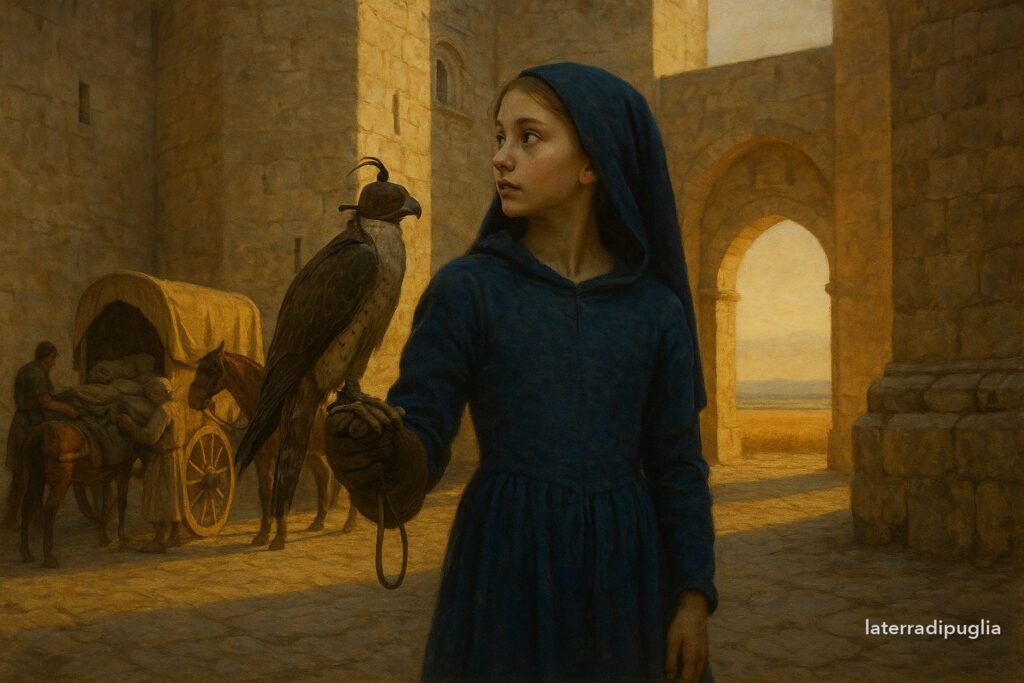
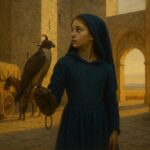
Selvaggia leaving Puglia, in an illustrated reconstruction made with artificial intelligence: it is neither a photograph nor a period document. No portrait of Selvaggia has come down to us.
In the series everything revolves around a skeleton found at the castle of Montorio Veronese and studied in a university laboratory. It is a choice that fits the plot — Selvaggia really did die in the Veneto — but it moves the whole story to the North. Filming, in fact, took place in studios in Rome, Vicenza and Verona: nothing was shot in Puglia.
And yet Puglia is where that story begins, and where Selvaggia dreamt of coming back. It is also the only part of the story you can still visit.
What is documented, in four lines. Selvaggia was born around 1225, a natural daughter of Frederick II, who later legitimised her. She married Ezzelino III da Romano on 23 May 1238, in the church of San Zeno in Verona, with six days of celebrations. She died around 1244, barely past twenty. Everything else — the falcon, the dreamt-of escape to Puglia, the poisoned pheasant pie — is story handed down. The three questions everyone is asking now (where she is buried, whether she had children, what she really died of) have no answer in the sources.
Castelpagano, where the story begins
The place where it all starts is on the Gargano, and almost nobody knows it. Castelpagano, in the municipality of Apricena, province of Foggia: a spur at about 545 metres looking out over the Tavoliere plain and the lake of Lesina. According to the town of Apricena, the site dates from the second half of the 9th century; it was destroyed in 1137 by Lothair III, then rebuilt and fortified by Frederick II, who handed it to a garrison of Saracens — which is probably where the name comes from.
It is here, in the tradition that has come down about Selvaggia, that a thirteen-year-old girl hears from her father the emperor that she is to marry the most feared man in Italy. What remains of the castle today are ruins: a stretch of wall, the remains of a watchtower, silence. Access is free, you get there along provincial road SP 48, but do not expect a museum: it is an open-air archaeological site, best tackled in walking shoes.
Castelpagano is not the only ruin of Frederick II in the Capitanata, the north of Puglia around Foggia, and that is why this area is worth the trip more than the famous destinations: here the empire has not been restored for visitors, it has stayed where it was.
Why Puglia, and not Germany or Sicily
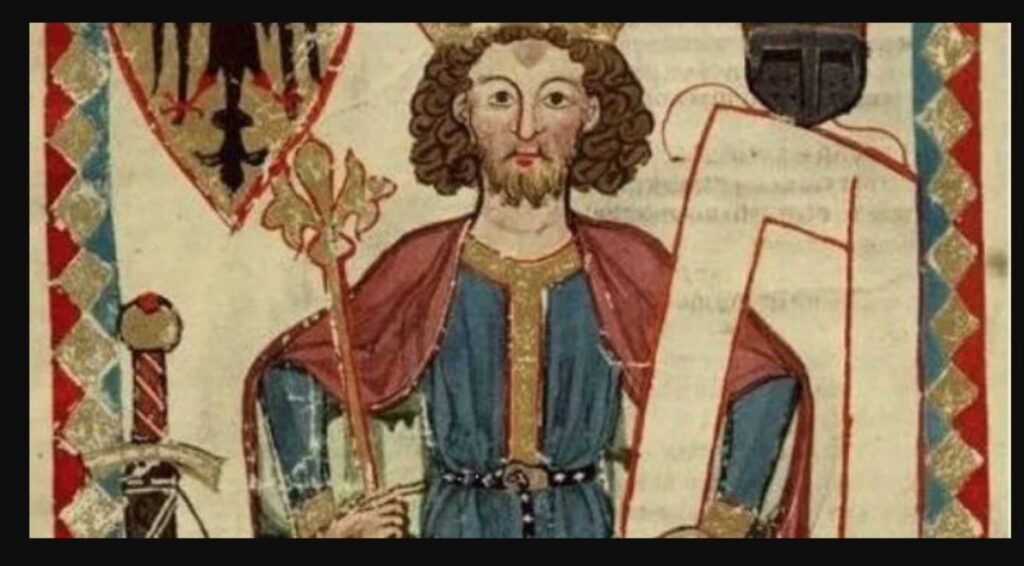
Frederick II of Swabia was born in Jesi in 1194 and crowned Holy Roman Emperor in 1220. He could have chosen any land in the empire as the seat of his government. He chose this one, and called it “the apple of our eye”. His contemporaries called him Puer Apuliae, the boy of Puglia.
There was a practical reason: Puglia was central, reachable overland from the North and by sea from every direction, and the Adriatic ports kept the road to the East open. But that does not explain everything. In Foggia he built his main palatium, and the town became in effect the travelling capital of the empire — all that is left of that palace today is a single doorway, kept in the civic museum. To Lucera, between 1224 and 1246, he moved the rebellious Muslims of Sicily: Lucera Saracenorum grew to tens of thousands of inhabitants, and those soldiers were the most loyal he ever had. Altamura was founded in 1232 by his decree.
And then there was hunting. Frederick spent whole months in the Apulian game reserves, and out of that passion came the De Arte Venandi cum Avibus, the treatise on falconry still regarded as the first medieval text of scientific ornithology. It is the same passion the story gives to Selvaggia, and the reason, so it is said, that of all his children she was the one most like him.
The castles you can visit
Between about 1220 and 1240 Frederick II built or rebuilt dozens of fortresses across the region: not isolated strongholds but a real network of castles — hunting lodges, military garrisons and courts where learning and poetry were kept. These are the ones you can visit today.
Castel del Monte, Andria
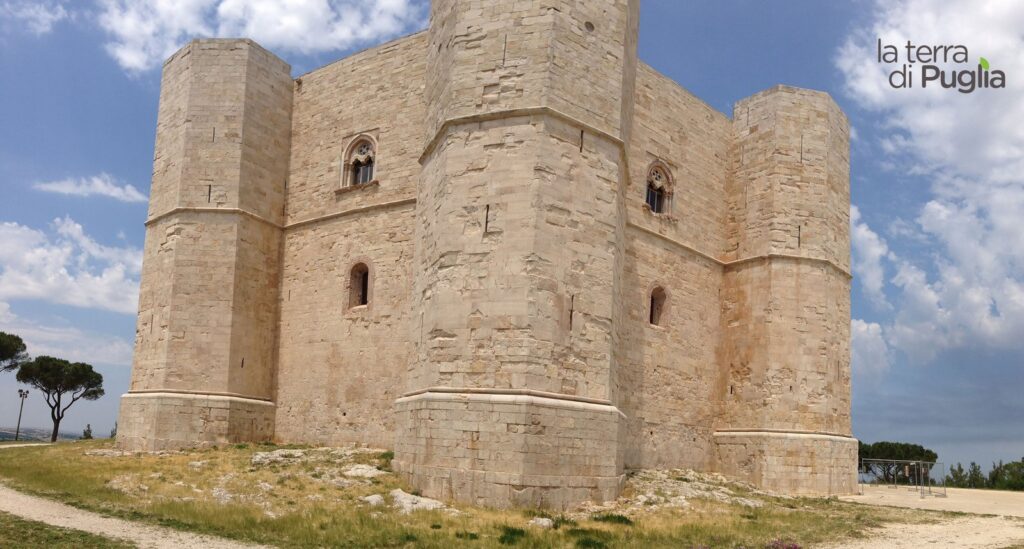
The most famous and the most argued about: an octagonal plan, eight octagonal towers at the corners, no moat and no stables. Built around 1240 at 539 metres on the Murgia plateau, it has been a UNESCO World Heritage Site since 1996, and nobody has yet established for certain what it was for. It stands in the territory of Andria, and our piece on Castel del Monte tells the rest.
The castle of Lucera
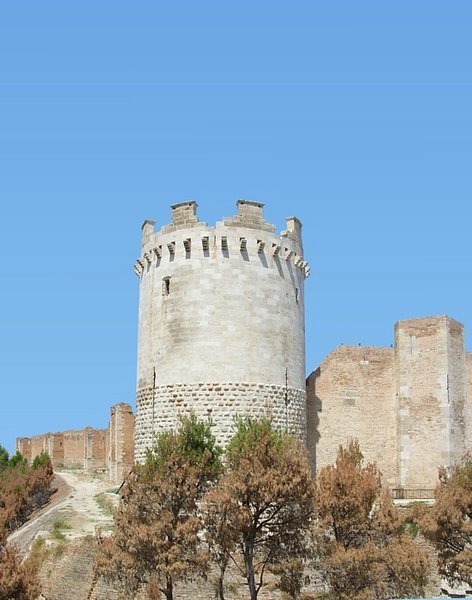
Built on the ruins of a Roman temple and later enlarged by Charles of Anjou and his successors, who in 1300 wiped out the Saracen colony. It is the largest fortress in the Capitanata, and it closes the circle with Castelpagano: the castle of Lucera and the town around it are the visible face of Frederick’s Saracen Puglia.
The castle of Oria
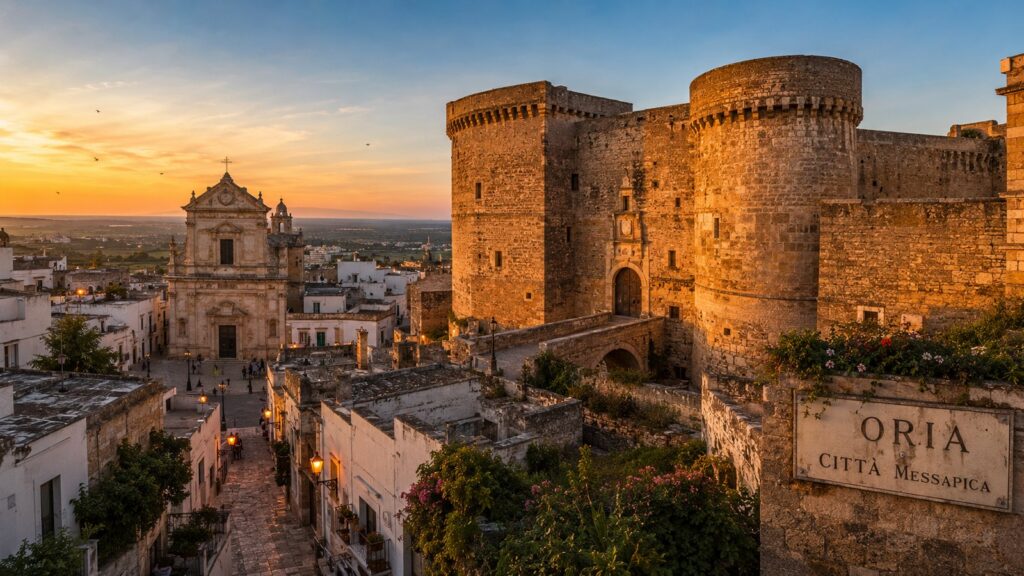
Triangular, with the Knight’s Tower and the Tower of the Seven Corners still intact, it looks down over Oria. It is also the one place where Frederick II comes back in the flesh once a year: the Corteo Storico and the Torneo dei Rioni, a historical pageant and a tournament between the town’s quarters, recall every summer the tournament that, according to tradition, the emperor held here. If you want to see the castle out of season, it is open to visitors anyway.
The castle of Gioia del Colle
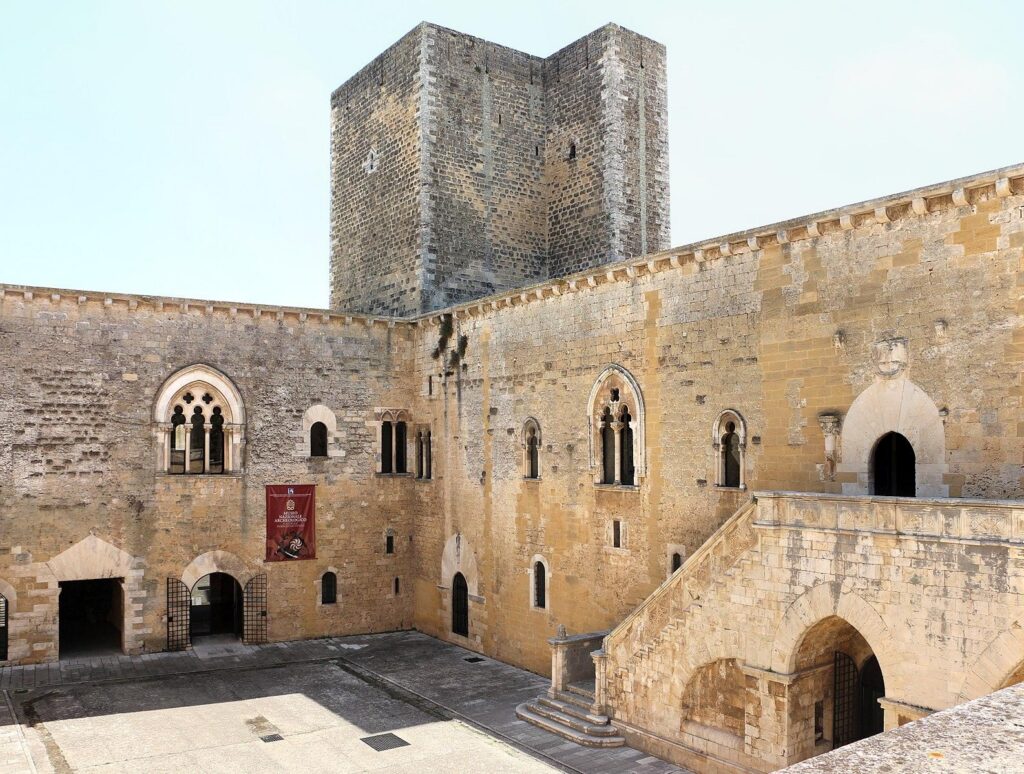
This is where the famous bas-relief with the emperor’s bust is kept, disputed between Gioia and Andria. The castle of Gioia del Colle is also the easiest to fit into a tour between the Murgia and the Valle d’Itria.
The castle of Trani
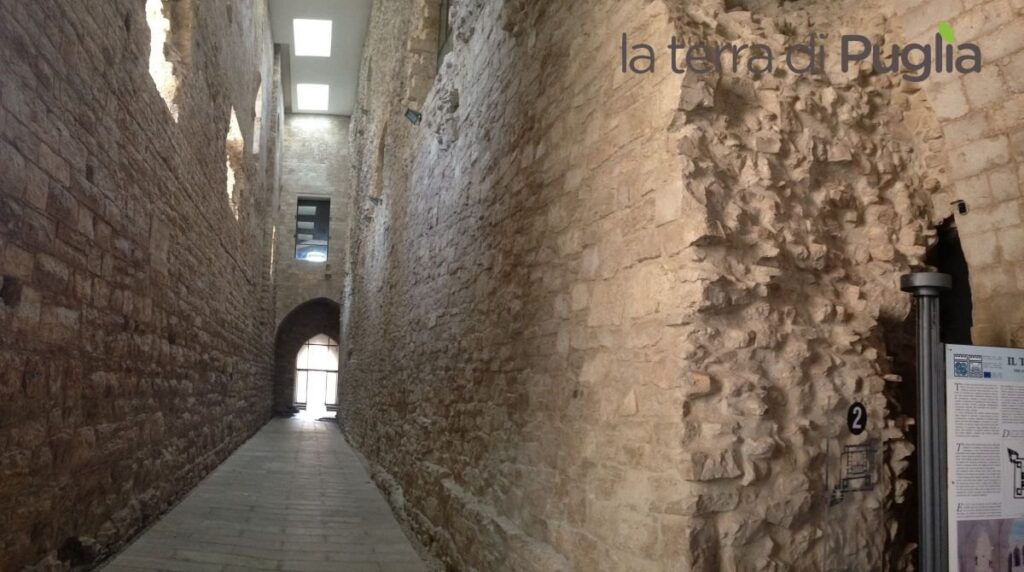
On the water, a few steps from the cathedral: for its setting it is probably the most beautiful of them all. The castle alone is worth the detour, and Trani is one of the towns where, in the evening, you best understand why Frederick II was so fond of this coast.
Bari, Barletta, Gravina, Monte Sant’Angelo
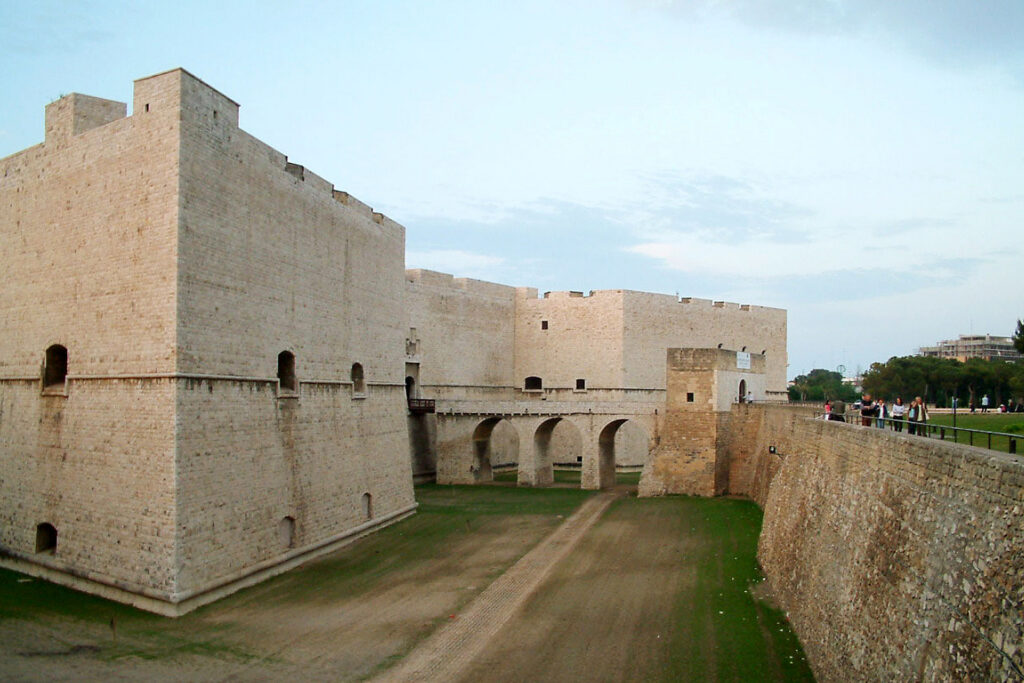
The Norman-Swabian castle of Bari was rebuilt by Frederick on its Norman foundations, and today it stands in the heart of the city.
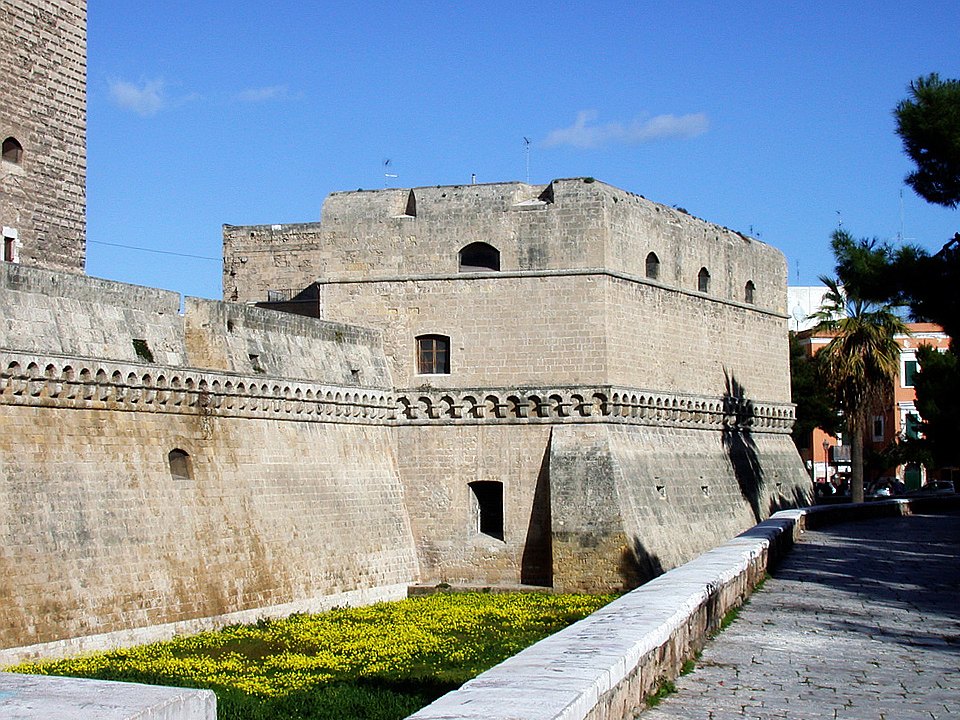
The castle of Barletta is among the best preserved in the region. The one at Gravina in Puglia was a hunting lodge in the Murgia, and today it is a partly restored ruin.
And in Gravina the emperor comes back this year too: the re-enactment Historia, from 18 to 20 September 2026, gives him the Saturday evening.
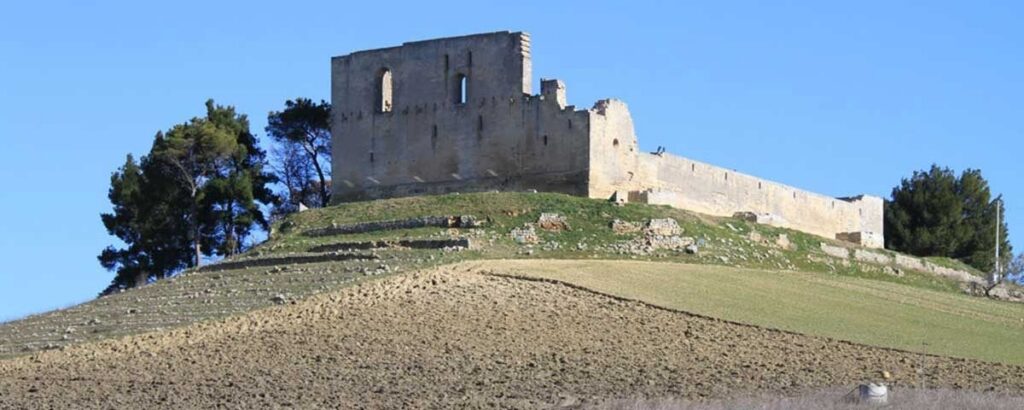
The castle of Monte Sant’Angelo, above the sanctuary, closes the network towards the Gargano.
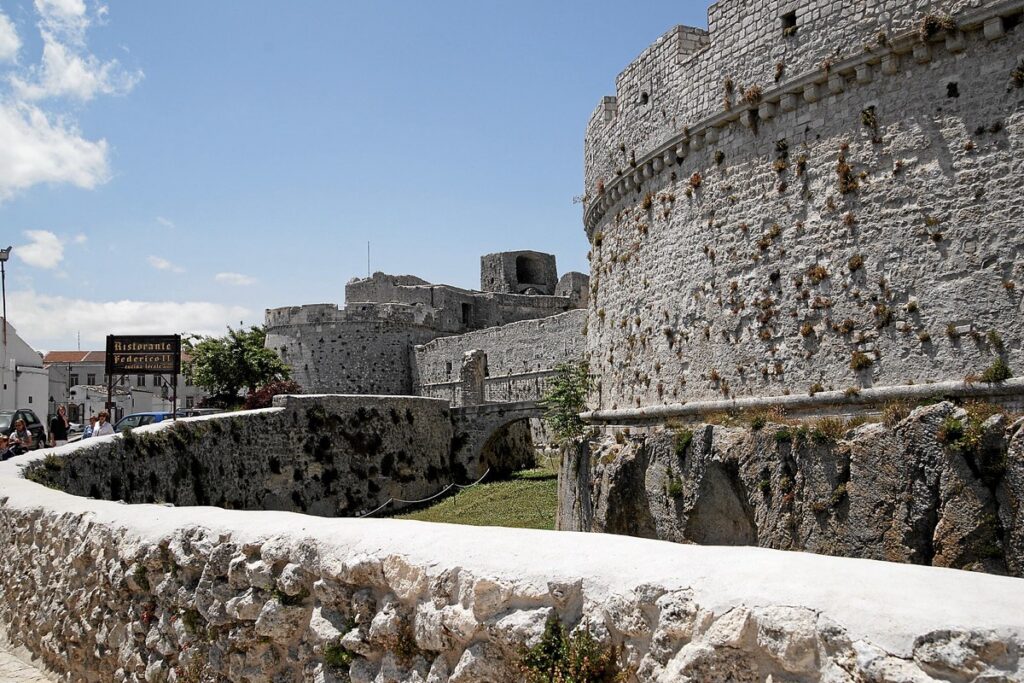
Where it all ends: Castel Fiorentino
Frederick II died on 13 December 1250 at Castel Fiorentino, in the territory of today’s Torremaggiore, province of Foggia. Not in Palermo, where he is buried, and not in Germany: in his Puglia, in a hunting domus on the Tavoliere, six years after Selvaggia’s death. What is left of the site today is ruins and an archaeological area you can visit — and it is the right place to end this route, because it is the only one that closes both the empire and the family story.
The route, in three days
- Day 1 — the Capitanata. Lucera in the morning, Castelpagano near Apricena in the afternoon, Castel Fiorentino near Torremaggiore at sunset. It is the least comfortable day and the truest: here the empire has not been restored, it has stayed where it was.
- Day 2 — the coast and the Murgia. Trani and Barletta in the morning, Castel del Monte in the afternoon, when the light falls sideways across the octagon.
- Day 3 — heading south. The castle of Bari, then Gioia del Colle, and if you have time Oria, the only place where Frederick’s story is still a village festival.
The series, the history and what remains
We know very little about the life of Selvaggia of Staufen: a wedding date, an approximate date of death, a famous father and a husband Dante put in Hell. The rest is story, and the television series has added more — the daughter, the discovery of the remains, the laboratory. There is nothing wrong with that, as long as you know where one ends and the other begins.
What can be checked, on the other hand, and touched, are the walls. They are all here, between the Gargano and the Murgia, and they are not waiting for anyone to go and see them.
After a tour of Frederick II’s castles, take a piece of Puglia home with you: extra virgin olive oil, preserves and traditional products, shipped directly by us.