In short. A collapsed sea cave at Roca Vecchia, near Melendugno, that forms an almost perfect natural pool joined to the Adriatic. Swimming has been banned since 2019, and since 18 July 2026 entry to the site costs €5. What you come for now is the archaeology: more than 3,000 inscriptions cut into the walls.
It is one of the most photographed places in Italy and one of the most important archaeological sites in the Mediterranean — and those two facts have been pulling against each other for years.
🏊 No, you cannot swim in it
This is the question we are asked most, so it goes first. Bathing has been forbidden since 2019. It is not bureaucracy: the salt water, the sun cream carried in by swimmers and the mechanical stress of the waves they make were measurably accelerating the decay of the inscriptions on the walls.
The €5 ticket introduced in July 2026 covers access to the archaeological area — paths, guided visits, services. It does not reintroduce swimming. You pay to visit, not to bathe.
Tickets and hours. €5 for the archaeological area of Roca Vecchia, free for residents of Melendugno; €10 for the guided version with audio guide and a virtual-reality experience, or for the family workshops. Open every day, 9:00–20:00 in July and 9:00–19:00 in August and September. Tickets at the Castle and Grotte Poesia gates, or online. Reduced rates for families and groups. Lecce is 25 km away.
🕳️ How it got there
Rainwater is slightly acid, and the Salento is limestone: over thousands of years the water dissolved the rock, the roofs of the cavities thinned until they gave way, and two natural pools opened to the sky. Sea water reaches them through tunnels below.
There are in fact two: Poesia grande and, sixty metres away, Poesia piccola, joined to each other by a passage and to the open sea on the other side. Before the roofs fell in they were not pools at all — they were inhabited.
📜 Why it is called that
The name has nothing to do with romance. It comes from the medieval Greek posis, a spring of fresh water: there was once a freshwater source here, possibly the outlet of an underground river. The water that fills it today is sea water.
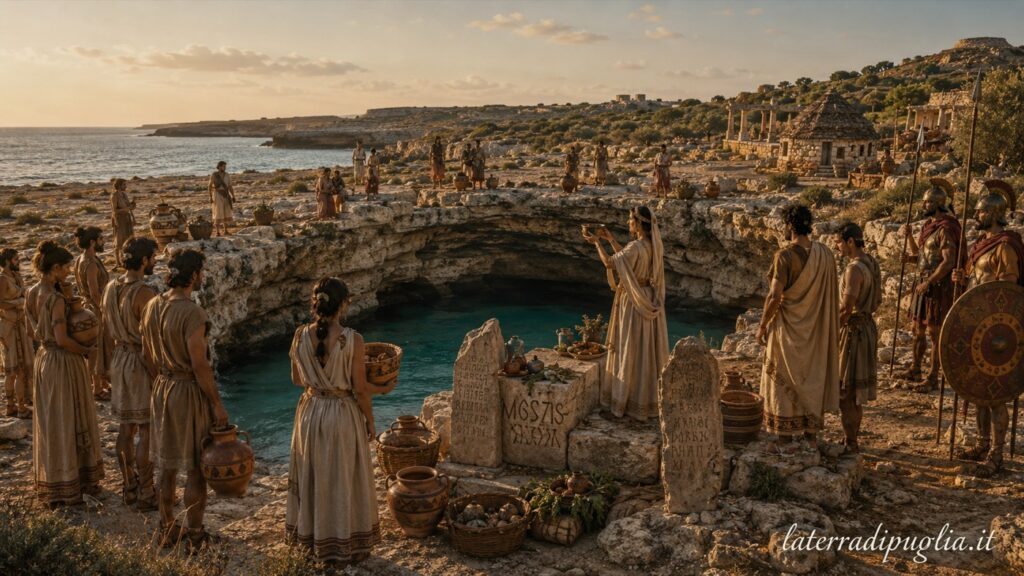
Roca Vecchia. The walls carry more than three thousand inscriptions in Messapian, Greek and Latin, along with prehistoric graffiti — left over centuries by people who came here to worship. The Messapians were the people of the Salento before the Romans, and this was one of their sanctuaries long before it was a swimming hole.
🌊 Where you can swim instead
The Salento has other natural pools where bathing is allowed: the rock pools of Tiggiano and Santa Cesarea Terme, the Grotta Zinzulusa near Castro — reachable by boat or on foot — and the sheltered coves of Castro and Marina di Andrano.
When to come. The site is genuinely crowded from mid-morning in August. In September it is another place entirely.
The coast around it is in Melendugno.