There is a day, at the end of August, when the houses in Puglia empty out again. It is the day the ones who came home go back — and for thirty years it was the hardest day of the year here. If your surname is Italian and your family is not in Italy, this is very probably how it began: with a car loaded before dawn, and a date that should not be forgotten — 8 August 1956.
There are around 80 million people of Italian descent in the world, and a great many of them can name the village their family left. What almost nobody can picture is the morning of the leaving itself — not the arrival in Toronto or Melbourne or Charleroi, which got photographed, but the hour before, in the courtyard, when the car was being packed.
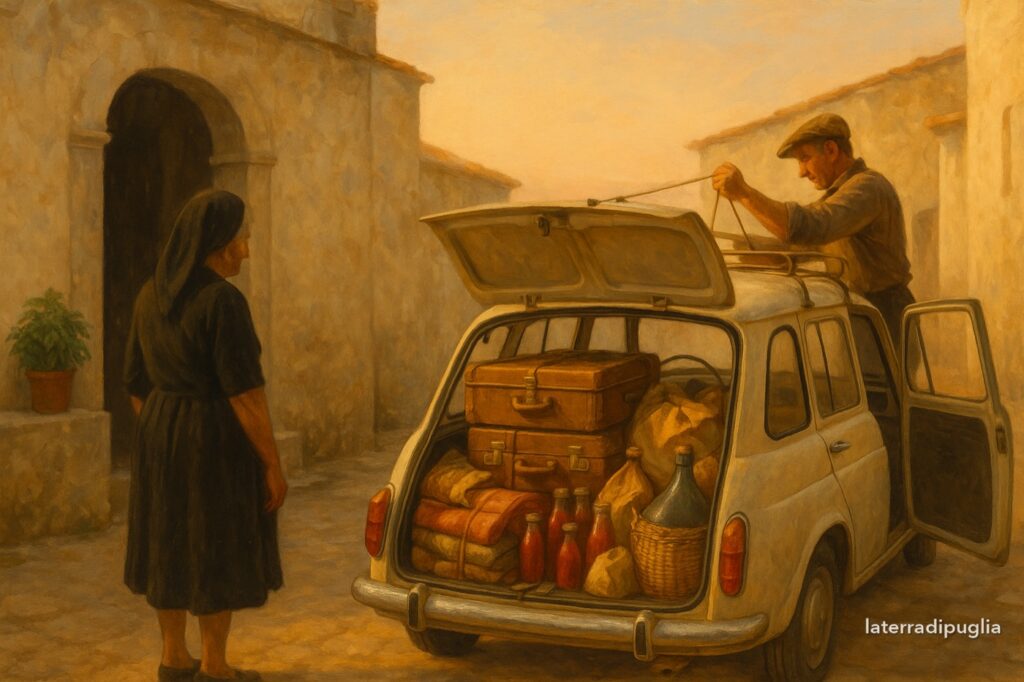
An illustration made with AI: a reconstruction of the scene, not a period photograph.
The car was heavier going back, and that is not a figure of speech
People left early, almost always at night — «to avoid the traffic», which was half true. The other half is that goodbyes are easier in the dark. And the boot, half empty on the way down, went back full.
What was in it was not souvenirs. It was food, and for a practical reason before a sentimental one: in Turin, in Belgium, in Switzerland, some of it could not be bought at all and the rest cost twice as much. So in went taralli in the baker’s paper bags, oil in straw-wrapped demijohns tied with string, capocollo in waxed paper, plaits of tomatoes hung from the roof, and above all the bottles.
The bottles were from the Sunday before. The day of the sauce falls on the last Sunday of August, and the timing is not a coincidence of the calendar: it was the last work the family did together before splitting up again. The ones staying made the passata. The ones leaving loaded it into the car the next morning. Same hands, same courtyard, two different lives twenty-four hours apart.
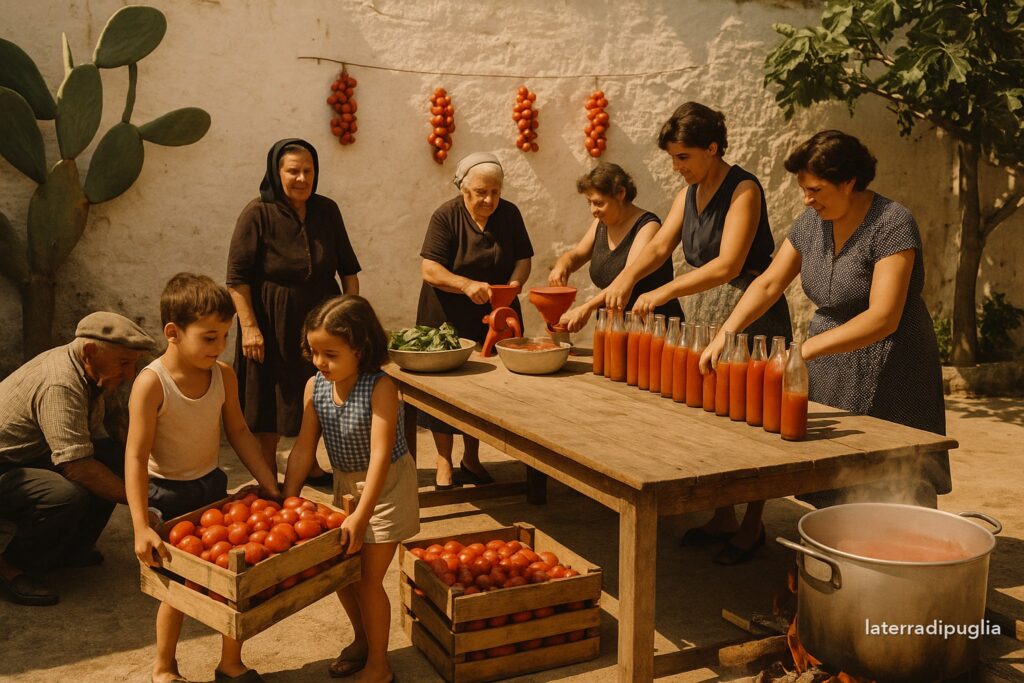
The Sunday before: the bottles that would go into the car the next morning. This too is an illustration made with AI.
The bottles travelled upright, wedged between blankets, and now and then one broke on the motorway. Anyone who lived through those years remembers the smell that stayed in the car until Christmas.
But leaving was not romantic, and one date says so
The suitcase story always risks turning into a postcard. It was not one. To understand how far from one it was, you only need a date: 8 August 1956, the Bois du Cazier coal mine at Marcinelle, in Belgium.
That day 262 miners died, of twelve different nationalities. 136 were Italian. Of those, 22 were from Puglia, and fifteen came from the Salento.
Why they were there. In 1948 Italy and Belgium signed an agreement remembered by a phrase that needs no commentary: men in exchange for coal. For every Italian miner who went underground, Italy received 200 kilograms of coal a day.
This is not a modern turn of phrase for effect. It is the consideration written into the agreement. The price of a man was two hundred kilos of coal a day, and for eight years every signatory treated that price as normal.
The 136 Italians came from thirteen different regions. The worst hit was Abruzzo, with 60 dead — twenty-three from the single town of Manoppello, in the province of Pescara. Puglia counted 22, and the towns that buried someone that day read like an ordinary list of villages: Racale, Tuglie, Salice Salentino, Gagliano del Capo, Alezio, Melissano, Taurisano, Mola di Bari, Lesina, Brindisi, Martina Franca, Crispiano, Laterza.
There is a museum, and a man who left built it
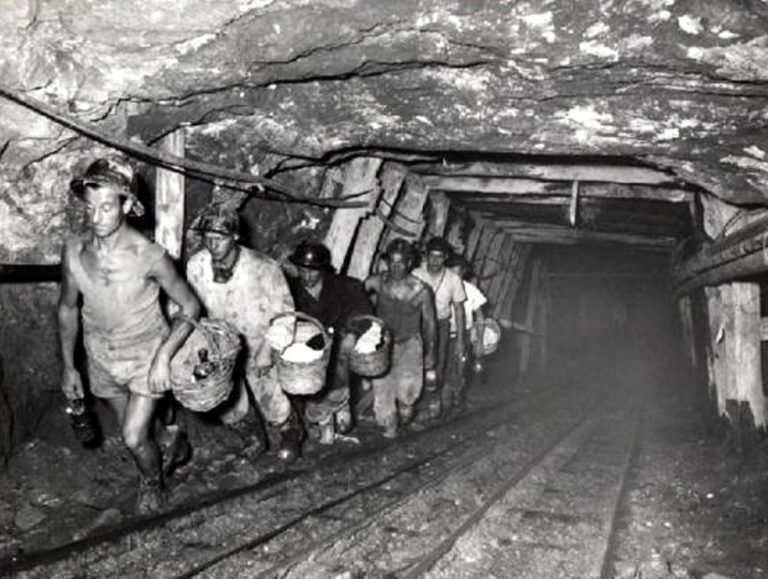
At Casarano, in the province of Lecce, there is the Museo del Minatore — the Miner’s Museum. No public body opened it: it was assembled by Lucio Parrotto, who left Casarano for Belgium in 1956, the year of Marcinelle, and who lived that life himself.
Inside there are shovels, picks, compressed-air hammers, lamps, helmets, a coal trolley and photographs taken underground. It is a single room, and it says more than most books.
And the town does not keep the memory only in there. Casarano is twinned with Charleroi, the Belgian city Marcinelle belongs to, and with Manoppello — the town in Abruzzo that lost twenty-three men in that same mine. The town that built the museum and the town that paid the highest price went looking for each other, and both found the place where it happened.
Every 8 August a procession crosses Casarano and lays a laurel wreath at the miner’s monument. In 2025 it was the sixty-ninth anniversary: not a memory, a standing appointment.
Where they went, and how many
Across the twentieth century Puglia was the third Italian region for emigration, behind Sicily and Campania. The destinations changed by decade. The first wave, either side of the First World War, went almost entirely to the Americas — the United States, Argentina, Brazil. The second peaked after the Second World War and reached as far as Australia. From the 1950s the flow turned to nearby Europe, which needed hands and paid cash: Germany, Switzerland, France, Belgium, and the factories of Turin and Milan.
Today the consular registers count around 370,000 people from Puglia living abroad — some eighty thousand in Germany alone, another hundred thousand split between Switzerland, France and Belgium, and about eighteen thousand each in the United States and Canada. They are the grandchildren and great-grandchildren of those cars packed at night. It is also why, every August, the Salento speaks German in its bars and the villages fill up with number plates nobody can read.
People still leave, but the suitcase has not changed
The real difference is that today people go by plane and by choice, not by train and by necessity: to Milan, to London, to Berlin, with a degree instead of a contract somebody else already signed for them. That is another story and it deserves to be called another story.
But look at the luggage at Bari or Brindisi airport in the last days of August. The contents have not changed. The container has — a wheeled case instead of a cardboard suitcase, vacuum packs instead of waxed paper — and so has the fact that if something runs out you can now order it from home instead of waiting for August. But what people carry away is still the food of the house: the taralli, the oil, the bottles from the Sunday before.
For seventy years part of Puglia has lived somewhere else and gone on eating here. Which makes it, if you think about it, the one kind of homecoming that needs no ticket.
What is verified and what is memory. The Marcinelle figures — 8 August 1956, 262 dead of twelve nationalities, 136 Italians from thirteen regions, 22 from Puglia of whom 15 from the Salento — together with the 1948 Italy–Belgium agreement and its 200 kilograms of coal per miner per day, come from the reporting and the public commemorations of that disaster. The figures on Apulians abroad come from the consular registers, and Casarano’s twinnings with Charleroi and Manoppello from the municipal twinning listings. Everything else — the demijohns, the smell in the car, the leaving at night — is oral memory, gathered in families and villages, and should be read as such: not a source, but a recollection shared by a great many people.